Hula Hoop Size Calculator
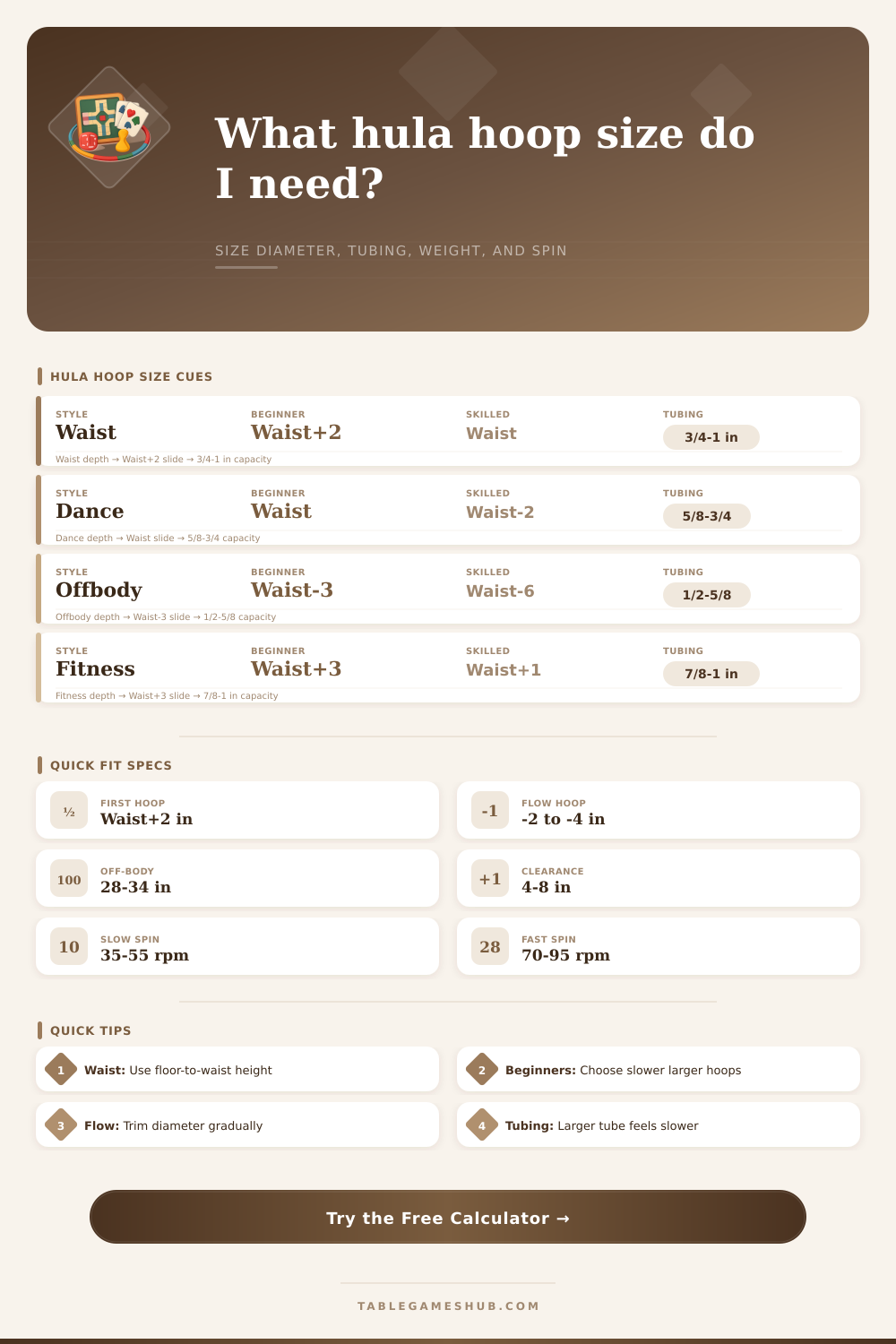
Match hoop diameter, tubing size, weight category, clearance, and spin speed to your body height, waist height, skill level, and hooping style.
| Height Range | Typical Waist Height | First Waist Hoop | Smaller Flow Hoop |
|---|---|---|---|
| 4 ft 6 in - 5 ft 0 in | 30-34 in | 32-36 in | 29-33 in |
| 5 ft 0 in - 5 ft 5 in | 34-38 in | 36-40 in | 32-36 in |
| 5 ft 5 in - 5 ft 10 in | 38-42 in | 40-44 in | 35-39 in |
| 5 ft 10 in - 6 ft 4 in | 42-47 in | 43-48 in | 38-42 in |
| Skill Style | Diameter Cue | Clearance Cue | Spin Speed Cue |
|---|---|---|---|
| Beginner waist hooping | Waist height + 1-3 in | 5-8 in per side | 35-55 rpm |
| Dance flow | Waist height - 1-4 in | 3-6 in per side | 50-75 rpm |
| Off-body tricks | 28-34 in often works | Arm clearance matters | 65-95 rpm |
| Twin hoop drills | 26-32 in often works | Even pair preferred | 70-100 rpm |
| Tubing Size | Common Feel | Best Match | Notes |
|---|---|---|---|
| 1/2 in | Very quick | Twins, tech tricks | Low visual mass |
| 5/8 in | Quick and light | Flow, off-body | Popular downsize step |
| 3/4 in | Balanced control | All-around dance | Useful middle ground |
| 7/8-1 in | Slow and grippy | Waist, fitness | Easier timing cue |
| Weight Category | Diameter Pairing | Tempo Feel | Use Case |
|---|---|---|---|
| Ultra-light | 26-34 in | Fast response | Tricks and twins |
| Light | 30-38 in | Moderate quick | Dance flow |
| Standard | 36-44 in | Steady timing | Waist learning |
| Weighted | 38-46 in | Slow momentum | Fitness sessions |
When people begin to learn how to hoop, they often use any hoop that is available to them. Many people use incorrect hoop for this skill, and as a result, they experience frustration when they attempt to use those hoops. Their frustration at struggling with hoops that have the incorrect diameter and weight indicate to these individuals that they lack the coordination to perform this skill.
The physics of the hoop, however, are the true cause of their frustrations with these incorrect hoops. Hoops have specific diameter and weight measurements that must correlate with the individual performing the skill for them to exhibit smooth skill performances. If the diameter of the hoop does not match the length of you torso, or if the weight of the hoop does not match your muscular response to the object, you will struggle with using that hoop due to the fight between your body and gravity.
How to Choose the Right Hoop Size and Weight
The most important factor in hooping skill performances is the relationship between your body and the circumference of the hoop that you use. Many individuals believe that using a large hoop is always the best choice for this activity. However, the diameter of the hoop must be relative to the measurements of your body.
One of the most important measurements is the distance from the floor to your waist. If the diameter of the hoop is too small for your waist measurement, the hoop will hit the floor before it completes a full rotation. If the diameter of the hoop is too large for your waist measurement, it will be difficult for you to control the hoop while using it.
Your hoop diameter should allow the hoop to clear the floor by a few inches. The calculator that is available on this page will help individuals to calculate the diameter of hoops that will be best for you, as well as the specifications of the tubing of the hoop that you decide to purchase. This calculator will provide you with an indication of the amount of clearance that your hoop will have.
As many individuals tend to underestimate the amount of clearance that will be provided for their hoop, providing extra space for the hoop to remain level will slow the perceived rate at which they are performing the skill. Thus, the slow rate at which hoops should be performed will allow individuals to feel as if the hoop is stable while they are performing the skill. In addition to hoop diameter, there are other requirements for hoops that are used in dance flow tricks.
While fitness hoops are beneficial for individuals looking to incorporate some of those tricks into their workouts, those same hoops can make it difficult for an individual to perform dance flow tricks. For dance flow tricks, it is beneficial for individuals to use hoops that are more smaller in diameter and that have less weight. This allows for better range of motion for those tricks.
Tricks that require smaller hoops require more tempo in which the hoops must be performed. Individuals often struggle with these tricks when they attempt to use the same body mechanics that they use for trick hoops that were taught to them as beginners to the skill. Beyond size and weight, the tubing that comprises the hoops also has an impact upon the way that the hoop will perform when used by an individual.
Hoops with a larger outside diameter of their tubing will exhibit different characteristics than hoops with thin tubing. Hoops with thick tubing will exhibit greater stability than hoops with thin tubing. Thicker tubing hoops are a better choice for beginners to the skill, while hoops with thin tubing are a better choice for individuals who have mastered the basic skill of hooping.
Using tubing that is too thin for your skill level will cause the hoop to feel as if it is “twitchy.” In contrast, using tubing that is too thick for your preferred style for the tricks will cause the hoops to feel “sluggish.” Thus, balance is required between tubing and skill. Tables that are available on this page provide information regarding the size requirements for hoops of specific styles. Weighted fitness hoops are used for cardio workouts because the added weight of the hoop contributes to the calories that are burned during those activities.
However, the momentum that the added weight of twin hoops creates limit the use of fitness hoops for those tricks. Due to the weight of fitness hoops, they are not suitable for use in twin drills. Each style of hooping has a specific purpose and each type of hoop should be used for those specific skills.
Individuals will eventually reach a point where they are advanced in their skill at hooping. At that point, individuals can change their hoop from the beginner hoop to trick hoops. However, it is best for individuals to gradually decrease in size the hoops that they use.
Instead of jumping from a forty-inch beginner hoop to a thirty-inch trick hoop, individuals can gradually decrease the size of hoops by a few inches every few months. This provides the brain with time to adjust to the different tempo at which trick hoops must be performed, while still retaining the muscle memory that is required for those tricks. While the numbers that the calculator calculates are important in providing an individual with an understanding of the size and weight of hoops that will best suit their skill, individual preference is the most important factor.
The tools will assist in an individual in narrowing their options for hoops, but after they are fitted around the individual’s waist, the most important factors for purchase will be the hoop diameter and the hoop weight. If these two factors are balanced with the individual’s body, they will feel as if the hoop is stable and able to exhibit smooth flow of the tricks.