Cassino Score Calculator
Total a Cassino hand with cards, spades, aces, big cassino, little cassino, sweeps, majority ties, running scores, and exact points needed to reach the target.
1Preset Score Sheets
Choose a realistic Cassino hand, then edit any line for your table before calculating.
2Scoring Rules
3Captured Cards and Running Scores
Hand score = majority cards + majority spades + aces + big cassino + little cassino + sweeps + adjustment. A capture audit checks whether the active lines total a full 52-card deck.
| Side | Previous | Cards | Spades | Aces | Big cassino | Little cassino | Sweeps | Adjustment |
|---|---|---|---|---|---|---|---|---|
4Component and Score Specs
5Cassino Reference Tables
| Scoring item | Default points | How it is awarded | Calculator field |
|---|---|---|---|
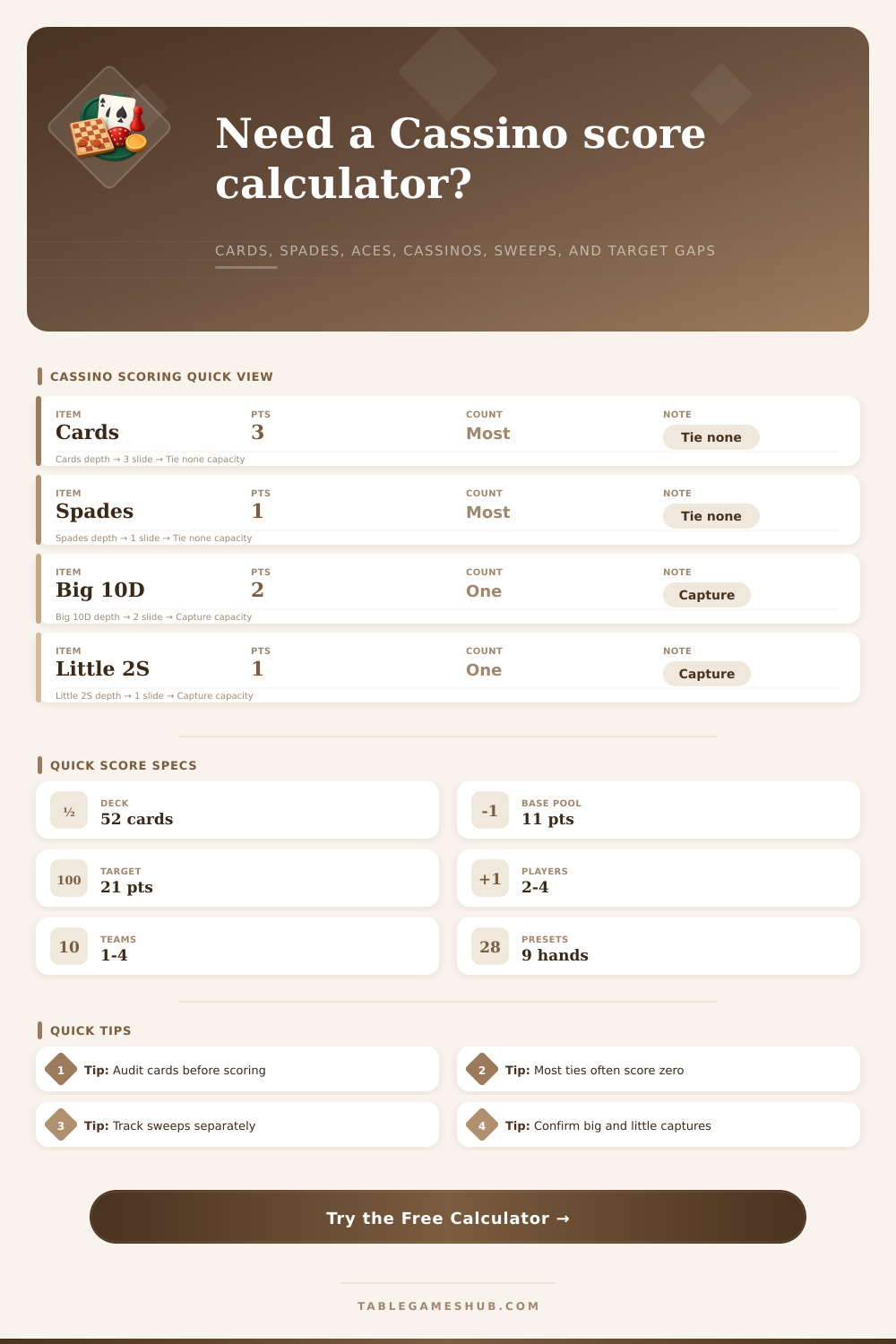
| Most cards | 3 | Side with the most captured cards; ties usually score zero. | Cards |
| Most spades | 1 | Side with the most captured spades; tie behavior follows the selected rule. | Spades |
| Big cassino | 2 | Side that captured the ten of diamonds. | Big cassino |
| Little cassino | 1 | Side that captured the two of spades. | Little cassino |
| Aces | 1 each | Each captured ace scores the selected ace value. | Aces |
| Sweeps | Optional | Each table sweep scores the selected sweep value when used. | Sweeps |
| Table format | Active score lines | Deck audit target | Typical use |
|---|---|---|---|
| 2 players | North and South | 52 cards, 13 spades, 4 aces | Classic head-to-head match |
| 3 players | North, South, East | 52 cards, 13 spades, 4 aces | Individual table with one idle seat |
| 4 players | North, South, East, West | 52 cards, 13 spades, 4 aces | Individual four-way scoring |
| 4 partners | Team A and Team B | 52 cards, 13 spades, 4 aces | Partnership Cassino score sheet |
| Audit check | Expected range | Warning sign | Practical fix |
|---|---|---|---|
| Total cards | Exactly 52 | More or fewer than 52 | Recount capture piles before scoring majorities. |
| Total spades | Exactly 13 | Spade count does not match deck | Separate spades from each capture pile. |
| Total aces | Exactly 4 | Ace count is missing or overfilled | Check each side for ace captures. |
| Cassinos | One big, one little | Both sides marked for the same card | Only the capturing side receives that item. |
| Preset style | Pressure point | What to inspect | Useful output |
|---|---|---|---|
| Race to 21 | Short target | Current leader and exact target gap | Leader card and target gap |
| Partnership | Team swing | Shared captures and majorities | Best hand and running total |
| Sweeps on | Bonus volatility | Sweep count versus base 11 points | Total awarded points |
| Audit hand | Capture mismatch | Cards, spades, aces, and cassinos | Capture audit status |
6Scoring Tips
Majority check: Score most cards and most spades after all capture piles are counted. A normal tie gives no majority point, but the calculator can split or award tied leaders if your table uses that house rule.
Audit first: The safest Cassino score sheet totals 52 cards, 13 spades, 4 aces, one big cassino, and one little cassino before any running totals are accepted.
A quiet moment at Cassino table may not mean what it appears, as there are likely arguments occurring about who was counting incorrectly. A good score calculator will take care of all that stuff for you, and let you spend your time strategizing, not doing math. While you might think capturing the most cards is enough, nuances like sweeps and cassinos change everything, so it helps to understand what goes into those scores.
There are 11 base points available on each hand; most people distribute them so that they get 3 points for having the most cards and 1 point for having the most spades. The rules seem simple enough, but tensions arise between players because different houses has different rules for ties. If your table decide to award no points for a tie, or split up points, this can make a difference to your game, which is why you can adjust for this with calculator. It’s also worth looking through the reference table to see how it change with different options. This is particularly useful if you are below par on the card and working towards target score.
Why Use a Cassino Score Calculator
Multipliers: Cards that indicate command of the board are special cards, such as the two of spades and the ten of diamonds. The calculator treat these as multipliers, meaning they capture a special score. While the default is for the calculator to apply a certain number of points based off this capture, it’s important to note that you can change it to whatever your group want (whether more or less). One of the most frustrating parts about any scoring sheet is the rigidity, which doesn’t necessarily take into account the way your table play. The point is, make the tool work for your house rules, not the other way around.
Adding another wrinkle: Sweeps. On each turn, a sweep happen when you capture every card on the table. Use the calculator to enable or disable sweep points. You can also adjust how many points are awarded based off whether your group prefers to play aggressively or more steadily. Enabling this option rewards bold moves during a turn; disabling it means the game remains about accumulating consistent points throughout. Before dealing out the cards, you can view a sample score sheet and see what effect those options has on the final count.
Because you have to capture exactly thirteen spades and fifty-two card in total (including piles), it’s important to audit your captures before awarding yourself any points. To help with this, the capture audit function of the calculator will check whether or not your captures adds up correctly. Preventing an otherwise invalid score due to capturing errors. You’ll save yourself a lot of time arguing about missed cards after the fact. Checking quickly ensures fair play for everyone at the table and keeps the game rolling along without interruption.
Typically, the goal would of been to get 21 points, but you might want to adjust that for a longer game. As you put in the result for each round of hands, it runs a total against that target and lets you know precisely how many more points you need to win. There’s no anxiety because everything is immediately updated onto the leader board, so you can see where everyone stands and who still has some catching up to do. It takes the thinking out of remembering who won what and allows you to enjoy the fun of the game with friends.
Scoring points in Cassino means more than simply making points; it’s also about understanding your opponent and playing cards carefully to avoid taking risks. A good scoring system help because it removes all of the administration from the table so you can focus on what realy matters: the next card. A scoring system that allows for audits, sweeps, and ties and has a built-in calculator make the game fairer for all players. It also sharpens up the game itself.
From now on, you don’t need to worry about the numbers. You know where you stand, so you focus on the next card. That is when the strategy takes over. The game becomes clear once more, replaced by anticipation and fun!