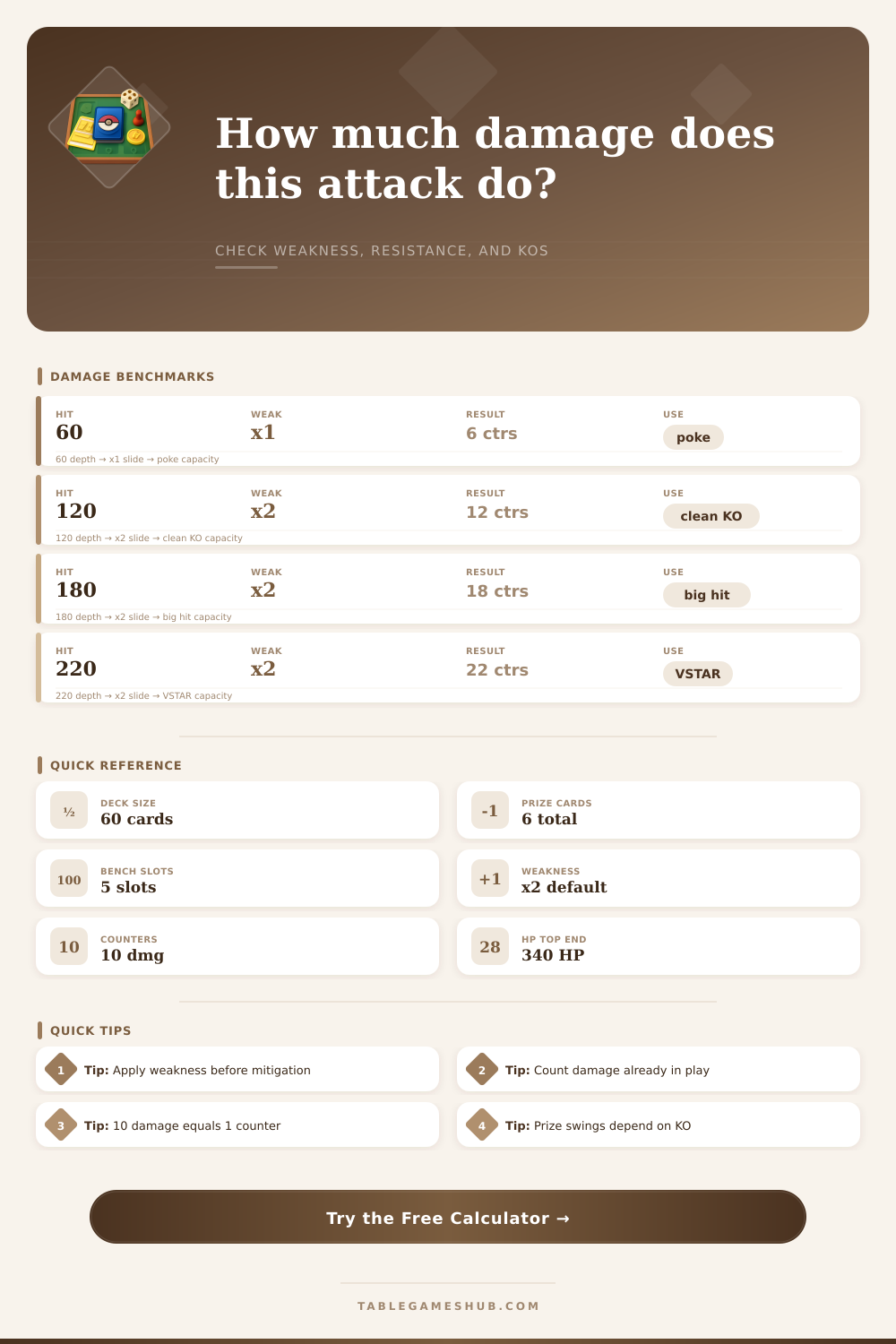
💥 Pokemon TCG Damage Calculator
Test weakness, resistance, damage counters, and prize swings so you can see exact knockout math before you commit the attack.
| Measure | Formula | Value | Notes |
|---|
| Modifier | Effect | Common value | Calculator note |
|---|---|---|---|
| Weakness | Multiply damage | x2 | Apply before mitigation |
| Resistance | Flat reduction | 20-30 | Often handled with mitigation |
| Prevention | Reduce damage | 10-100 | Stops small hits from KO'ing |
| Bonus damage | Add to attack | +20-120 | Useful for heads and Tools |
| Prize value | Target type | Usual HP band | KO note |
|---|---|---|---|
| 1 prize | Single-prize | 70-150 | Faster trade target |
| 2 prizes | Double-prize | 170-280 | Common midgame swing |
| 3 prizes | Triple-prize | 280-340 | Big knockout payoff |
| 0 prize | No KO | Any band | Not enough damage yet |
| Final damage | Counters | Typical result | Example |
|---|---|---|---|
| 60 | 6 | Small chip | Basic poke |
| 120 | 12 | Clean trade | Weakness boost |
| 180 | 18 | Midgame KO | Most ex targets |
| 220+ | 22+ | Big swing | Tank pressure |
| Line | Build | Damage math | Use case |
|---|---|---|---|
| One-hit 60 | Base only | 60 x1 | Early pressure |
| Weakness 120 | 60 x2 | 120 total | Simple KO check |
| Spread 90 | 60 + 30 | 90 total | Bench chip math |
| Big finisher | 140 + bonus | 220 total | Prize swing turn |
Apply weakness first
Multiply the attack before you subtract flat mitigation so the KO math stays accurate.
Always count existing damage
Damage already on the target can turn a near miss into a clean knockout.
Damages is a necessary skill for any persons playing the Pokémon Trading Card Game. Damage determine whether the attack will result in a knockout for a Pokémon, and damage for players will determine the number of prize cards that the player will take from the opponent. Incorrectly calculations of the damage that will be dealt to the Pokémon will result in the loss of the player’s game and there prize cards.
There are several different factors that may impacts the amount of damage that is dealt to the Pokémon. One of the factors that impact damage is weakness, which will multiply the damage of the attack by a specific number. Additionally, there is the factor of resistance, which will subtract a specific amount of damage from the attack.
How to Calculate Damage in the Pokémon Card Game
Additionally, there is an factor of existing damage, which is the damage that is already on the Pokémon from previous attacks. Weakness is applied to the base damage of the attack first, then any resistance or other damage reductions is applied to the total damage. Finally, the existing damage from the Pokémon are applied to that total damage to determine the total damage to be dealt to the Pokémon.
The amount of damage that is dealt to the opponent will determine how many of the opponent’s prize cards the player takes. If the player take out a Pokémon that has one prize card, the player takes one of the opponent’s prize cards. If the player takes out a Pokémon that have two prize cards, the player takes two of the opponents prize cards.
Additionally, three prize cards are taken if the player takes out a Pokémon that has three prize cards. Therefore, if the player does not perform their damage calculations correct, they may not be able to knock out a Pokémon with two or more prize cards and thus, they will not be able to take those prize cards from the opponent. In addition to damage calculations, another factor that a player should consider prior to attacking is the energy that will be commit for the attack.
Energy is required to perform an attack, and if the player commits a large amount of energy to an attack that will not knock out the opponent’s Pokémon, the player is wasting energy. Thus, prior to committing energy to an attack, the player should calculate if the attack will result in knock out the opponent’s Pokémon. Another factor that impact damage calculations is the position of the player and their Pokémon on the field.
Damage that is dealt to the player’s active Pokémon is considered direct damage. Damage that is dealt to other Pokémon on the players field is call spread damage. Additionally, spread damage often does not benefit from weakness, since the Pokémon on the bench may not share the same type than the player’s active Pokémon.
Thus, the player must keep track of the damage to their active Pokémon and Pokémon on the bench. In order to calculate the damage that will be dealt to the opponent’s Pokémon, the player should perform the calculations in a specific way. First, the player should identify the base damage of the attack.
Additionally, the weakness factor multiplies the base damage if the opponent’s Pokémon has weakness to the type of attack. Any bonus to the attack are added to the total damage. Any resistance to the opponent’s Pokémon is subtract from the total damage.
The existing damage on the opponent’s Pokémon is added to the total damage. If the total damage is equal to or more greater than the opponent’s Pokémon’s HP, the opponent’s Pokémon will be knocked out. Thus, by following these step, the player can ensure that they correctly calculate the damage to be dealt to the opponent’s Pokémon.