🎲 Infinity Dice Calculator
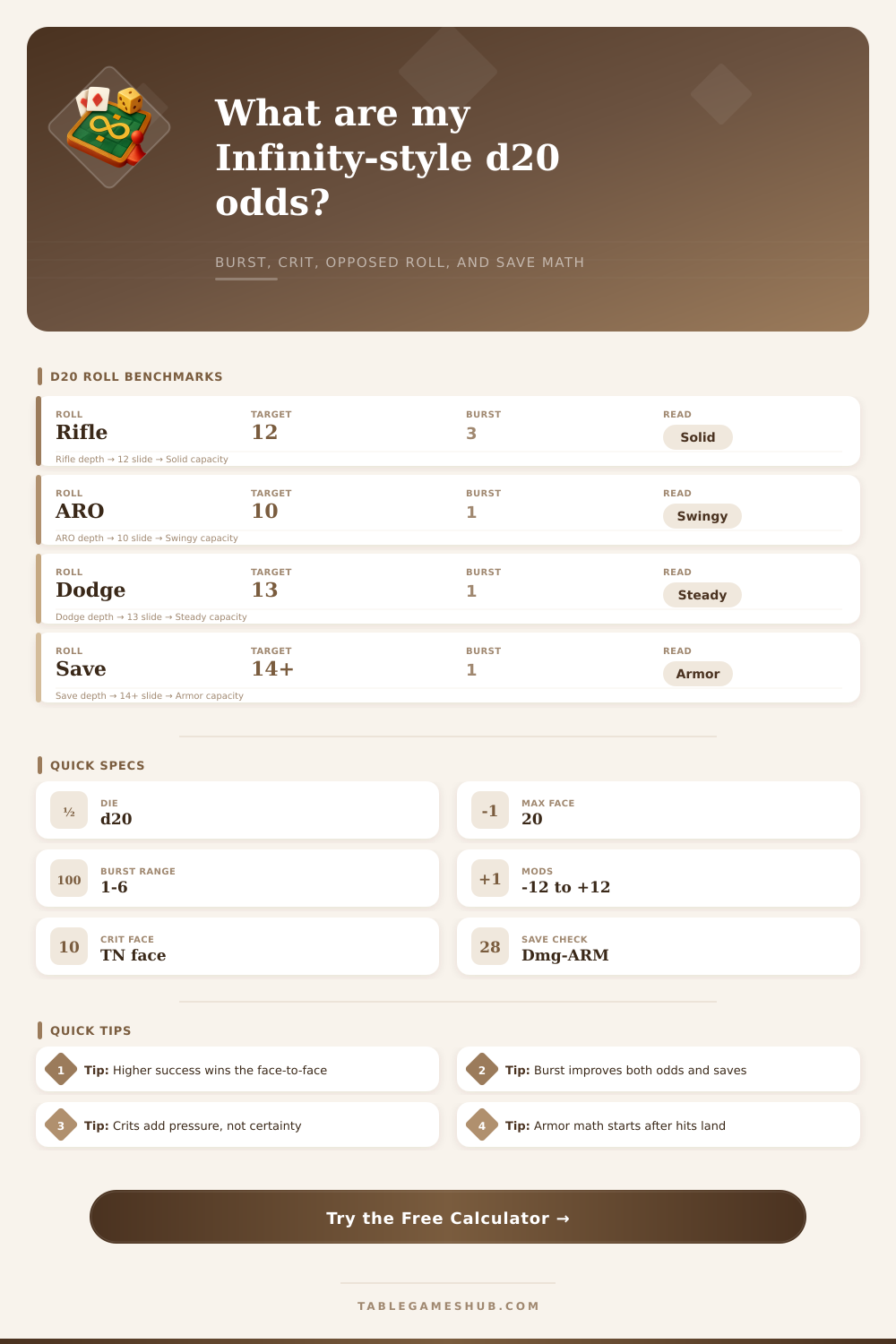
Model Infinity-style d20 burst rolls, target modifiers, crit faces, face-to-face comparisons, and armor save pressure.
| Modified Target | Single Die Success | Burst 3 Any Success | Burst 5 Any Success |
|---|---|---|---|
| 6 or less | 30.0% | 65.7% | 83.2% |
| 10 or less | 50.0% | 87.5% | 96.9% |
| 13 or less | 65.0% | 95.7% | 99.5% |
| 16 or less | 80.0% | 99.2% | 100.0% |
| Face-to-Face Concept | Calculator Handling | Input Affected | Output Affected |
|---|---|---|---|
| Successful face | Roll at or below target | Target and mods | Win chance |
| Higher success | Beats lower success | Both targets | Expected hits |
| Equal top face | Counts as tied pressure | Both dice pools | Tie chance |
| No opponent success | All active successes land | Opponent dice | Saves forced |
| Armor Math | Save Need | Fail Faces | Single Fail Rate |
|---|---|---|---|
| Dmg 13 vs ARM 0 | 13+ | 1-12 | 60.0% |
| Dmg 13 vs ARM 3 | 10+ | 1-9 | 45.0% |
| Dmg 13 vs ARM 6 | 7+ | 1-6 | 30.0% |
| Dmg 15 vs ARM 6 | 9+ | 1-8 | 40.0% |
| Scenario | Typical Burst | Typical Modifier | Best Reading |
|---|---|---|---|
| Active attack | 3 to 5 dice | Range plus cover | Expected hits |
| Reactive ARO | 1 die | Range or state | Swing chance |
| Dodge or reset | 1 die | Penalty common | Survival odds |
| Normal roll | 1 to 3 dice | Task based | Raw success |
Tip 1: Separate the roll from the save
Face-to-face math decides whether hits land. Armor math starts after those hits and crit pressure create save rolls.
Tip 2: Modifiers change both quality and ceiling
A higher target improves the chance to succeed and raises the best possible successful face in an opposed roll.
The d20 system are a method for determining whether an action will be successful or a failure within the game. The d20 system relies upon the rolling of dice to determine the outcome of an action, as well as the use of mathematics to apply modifiers to the rolls of the dice. When a player rolls a burst of dice, the player must look for any die that display a face that is a successful face.
The number rolled on a die that is considered to be a successful face is any number that is equal to or below a specific target number. Furthemore, if the player rolls multiple dice, only the highest number of successful face is used to compare the outcome of the player to that of the player’s opponent. For instance, if a player rolls a 4 and a 9, but the target number is 12, then the result of the player is a 9.
How the d20 Dice System Works
If the opponent roll a 10, the opponent will win that encounter. The more dice that are added to the burst pool, the more likely the player is to roll at least one successful face. However, adding more dice to a burst pool dont guarantee that a player will win a face to face duel with another player, however.
The target number for a burst of dice determines the results of the burst of dice. A target number is the value of the burst of dice that the players wishes to achieve; any die roll that is at or below this target number is considered to be a success. Modifiers are the values that are added to or subtracted from the target number.
A higher target number is more advantageous to the player. A higher target number will allow the player to roll a successful face more often, and will provide a higher potential value to the face of the die that rolls to the most highest successful face for that burst of dice. Thus, a soldier with a target number of 15 will be more effectively in fighting in duels with other soldiers then a soldier with a target number of 10.
A calculator can be used to visually demonstrate the effect of applying modifiers to the target number. For instance, the calculator can visually demonstrate the win chance of the player, as well as the expected number of successes for the player. To use the calculator, simply enter the active burst size and the defense value for the opponent.
The calculator will indicate whether the player’s shot is a statistical gamble or a reliable play. Additionally, consider that critical hit are a specific type of success on the d20. A critical hit allows the player to apply pressure regardless of the outcome of the face-to-face duel. A critical hit forces the opponent to save, and the player can use their pool of bursts to increase the chance of rolling a critical hit.
Thus, even if a player loses a face-to-face duel, they may still be able to score a critical hit against the opponent. After a player scores a hit, the game shifts from a probability-based system to one based on the durability of the opponent. Their armor and their BTS (Basic Toughness Score) values determines the durability of an opponent.
While armor does not prevent a player from being hit, it does make it more difficult for those with high armor values to take wounds. To calculate the damage that an opponent will take, the player subtracts the defense value of the opponent from the damage value roll. The resulting damage value can then be compared with the armor and cover bonuses of the opponent to determine if the opponent will have to make a save.
If the resulting damage value is high and the armor value of the opponent is low, the opponent will have a difficult time making a successful save. Reference tables provides an overview of the failure rate of saves based off the armor value of the opponent. Though many players believe that the hit and the opponent’s save are one event, these are two separate hurdle for the attacking player.
To score a hit against an opponent, the attacking player must win the face-to-face duel, as well as pass their armor save. Thus, opponents with heavy armor will find themselves able to avoid getting wounded from bursts with high burst pool. It is possible for an opponent to hit a player multiple times during a single burst.
However, if a player’s armor value is high, they may not take any wound from the attack. Understanding the d20 system requires an understanding of these two values. Burst pools allow for a high chance of scoring critical hits, while a high target number against an opponent provides the player with an advantage in the face-to-face duels.
The tool that is provided can help model different scenarios to determine whether a shot is worth taking with a burst pool, or whether it may be better to move more close to the opponent to increase one’s target number. You should of used the tool to check the probabilitys.