Hopscotch Box Size Calculator
Size a chalk grid by age stride, box count, line thickness, and the safe playground footprint around the lane.
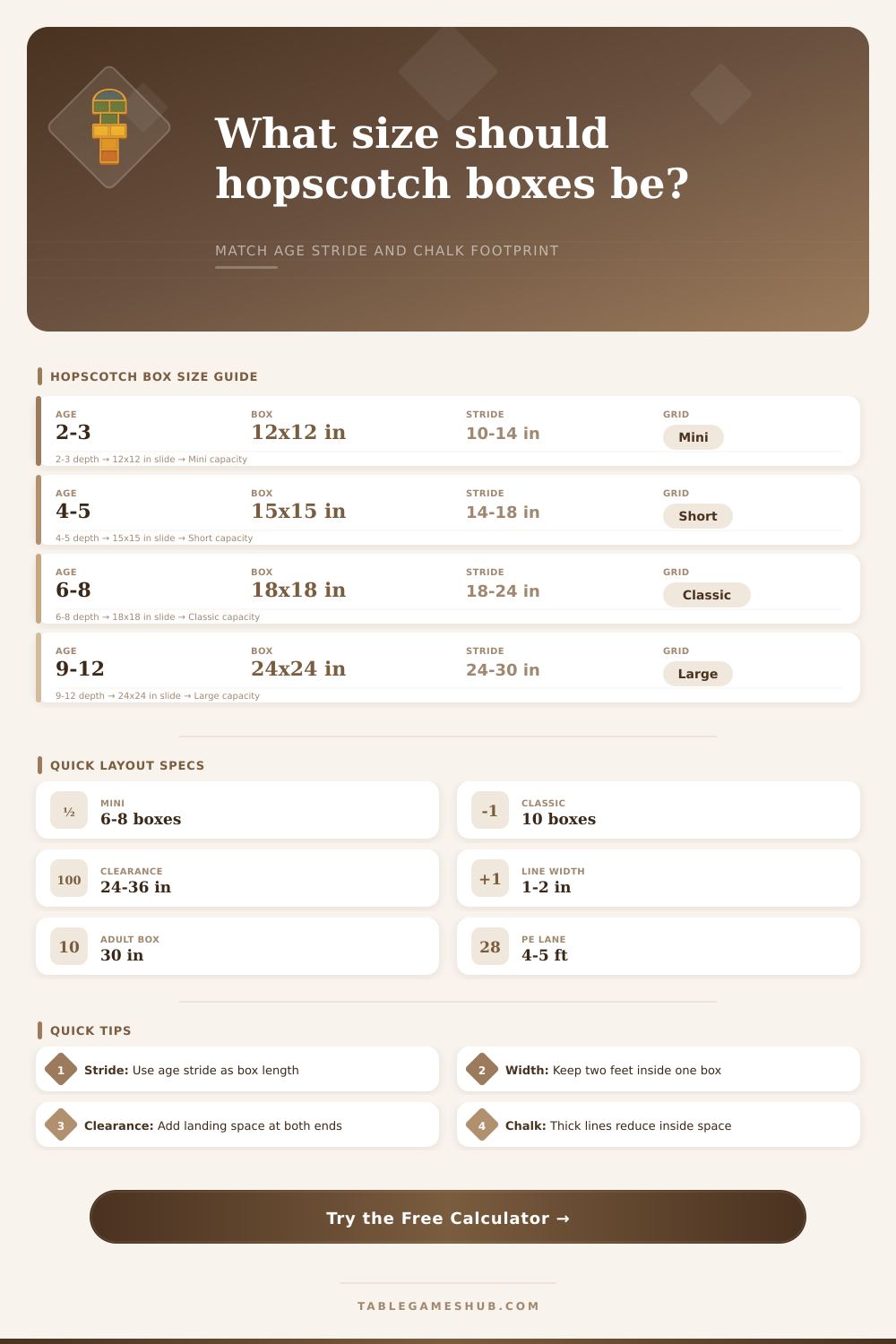
| Player group | Typical stride | Box length target | Best use |
|---|---|---|---|
| Toddler 2-3 | 10-14 in | 12-14 in | Short 4-6 box practice |
| Preschool 4-5 | 14-18 in | 15-18 in | Mini or short playground grids |
| Early elementary 6-8 | 18-24 in | 18-22 in | Classic 1-10 chalk layout |
| Older kids 9-12 | 24-30 in | 22-26 in | Longer outdoor grids |
| Teen / adult | 28-36 in | 26-32 in | Fitness, camp, or party play |
| Wide access practice | 18-30 in | 24-36 in | Balance and mobility practice |
| Layout style | Row math | Width math | Typical footprint |
|---|---|---|---|
| Classic alternating 1-10 | Boxes become about 6 rows | Two boxes on wide rows | 5-7 ft long, 3-5 ft wide |
| Single-file lane | One row per number | One box wide | 10-20 ft long, narrow sidewalk |
| Double-wide ladder | Half as many rows | Two boxes wide throughout | Shorter grid, wider stance |
| Compact spiral / snail | Rows from square-root packing | Three to four box columns | Good for patios and indoor tape |
| Two side-by-side lanes | Classic rows repeated | Four boxes plus lane gap | PE rotations or recess groups |
| Preset | Box size | Boxes | Clearance note |
|---|---|---|---|
| Toddler Mini 1-6 | 12 x 12 in | 6 | Use low-speed landing space |
| Preschool Short 1-8 | 15 x 15 in | 8 | Works on broad sidewalks |
| Elementary Classic 1-10 | 18 x 18 in | 10 | Add 24 in beside the grid |
| Older Kids Large 1-10 | 24 x 24 in | 10 | Use a wider court or driveway |
| Adult Fitness Steps | 30 x 30 in | 10 | Allow a longer finishing zone |
| Players | Suggested lanes | Queue space | Best surface |
|---|---|---|---|
| 1-4 players | One classic lane | 24-30 in start zone | Sidewalk or driveway |
| 5-8 players | One lane with longer queue | 36-48 in start zone | Playground asphalt |
| 9-16 players | Two side-by-side lanes | 48-72 in shared queue | Open court surface |
| 17-30 players | Three or more lanes | Use marked waiting line | PE blacktop area |
The hopscotch box size calculator is a tool that allow people to calculate the dimension for a hopscotch grid. A hopscotch grid come with specific measurements for the size of the boxes. If a hopscotch box grid has box that are too small, the players will feel cramped within the boxes.
Furthermore, if the boxes are too small for young children, the players will lose the rhythm with which they normally play the game. On the other hand, if the boxes in a hopscotch grid are too large, the players will have to leap awkward to jump from one box to the next. Additionally, the players may struggle to land on the lines that mark the different hopscotch boxes.
Find the Right Size for Hopscotch Boxes
In order to use the hopscotch box size calculator, there are several different input that must be made. Each of these different inputs will impact the dimensions of the resulting hopscotch grid. One of these inputs is the age group of the children that will play on the hopscotch grid.
For instance, a two-year-old will have a different stride length than a ten-year-old, which will impact the size of the hopscotch boxes. Next, the layout style for the grid will have an impact on the number of boxes that are of each size. The number of boxes that will be included in the grid will also impact the total length of the grid.
Furthermore, the number of players that will use the hopscotch grid will impact the amount of space that is required for the queue of players waiting to jump on the hopscotch grid. Another factor to consider includes the thickness of the lines that mark each hopscotch box. If the lines are thick, there will be less usable space within each of the boxes for the players to land both of their feet.
In this case, it is important to consider the space required for each player to land within the boxes. Another factor to consider includes the amount of space that will be cleared to the side of the hopscotch grid for each player to jump onto the grid. Additionally, there must also be sufficient space within the grid for the players to land after they jump from the final box to the other side of the hopscotch grid.
The calculator will calculate all of the dimensions of the hopscotch grid based off the various factor that are considered. This calculation will allow the individual to determine the footprint that the hopscotch grid will require in order to fit into the desired location. For example, it is possible that the sidewalk may appear to be the proper length for the hopscotch grid, but with the additional space that is required for landing zones and side clearances, it is possible that the sidewalk is too short to accommodate the hopscotch grid.
Additionally, the driveway may appear to be an adequate alternative surface for the hopscotch grid. However, the driveway may have a slope that would make part of the driveway unusable for the hopscotch grid. By calculating the footprint of the hopscotch grid prior to actualy drawing the lines for the hopscotch boxes, the individual will be able to avoid making mistake with the actual grid in the designated space.
Another important factor to consider when calculating the size of each hopscotch box is the stride distance that each player will take while hopping on the grid. The length of each box should match the natural hopping distance of the players. If the length of the boxes is shorter than the stride distance of the players, the children will have to either stretch or skip some of the hopscotch boxes.
Additionally, if the length of each box is longer than the stride distance of the players, then the players will have to take running leap to jump from one box to the next. The hopscotch box size calculator will compare the length of the hopscotch boxes that are chosen with the stride length of the age group to which the players belong to ensure that the length of the boxes can be adjusted before actually drawing the lines for the boxes. The type of surface that will be utilized for the hopscotch grid is another factor to consider for the hopscotch box size calculator.
However, the type of surface will not change the mathematics that the calculator calculates. For example, if the hopscotch grid is to be played on a sidewalk, then there will be tight side clearances for the players to jump on the sidewalk. If the players are to draw the hopscotch boxes on an asphalt road, then there will be more space for the players to jump on the asphalt.
Furthermore, if the players play the hopscotch grid indoors on a grid that is marked with tape, then the area that is used for the hopscotch grid must be cleared of any obstacle, such as furnitures or doorways. The hopscotch box size calculator will provide the footprint for the hopscotch grid so that the individual can decide if the chosen surface area can hold the footprint of the hopscotch grid. Many individuals will make one or more mistakes when attempting to set up a hopscotch grid.
For instance, some individuals will copy a hopscotch grid that they have seen from another individual without considering the age of the players. Additionally, some individuals will not account for the thickness of the lines that will be drawn for each hopscotch box. Other individuals may not account for the number of players that will use the hopscotch grid, which will determine the amount of space that will be needed for the queue of those players.
Each of these mistakes are among the many factor that must be considered in creating a successful hopscotch grid. The reference table located on the calculator page provides information regarding these different factor. The reference table lists the age groups of the players and the stride length of each age group.
Furthermore, the table also provides information regarding the layout style of the hopscotch grid and the impact that each layout has upon the math that is used for creating the length and width of the grid. The component grid provides information regarding the typical length for the sides of the hopscotch boxes, the width of the lines, and the amount of space that is cleared to the sides of the hopscotch grid. This component grid allows the individual to determine if they’re inputs for the hopscotch grid are typical or unusual for hopscotch grid creators.
Some of the best places to play hopscotch may not have the most ideal condition. For instance, the playground on which the hopscotch grid will be played may have a fence, a slope, or a bench that will prevent its use for hopscotch. These obstructions will not change the mathematics of the hopscotch box size calculator, but they will change the way in which the individual uses the calculated footprint.
While the calculator will provide the individual with the footprint for the hopscotch grid, the individual will have to use there eyes and there feet to account for these obstructions in the determined area. Overall, a successful hopscotch grid will be one that has boxes that match the players and a space that matches the boxes. The hopscotch box size calculator performs the mathematics that are required to account for each player’s age, the layout of the grid, and the required clearances for each player.
Thus, the individual will have the ability to adjust the calculated dimension according to the actual surface area in which the hopscotch grid will be played.