Hero Realms Damage Calculator
Total a combat turn through guards, champions, class pressure, faction ally triggers, prevention, healing, and lethal margin.
Use the calculator as a turn-resolution worksheet: enter the combat you already produced, then add shortcut modifiers for class pressure, faction ally triggers, guards, champion targets, prevention, and the health race.
Turn Breakdown
| Hero role | Starting health baseline | Calculator pressure edge | Best damage read |
|---|---|---|---|
| Base Hero | 50 health | Neutral, no shortcut bonus | Clean PvP or teaching game counts |
| Fighter | 60 health | Flat combat and guard brawling | Turns where one extra hit breaks a wall |
| Ranger | 58 health | Steady pressure through board texture | Mixed attacks with champions and guards |
| Cleric | 55 health | Health swing and Imperial-style sustain | Races where survival is as important as lethal |
| Thief | 52 health | Item burst and tempo conversion | Guild turns that convert gold tools into damage |
| Wizard | 50 health | High ceiling from spell-like burst | All-in turns with large ability spikes |
| Faction focus | Damage pattern | Health effect | Calculator use |
|---|---|---|---|
| Imperial | Moderate combat with steady ally value | Extra healing on multiple triggers | Use when the turn wins by surviving the crackback |
| Guild | Item and action burst, often tempo-heavy | Usually indirect through faster kills | Add item bonuses and watch prevention closely |
| Necros | Drain pressure and sacrifice-style spikes | Small drain swing on ally chains | Good for lethal margins that look short at first |
| Wild | Raw combat, large creature turns, overrun feel | Limited sustain, high damage ceiling | Best when clearing guards and still hitting hero |
| Mixed Market | Reliable but lower synergy density | Only what you enter manually | Use for early turns or decks without a clear lane |
| Board state | Routing assumption | Damage formula | Best output to watch |
|---|---|---|---|
| No guards | Combat can hit hero immediately | Total combat minus prevention | Hero Damage and Lethal Margin |
| One guard | Stun guard first, overflow to hero | Combat minus prevention minus guard health | Guard Tax and Hero Damage |
| Multiple guards | Add all guard health before overflow | Combat minus prevention minus total guard health | Guards stunned estimate |
| Non-guard champions | Optional after guards depending on route | Hero-first or clear-champions-first | Compare lethal with future board risk |
| Preset | Class | Faction lane | Typical question |
|---|---|---|---|
| Fighter Opening Strike | Fighter | Mixed market | Can a simple early push matter through a small guard? |
| Ranger Guard Break | Ranger | Wild or mixed | Does champion combat help the attack crack a defender? |
| Wizard Fireball Turn | Wizard | Guild or Wild | Is the spell burst enough after shields? |
| Cleric Imperial Stand | Cleric | Imperial | Can healing keep you alive if lethal misses? |
| Co-op Boss Burn | Base Hero | Wild | How much extra combat should the team buffer? |
A damage calculator allow you to determine if your combat will succeed in the game. Many factors can influence amount of damage that is dealt during combat. Guards may stand in the way of your combat, champions may change the state of the lane, and the abilities of each class may changes the amount of damage that you can deal.
Each of these factors must be considered in your determination of whether or not your combat will succeed. A damage calculator is a tool that allows you to consider each of these variable in one place. Each of the inputs for the damage calculator represent a different component of the game.
How to Use the Damage Calculator
Base combat come from the number of cards that you have played. Any champion combat or item bonus must also be entered into the calculator as those components of combat have different effect when guards are present on the board. The number of allies that trigger must be entered as some of the factions may reward one trigger while others only reward the first trigger of an ally ability.
The guard health must be entered as one combined total as both the guard and guard health have a single value in the game. Prevention represents armor and shield that can be taken off of the opponent; this must be entered into the calculator before combat occur. The healing and crackback for the opponent must be entered into the calculator together as these two values will determine if the hero can survive the combat of the opponent for that turn.
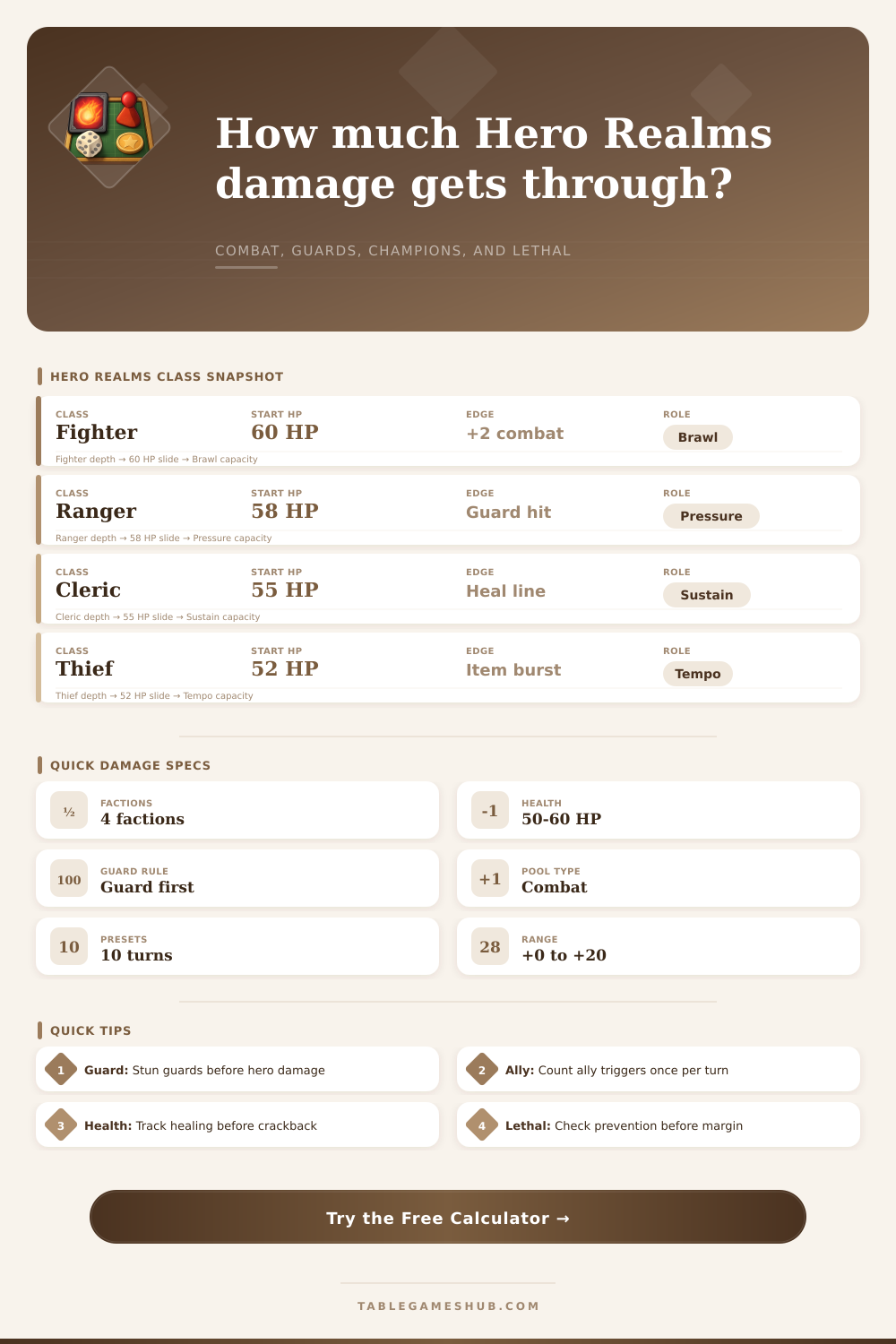
The class that is chosen for the hero can influence the game in two different way. First, combat for fighter classes tend to be steady with bonuses for dealing with guards. Ranger class deck tend to focus upon creating pressure on the board.
Cleric class decks may not have high combat but high healing ability. Thief decks use items to cause burst damage for that turn while wizard classes may use high amount of damage for a single turn. These tendency are automatically accounted for in the damage calculator as the calculator is designed to save the hero from having to calculate these effects manually.
The faction that is focused upon can also influence the game in several different ways. Imperial lines create steady value and healing for allies while the guild lines reward individuals with items and action performed in a burst of time. Additionally, necros lines improve the lethal margin for the hero while wild lines increase the raw combat that must be dealt to eliminate opponents.
Mixed markets may not contain a clear lane for any particular faction so they requires more manual input to account for the same density as other markets. The routing choice for the hero determine where overflow combat is sent. If overflow combat is to be sent to the hero first, this will maximize the lethal damage that is dealt to the opponent while leaving champions alive to deal crackback damage to the hero.
If combat is to be cleared of champions first, then the risk of crackback is reduced while the amount of lethal damage that is dealt to the opponent that turn is reduced. The damage calculator allow for each of these routing scenario to be entered to determine which poses the least risk to the hero. Within the health swing section of the damage calculator is a representation of the risk of the hero losing the game.
While it may appear that the hero will deal lethal damage to the opponent, the opponent may still succeed in eliminating the hero if they are able to survive their return combat. The health of the hero must be tracked both before crackback damage and after crackback damage is dealt. The health of the hero must be compared to the amount of combat that the opponent can deal in there return combat.
This section of the damage calculator transforms the concept of lethal damage into risk assessment of that lethal damage. Finally, players can set the buffer for combat as an additional means of ensuring that the hero will survive combat; a higher buffer mean the hero must deal more combat to survive. Players may make a few common mistake when setting up their combat calculations.
For instance, some players may not account for the number of allies that trigger; they may also apply prevention after guards when prevention should occur before guards. Additionally, players may not account for the pressure that their class can provide for the hero which is also an important value over multiple turn of combat. The damage calculator does not prevent these mistake from being made but does provide a means of surfacing those mistake after the players have entered their values.
The reference tables included in the damage calculator provide context for the various number that can be entered into the calculator. The health base lines for each class and the pattern for each faction are provided in these tables. The actual number that are entered will depend upon the players cards and opponent cards.
These tables are to be used as a turn resolution worksheet for the player. The most useful habit for players is to run the same position on the game twice with different routing choice. Comparing the number of combat points that is lethal after routing choice two to the amount of lethal combat after routing choice one will help to reveal the true cost of each routing choice.