Guandan Score Calculator
Advance a Guandan match from the finishing order, apply common level variants, check whether Ace has been confirmed, and estimate the remaining session pace.
Score breakdown
| Winning team finish pattern | Base formula | Standard gain | Score sheet note |
|---|---|---|---|
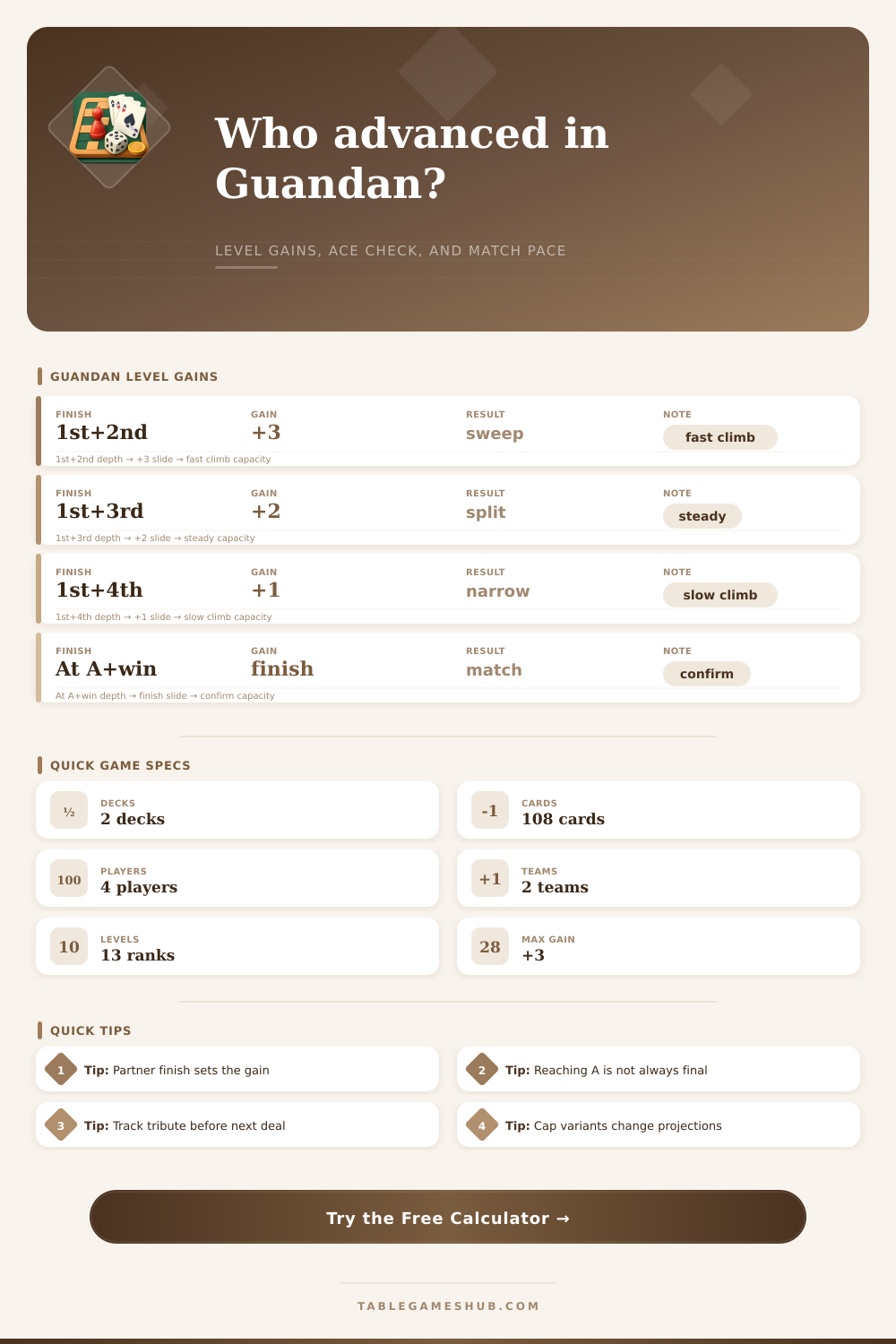
| Banker and Follower, partners finish 1st and 2nd | Base gain = 3 | +3 levels | Clean sweep; fastest legal standard promotion. |
| Banker and Third, partners finish 1st and 3rd | Base gain = 2 | +2 levels | Split finish; partner avoided last place. |
| Banker and Dweller, partners finish 1st and 4th | Base gain = 1 | +1 level | Narrow win; one-level climb only. |
| Winning while already at Ace under confirmation scoring | A + win = match | Finish | Calculator flags the match complete before adding overflow levels. |
| Index range | Level ranks | Promotion distance | Calculator use |
|---|---|---|---|
| 0 to 3 | 2, 3, 4, 5 | Opening climb | Best for early-session pace checks and teaching games. |
| 4 to 7 | 6, 7, 8, 9 | Middle ladder | Most club score sheets spend several hands here. |
| 8 to 11 | 10, J, Q, K | Endgame climb | One sweep can move a team from J to Ace. |
| 12 | A | Confirmation zone | Under Ace confirmation, the next winning hand ends the match. |
The calculator converts each rank to a zero-based ladder index, adds the earned gain, then caps the displayed rank at Ace.
| Previous hand state | Tribute note | Score impact | Calculator handling |
|---|---|---|---|
| Single Dweller | Dweller pays high card to Banker | No level change | Displayed as a next-hand reminder only. |
| Double-dweller by one side | Both losing players may pay tribute | No level change | Marks the result as a double tribute setup. |
| Red joker exemption | Tribute can be waived by table rule | No level change | Flags exemption so score and deal notes stay separate. |
| No tribute tracking | Score-only sheet | No level change | Keeps the breakdown focused on advancement math. |
| Model | Formula | Best use | Effect on projection |
|---|---|---|---|
| Standard Guandan | Gain = 3, 2, or 1 by partner finish | Normal match scorekeeping | Fastest possible future pace is +3 per winning hand. |
| Club cap +2 | Gain = minimum of base gain and 2 | League rounds that limit sweeps | Increases projected hands when a team is below K. |
| House sweep bonus | Gain = base gain +1 only on 1st+2nd | Short casual sessions | Can reduce the minimum climb by one hand. |
| Track only | Gain is recorded but no winner flag is shown | Practice reviews and unfinished tables | Projection reports pace without declaring match complete. |
The tension in a Guandan room lives in the silence between hands of cards. There is only the silence of four cardplayer gazing at their score sheet, trying to work out if they’re going to finish before dinner time or if they’ll have to stay up late with a few rounds of overtime. Here, arithmetic’s failure isn’t merely embarrassing: it shifts your approach to playing. If you reckon you’re two levels from winning, then you may attempt a dangerous squeeze. If you’re realy three levels away, that same play risks losing everything. The math determines your strategy: so the ability to keep one’s head about the numbers count as much as having any good hand.
It sounds so straightforward, yet it has weight. You begin at Level 2 and ascend to Ace. Depending on how your partner placed in the deal, the amount you advance when your team wins vary: Banker sweeps three levels if your partner is second; two if they’re third; just one if you finish dead-last as a partnership. It’s fast, it’s clean, and it rewards flawless teamwork. If your partner comes in second you sweep three levels, third you take two, and last you take one.
Why Math Matters in Guandan
The math for this is above in the calculator; no need to try to do it in your head while opposing team shuffles their deck. Every hand presents a delicate dance of risk vs. Reward thanks to its simplicity. The finish line turns out to be where most people fall down. In most formats, getting to level Ace doesn’t mean you’ve won yet. You still have to win a hand with Ace showing for it to count. Knowing this makes all the difference in way you approach the late game.
Someone who gets to Ace on the last deal but never wins it basically loses all their momentum. They sudden find themselves in an additional round that they didn’t think was necessary. Not knowing this fact can cause a team to celebrate too soon, and keep the pressure honest right up to the last card drawn. The result is that the final approach becomes a checkmate instead of a race.
The true work of planning comes in pacing. Good tables keeps track of time spent on each deal. If you’re planning on doing eighteen deals this session, and you’re averaging fifteen minutes per hand, then you’d better know sooner rather than later if you’re ahead or behind schedule. You might think you can average two levels per win, but those small differences adds up. The tool projects your pace based off your past inputs, so you’ll have an idea of how many more winning hands you need to go. This lets smart players dial back their aggression mid-session. If you don’t have much time left, maybe you’ll tighten up. If there’s still some wiggle room, hey, play around with riskier combinations, they has more ups and downs.
The other part of the Tribute rules that is easily overlooked but comes into play at the table are that every time a player ends up with worst hand (the “dwell”), he/she has to give a high card to the Banker before play begins on the following hand. This Tribute can have a dramatic effect on the flow of play by limiting the lead to the first hand and changing how players plan their leads. There are some exceptions, such as the Red Joker rule. There is also the case of having two “dwelling” player, which makes it even more complex to set up next deal. Though not technically affecting the counting per se, it does affect the way the game flows. Having a marker on the table for the person owing tribute eliminates any controversy regarding the first hand ten minutes later. It is a little administrative item that keeps the game flowing smoothly.
To summarize, Guandan is a cumulative-advantage game. Missing by a little bit when measuring out the levels or underestimating how far away Ace is, can add up to losing the match. But eliminating guessing in tracking the score free your brain to focus on what’s happening right now in front of you. The puzzle. Every time you shuffle the cards it’s different, but the ladder never changes. And when the last card has been turned down and the final hand announced, you’ll be able to look at the ladder and say “I won,” instead of “man, I lucked out with the math.”
You should of known the math better.