Generala Score Calculator
Score a five-dice Generala turn, compare every legal category, apply first-roll bonuses, handle Double Generala, and see the exact gap to your target score.
1Preset Generala Rolls
Pick a real table situation, then adjust dice, scoring slot, variant, scratches, and current total.
2Dice Roll
3Score Sheet Inputs
4Generala Component Grid
5Reference Tables
| Category | Dice Requirement | Built Score | Served Score |
|---|---|---|---|
| Ones to Sixes | Any matching face value | Face value times count | No bonus |
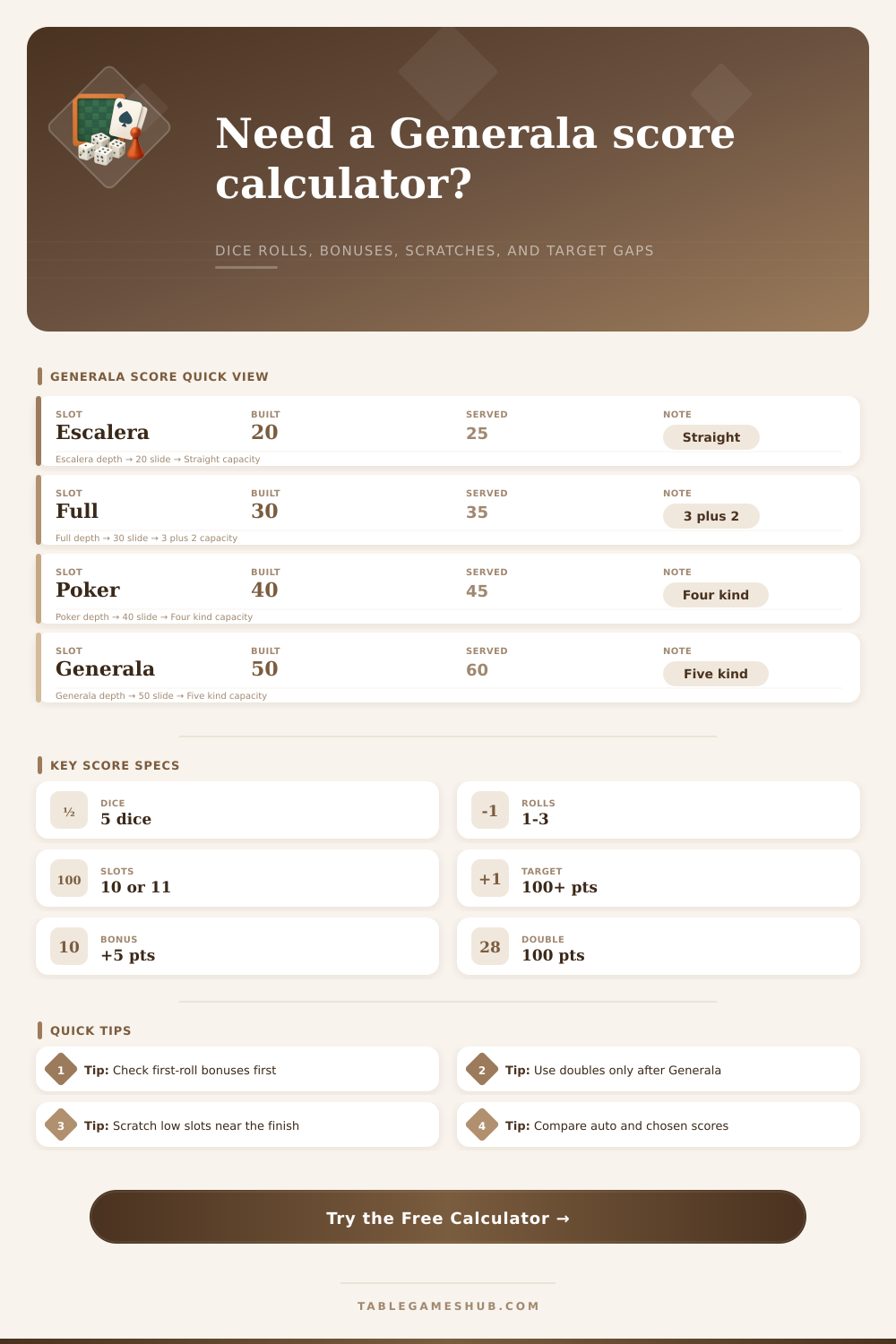
| Escalera | 1-2-3-4-5 or 2-3-4-5-6 | 20 points | 25 points |
| Full | Three of one face plus two of another | 30 points | 35 points |
| Poker | Four dice showing the same face | 40 points | 45 points |
| Generala | Five dice showing the same face | 50 points | 60 points in classic play |
| Variant Setting | What It Changes | Calculator Use | Best For |
|---|---|---|---|
| Classic served scores | Escalera, Full, and Poker receive +5; served Generala scores 60 | Default scoring mode | Most casual score sheets |
| Served +10 house rule | First-roll combo bonus is larger | Select House: served is +10 | Tables that mark 30, 40, 50, and 60 |
| No served bonus | First-roll combos score the same as built combos | Select No served bonus | Strict simple score pads |
| Generala always 50 | Five of a kind never becomes 60 | Select Generala is always 50 | Short target games |
| Pattern | Example Roll | Legal High Combo | Scoring Watchout |
|---|---|---|---|
| Five of a kind | 6-6-6-6-6 | Generala or Double Generala | Can also score Sixes or Poker by choice |
| Four of a kind | 4-4-4-4-2 | Poker | Compare Poker to Fours if the row is open |
| Full house | 5-5-5-2-2 | Full | Five of a kind is not treated as Full here |
| Straight | 1-2-3-4-5 | Escalera | Wrap sequences depend on table variant |
| Table Situation | Useful Input | Result to Read | Decision Signal |
|---|---|---|---|
| Near target | Current total and target score | New total and points left | Take the smallest score that reaches target |
| Early round | Auto-pick highest legal score | Best legal slot | Preserve rare slots when number score is strong |
| Generala already scored | Double slot available | Double Generala line | Use Double only if the first Generala row is filled |
| No legal category | Scratch selected slot | Chosen score of zero | Cross off the least valuable remaining row |
6Scorekeeping Tips
Served roll audit: Check the roll count before writing a combo score. Escalera, Full, Poker, and Generala often change when made on the first throw.
Double Generala order: Most tables only allow Double Generala after the first Generala row has already been scored, not when it was scratched.
Generala players cringe at the sound of dice tumbling in a cup. It’s the difference between possibility and an irreversible choice: You get three rolls, ten or eleven slots to play with, and a hand to cobble together. A spectacular throw might force you to choose between two high-value options, while a modest roll might be the only thing standing between you and a scratched category. Use the calculator above to run numbers for you, so you can concentrate on strategy instead of arithmetic.
The next level of complexity here is understanding what a served roll mean. While most players are aware that if you get a poker or full house on your initial dice throw, you gain extra points, few will remember exactly how much it’s worth and which category it apply to. By allowing you to identify your roll as either a standard roll or a served roll, the tool covers all these bases.
How to Play Generala Better
In classic play, for instance, a served generala is worth sixty points instead of just fifty. A swing that can instantly win a round. Other combos only recieve a five-point bonus, but those incremental bonuses add up: the difference between being comfortly ahead and scrambling for every last point before time runs out.
If one of your rolls fall into more than one category, like four fives and a two (scoring forty-five points if served, or putting your total fives in the Fives slot for twenty-five) things gets strategic. Do you play the combo, or save that rare high-value category for later? You’ll often want to go with the combo.
If your number slots is empty, though, taking the combo score is usually safe. But if you’re trying to hit a target score and still have a few twos and ones open, saving some of these precious spaces becomes important. Because now you need to balance current points with possible points down the road. This tradeoff is not always clearer in the moment.
The defensive part of the equation is crossing off a category when there’s simply nothing good on your dice to roll in an open slot. Here’s where the wisdom come in: Which slot do you scratch? Novices randomly scratch or select the slot that seems most unlikely to land in the future. Pros see what’s left. They’ll cross out the category offering smallest amount of insurance against opponents or the lowest probability of landing by the end of game.
It’s risky to leave an Escalera spot open early in the game (lots of points if you get it). But to take a pass on Generala when you’re so near your target score might be a planned effort to lock up a win versus risking a zero.
There’s another important factor here: variants. For instance, some tables accept wrapped straights (i.e., 4-5-6-1-2 is an Escalera). Other tables has a Double Generala slot that gives you extra hundred points on top of your original Generala score if you roll five of a kind. These house rules can significantly shift the odds.
The calculator accounts for this variation. The recommended scores will match the specific rules being played at that table at that moment. That takes the guesswork out of arguing over what should of been allowed based off local customs.
In the end, however, Generala isn’t as much about luck as it is about managing resources in pressured situations. You have a limited supply of score sheets (represented by your score). Each turn, you spend one of these unit. It’s not just about rolling well, but rather applying those rolls in such a way that you get the greatest value at any given point in time, considering your position.
By getting rid of the mental work of totaling and checking for bonuses, you free up brainpower to focus on your own path toward the desired score and your opponent’s progress. The dice bring the chaos; you create the order. That skill of balancing both is what makes the difference. It separates casual players from those who always seem to find a way to win, even when rolls aren’t going their way.