Sueca Score Calculator
Total a Sueca hand from captured card points, trick count, regional bandeira and pente rules, tied-hand carryovers, and the current rubber score.
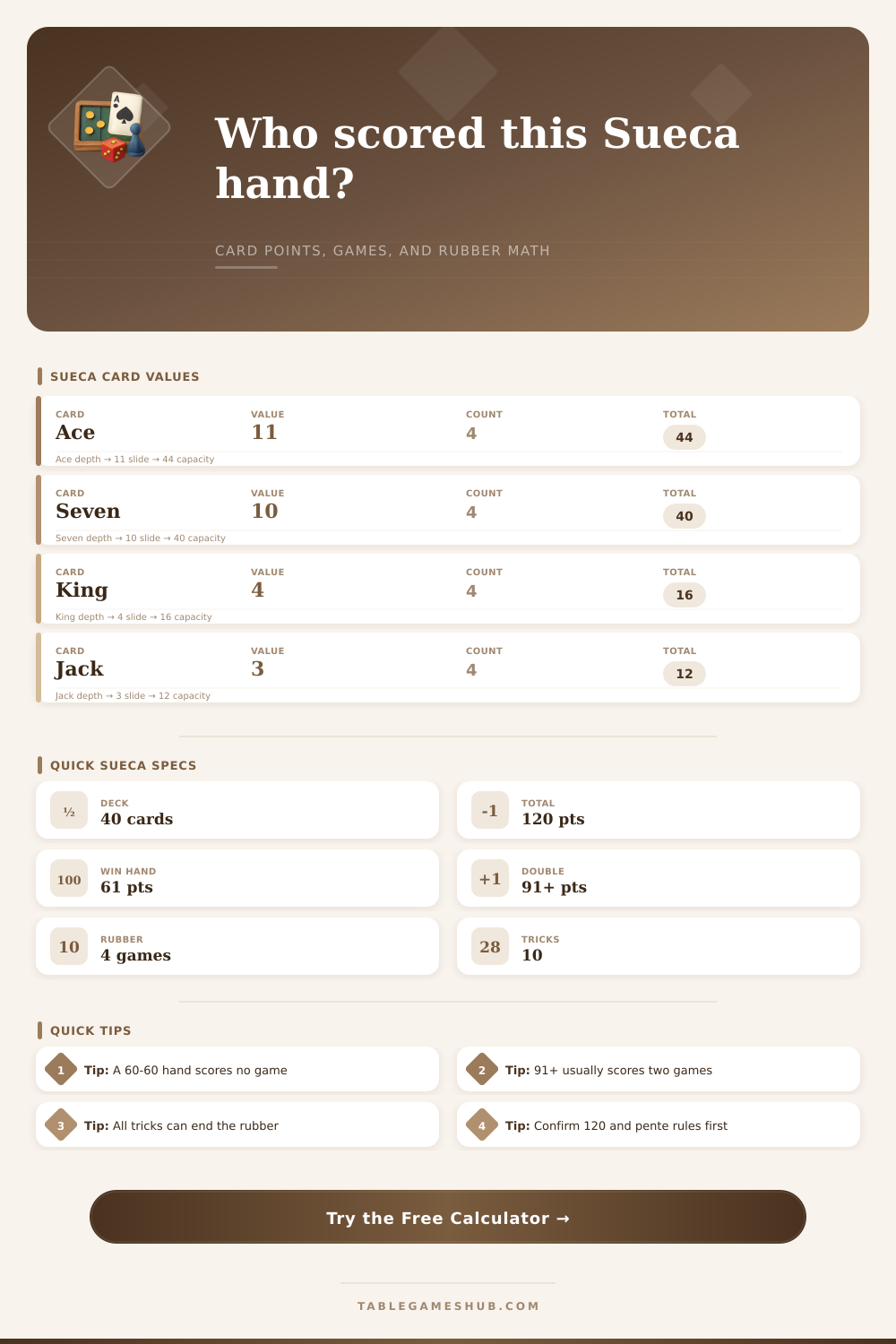
Card point values
| Rank | Value each | Copies | Deck total |
|---|---|---|---|
| Ace | 11 | 4 | 44 |
| Seven | 10 | 4 | 40 |
| King | 4 | 4 | 16 |
| Jack | 3 | 4 | 12 |
| Queen | 2 | 4 | 8 |
| 6, 5, 4, 3, 2 | 0 | 20 | 0 |
Hand award bands
| Winner points | Loser points | Game award | Common note |
|---|---|---|---|
| 60-60 | 60-60 | 0 | No hand score |
| 61 to 90 | 59 to 30 | 1 | Normal win |
| 91 to 119 | 29 to 1 | 2 | Rolha table |
| 120 | 0 | 2 or rubber | Depends on tricks |
| All 10 tricks | 0 tricks | Rubber | Bandeira rule |
Rule profile shortcuts
| Profile | Target | 120 rule | Under-30 rule |
|---|---|---|---|
| Standard | 4 | All tricks | Off |
| North strict | 4 | All tricks only | Off |
| Regional 120 | 4 | 120 ends rubber | Off |
| Pente | 4 | All tricks | Under 30 ends |
| Long rubber | 10 | All tricks | Off |
Preset score cases
| Preset | Card score | Tricks | Expected award |
|---|---|---|---|
| Standard 65-55 | 65 to 55 | 6 | +1 game |
| Rolha 94 | 94 to 26 | 7 | +2 games |
| All Tricks Flag | 120 to 0 | 10 | Rubber |
| 60-60 Tie | 60 to 60 | 5 | 0, maybe carry |
| Pente Table | 96 to 24 | 8 | Rubber by rule |
In a room full of people, calling out a 61 breaks through like cool air on a hot day. In Sueca, it’s the magic number: defeat lies beyond it, and victory awaits before it. That’s no ordinary card game. That’s a dance of mathematics.
Each jack, king and ace is weighted differently then the next, creating a test of mathematical tension. And while you may believe that scorekeeping is just addition, regional variations make even simple sums a bonus-and-carryover puzzle. Use calculator at left to do math for you; save your partnership from any embarassing arguments about who won what exactly in that last hand.
Why You Should Use a Sueca Calculator
The game is built around a deck of forty cards that add up to precisely one hundred and twenty points. Kings is worth four and queens are worth zero. Jacks are worth three, aces eleven, and sevens ten. It’s an odd distribution in which you might capture lots of trick and still end up losing the hand, depending on what they were. If your captures was mostly empty, you’re sunk.
And remember: Any side with more than half the pack (i.e., fifty or more) is a winner. If you hold aces and sevens, it add up fast. See reference table on the page. You’ll see why most casual player never keep score; just try to win tricks. Trouble is, they don’t realize there’s a point value in each trick, too.
At most tables, crossing the ninety mark triggers a double-game bonus called Rolha. For any score from sixty-one to ninety, it’s a game apiece. Play continues until someone wins four games, though Sueca isn’t a monolith of identical rules. Tie games is treated differently by different regions. Under standard play, a perfectly even sixty-to-sixty hand is worth no points whatsoever; however, some groups carry a virtual game over into the next deal to break the stalemate. Other groups call this rule bandeira, treating the capture of all ten tricks as an automatic rubber win regardless of points. Before trusting final tally, be sure you know how your group does things. There are different sets of rules at each house.
This tool can handle them all with selectable profiles so you don’t have to remember the house rules. Just select right profile for your table, type in number of tricks you’ve won and how many cards you’re holding, and it will calculate what is needed to go up (or down) and when it’s safe to stop playing. It takes into account if one hundred twenty tricks wins the match instantly, or if you must win every single trick to win on 120. That makes a difference to the strategy; should you play conservatively or aggressively towards the end of a set?
More than the math, though, it’s the mind game of the rubber that’s appealing. A traditional Sueca race runs to four games, and if you’re down 3-1 then any single poor hand can turn the tide dramatically. You’ll be able to see at a glance precisely how far you are from finishing the rubber, and exactly how many games remain. The Pente rule also applies. When a partner score under thirty, they may end the rubber on the spot, and the calculator calls that out as well. It adds to each low-point trick because there are stakes attached to the game: huge defensive mistakes will be punished.
Don’t make the mistake so many of us do when playing casualy. Mistaking a carryover from a tied hand two deals back for something that actually happened on the deal at hand. Use such a calculator not only as a scorekeeper but also to learn how you’re doing overall. Are you winning or losing by slivers, or are you steamrolling people, hauling in high-point bags? That breakdown allows you to tell the difference between streakiness and steady competence.
By taking away the human element and having it apply the regional logic automatically while logging the current state, you avoid mistakes like forgetting you won a hand and then remembering incorrecty later on. Tactical positioning as well as the strength of the cards that you play matter when playing Sueca well. You can tell from moment to moment precisely how much you’ve got going for you so it’s easy to make calculations about taking risks or not. With two tricks remaining and you’re sitting at fifty-eight points, you know you’re under pressure. There’s no point being aggressive if your opponents is holding kings and aces; the math says caution. The hand speaks more loudly than memory.
Bottom line: it’s all about accuracy. Whatever set of rules you follow, tight North America, loosey-goosey regional variation… It’s a game in which crossing that line first is key. You must also do this without handing your opponents any freebies. So hold those cards up right, keep an eye on trick count, and leave the math for the tools. Let ’em do their job so you can concentrate on what truly counts: outthinking your opponents on the other side of the table. Feed ’em correctly, and they’ll take care of the numbers for you.