Group Stage Standings Calculator
Project qualification status from wins, draws, losses, goal differential, remaining matches, scoring rules, and the selected group-stage tiebreaker order.
| Rank | Team | Pld | Pts | GD | Form note |
|---|
| Group format | Qualifies | Typical cutoff | Safe target |
|---|---|---|---|
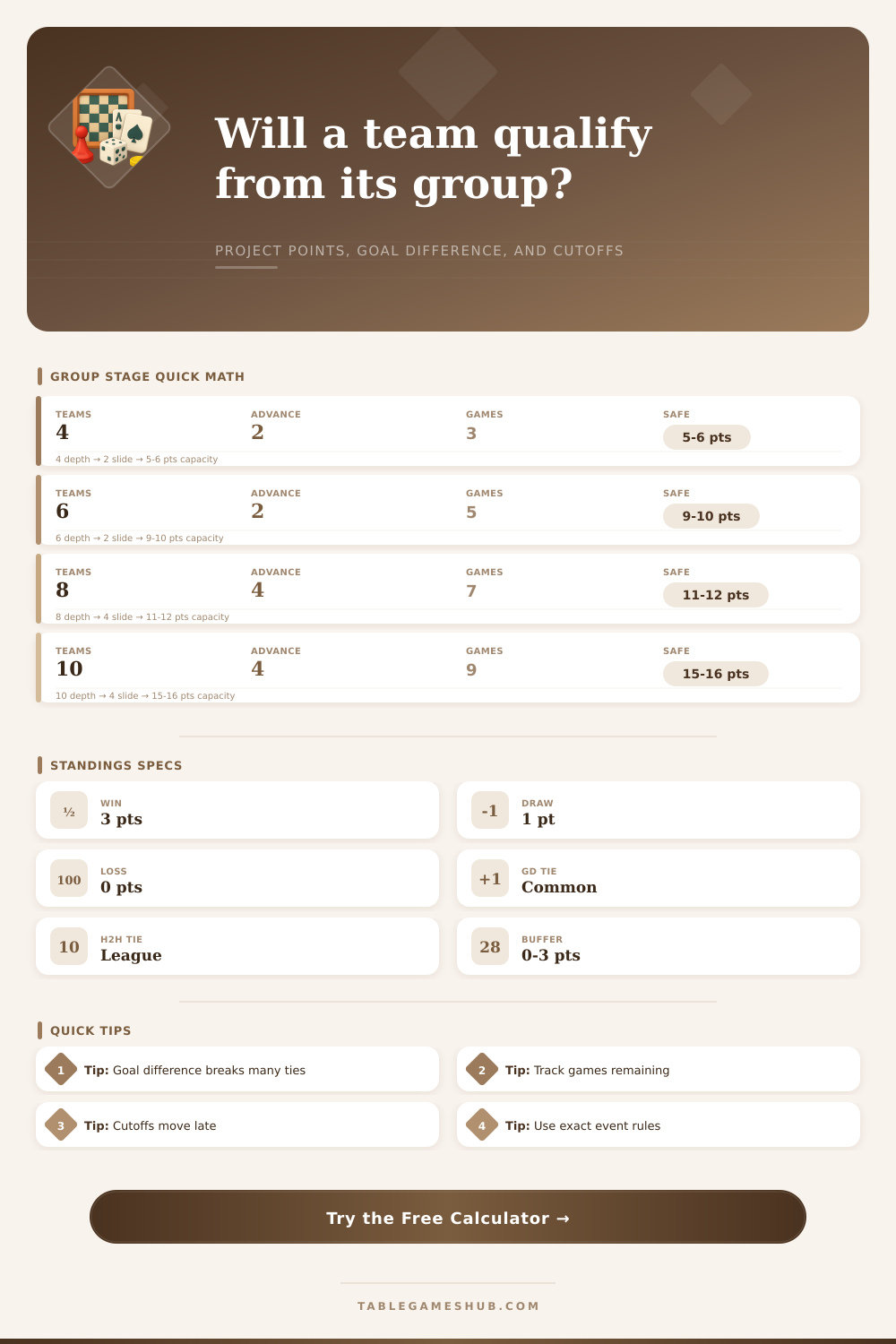
| 4 teams, top 2 | 2 | 4 to 5 points | 6 points with neutral GD |
| 5 teams, top 2 | 2 | 7 to 8 points | 9 points or strong GD |
| 6 teams, top 2 | 2 | 8 to 10 points | 10 points with positive GD |
| 8 teams, top 4 | 4 | 10 to 12 points | 12 points or tiebreak edge |
| Tiebreaker | What it rewards | Calculator input | Standings effect |
|---|---|---|---|
| Goal difference | Balanced scoring and defense | Goals for minus against | Positive GD can beat equal points |
| Goals for | Aggressive scoring | Total goals or points for | Useful when GD is level |
| Head-to-head | Direct matchup results | Manual rule selection | Can override total GD in some events |
| Wins first | Decisive results | Total wins | Draw-heavy teams lose edge |
| System | Win | Draw | Loss | Best use |
|---|---|---|---|---|
| Soccer standard | 3 | 1 | 0 | Most football and group tournaments |
| Board game league | 2 | 1 | 0 | Smaller score spread for casual groups |
| Participation point | 3 | 1 | 1 | Events that award completed losses |
| No-draw format | 3 | 0 | 0 | Games with overtime or shootouts |
Track the real tiebreaker order
Two teams can share the same point total but sit on opposite sides of the line because the event uses goal difference, head-to-head, wins, or goals for first.
Separate possible from safe
Maximum points shows whether qualification is still alive. The cutoff plus buffer is a better target for deciding whether the team controls its own finish.
Group stage standings are often difficult to understands for spectators and teams once many of the group stage soccer matches have taken place. Standings become more complex for teams that has different point totals and goal difference for there teams. For example, one team might have seven points and a plus-three goal difference, but another team may also have seven points but a different goal difference.
The goal difference for these teams can impact the final standings for the team. Thus, a person may use a group stage standings calculator to project the group standings for the remaining matches for a team. To use the group stage standings calculator, a person must provide several inputs into the calculator.
How to Use a Group Stage Standings Calculator
The first of these groups of inputs are the number of teams that compete in the group stage, the number of teams that should advance from the group, the number of times that each team plays its schedule (once, twice, or three times), the current record of the team that is being calculated, the number of goals that the team has scored and conceded, and the number of remaining matches for that team. The points system for the competition is another required input; many competitions use a three-point system for wins, one point for drawn games, and zero points for lost games. Other esports and board-game competitions, however, use a two-point system for wins.
Setting the correct points system will impact the projection of the cutoff point for teams; changing the points system will impact the number of points that is required for teams to win the tournament. The goal difference for each team is another critical input that impacts the projection of the standings for each team. Each team receives the same number of points, but the goal difference may allow one team to overtake another.
Thus, the calculator will compute the goal difference for each team and project the changes to that goal difference according to the scoring rates for the remaining matches for each team. This projection will not necessarily be perfect, but it will allow a team and its spectators to determine whether the lead that the team currently has in the standings is fragile. If the points lead starts to weaken, spectators and the team may be able to adjust the schedule of games to minimize the risk of losing those points.
The average points-per-game that the rival teams in the group stage score is another input that should be set for the calculator. If the rival teams score many points per game, then the number of points that is required for the team to win its championship will be high. If, however, the rival teams score few points per game, then the number of points that a team requires to win the tournament will be lower.
Thus, by changing this input, a spectator can alter the projection of the required points for the team to win the championship. Many different tournaments use different tiebreakers to determine the championship and standings for each team in the championship. For example, some sports use head-to-head results for the teams to determine the standings.
Away goals, disciplinary points, and other factors may also be used in different tournaments to determine the standings for each team. Thus, another input into the group standings calculator is the primary tiebreaker for the tournament; the calculator will generate mathematical projections for the tournament, but the tiebreaker must be checked against the rules for the tournament. A person can also use the calculator to create a safety buffer for the team.
A person creates a safety buffer by setting the cutoff point for the number of points that a team must earn to win the tournament to a value that is higher than the mathematical projection for that point total. A safety buffer can be utilized to protect a team from unexpected results or draws in the remainder of its remaining games. Without a safety buffer, a team may believe that it is safe from elimination from the tournament; however, an unexpected result may lead to its elimination from the tournament.
Thus, a safety buffer ensures that a team and its spectators are protected from unexpected outcomes. Many people focus upon the number of points that a team can score as its maximum potential point total. Often, though, the difference between the current points that a team has earned and the projected point total for the team is more important to those who follow the team.
A wide gap between the current and projected points means that the team is in control of its destiny; a narrow gap means that it may be in need of assistance from other teams results to qualify for the championship. The group stand’s calculations change if a larger group stage is managed. For instance, a ten-team group will calculate differently than a four-team group.
The ten-team group feature could be adjusted to calculate the number of points that are required to advance to the next round in a top-four finisher, for instance. Thus, the calculator can calculate the number of points that is required for each of these different sized groups. Using projected standings for a team allows a person to separate the current record for that team from the remaining games.
The record can not change, but the remaining games can be adjusted to determine the number of points that is required for the team to win the championship. This adjustment will allow a person to determine if a team’s current standings are stable. Although the calculator will generate the calculations for the standings, the human mind must perform one final function to use the projections generated by the calculator: to remove the mental arithmetic of the problem.
No mental calculation is required to determine the number of points that a team can earn, the cutoff points for remaining teams, and whether a team has control of its destiny. These questions will allow a person to more clearly understand the standings of each of the teams in the group stage tournament.