🎲 Pig Dice Game Probability Calculator
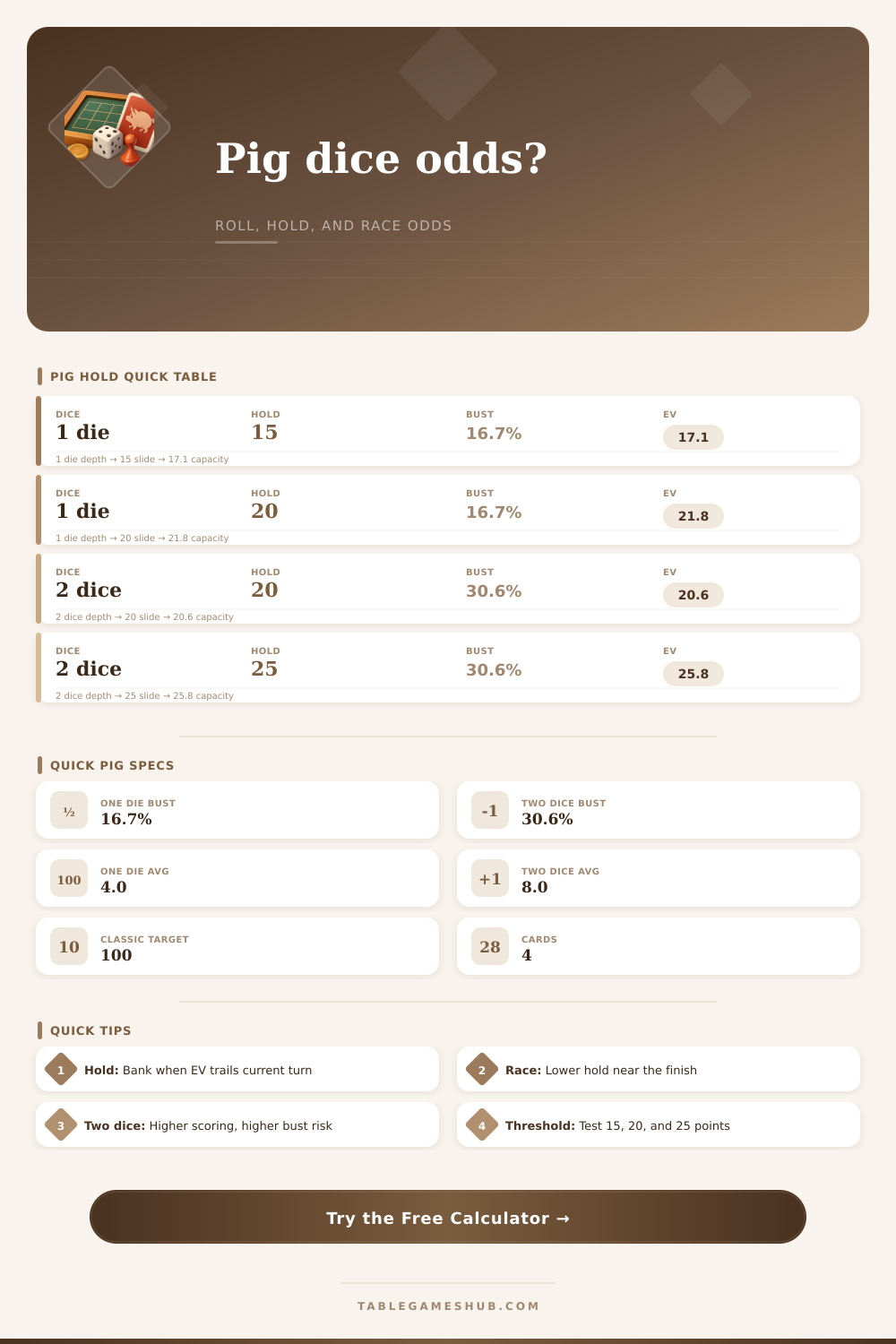
Compare turn total, hold threshold, bust chance, expected turn value, and race-to-target odds for one-die or two-dice Pig.
| Variant | Bust Event | Bust Chance | Safe Roll Average |
|---|---|---|---|
| One die classic Pig | Roll exactly 1 | 1 / 6 = 16.7% | 4.0 points on rolls 2-6 |
| Two dice Pig | At least one die is 1 | 11 / 36 = 30.6% | 8.0 points when both dice are 2-6 |
| Hold action | No roll risk | 0.0% | Bank current turn total |
| Threshold policy | Roll below threshold | Depends on state | Hold at or above threshold |
| Hold Threshold | One-Die Starting EV | One-Die Bust Before Hold | Typical Use |
|---|---|---|---|
| 15 points | about 17.1 | about 51% | Short race or opponent pressure |
| 20 points | about 21.8 | about 62% | Classic balanced Pig policy |
| 25 points | about 26.5 | about 70% | Catch-up or aggressive play |
| 30 points | about 31.4 | about 76% | High variance chase |
| Race Situation | Your Need | Opponent Need | Pressure Reading |
|---|---|---|---|
| Even midgame | 40+ | 40+ | Use normal threshold EV |
| You can win by holding | 0 after bank | Any | Hold is automatic |
| Opponent near target | 10-25 | 1-15 | Roll more aggressively |
| You lead near target | 1-15 | 20+ | Bank modest turns sooner |
| Formula | One Die | Two Dice | Calculator Use |
|---|---|---|---|
| Immediate bust | 1 / 6 | 11 / 36 | Bust chance now card |
| Turn EV state | sum EV(roll + t) / 6 | safe pairs over 36 | Expected turn value |
| Finish chance | gain distribution | gain distribution | Race-to-target model |
| Alternating race | pA / (pA + pB - pA pB) | same | Eventual win estimate |
Tip 1: Compare EV to the current turn total
If the expected value from rolling is below the points you can bank now, holding is usually the cleaner mathematical choice.
Tip 2: Change thresholds near the target
A flat 20-point policy is useful midgame, but the race model matters once either player can finish in one turn.
Pig is a dice game that uses simple rules, yet the game of Pig require players to make decisions. In the game of Pig, players will roll the dice to accumulate points for their current turn. The player decide when to stop rolling the dice to accumulate those points.
If a player rolls a one with the die, however, they will lose all points accumulated during their current turn. Players must decide, before each turn, whether to risk losing their accumulate points by rolling the die to gain more points, or to stop rolling and safely bank their earned points. This decision is whether a player chooses to play the version of the game that use only one die, or the version of the game that use two dice.
When to Stop Rolling in Pig
The version of the game that use only one die present different strategic considerations than the version that use two dice. With the use of only one die, the player will bust if that die comes up a one; there is a one in six chance that it will come up as one. With the use of two dice, however, the player will bust if either of the two dice come up a one; there is an eleven out of thirty-six chance that the player will bust on their turn.
Thus, the two-dice version of the game present a higher risk of busting, but also a higher potential for scoring points in a player’s turn. A hold threshold for the game of Pig is the number of points that a player decides to accumulate before they stop rolling the dice. A low hold threshold indicate a player that is more cautious with their points, as they will bank their points more often.
A high hold threshold, however, suggest that a player is more likely to continue rolling to accumulate more points. Yet a high hold threshold is also associated with a higher risk of busting. The hold threshold that a player choose may change throughout the game based off the player’s score and that of their opponent.
The current turn total is the number of points a player has accumulated during the current turn. Players may not bank their points until they have reached a decision as to when to stop rolling the die. The current turn total, thus, is not safe until a player choose to hold.
The current turn total may be compared to the chance of rolling a one on the next roll of the die; if the value of the current turn total is higher than the chance of rolling a one, players may opt to stop rolling the die and safely bank their points. The race between players affect the way that players value risk. If a player is behind in the race, the upside of rolling a large number of points is higher than if a player is ahead in the race.
Conversely, if a player is ahead in the race, a bust will cost the player more points than if they were behind. The chance of a bust with one die may indicate the risk of the current turn, but it do not indicate the risk if a player must roll the die multiple times to reach their hold threshold. Thus, the risk is more complex than the immediate chance of a bust.
Many players commit the mistake of using the same strategy in every game of Pig. Such a strategy may have appeared to work well in one game, but this do not assure that it will work well in another game. A player may, for instance, remember a turn in which a high hold threshold led to a winning turn for the player; the player may believe that using a high hold threshold is a good strategy for the game of Pig.
Yet a strategy that works in one situation may not work in another. Thus, it is necessary to recheck the mathematical value of the game when a player adjust their score relative to that of their opponent. A player can utilize a table that lists the bust rates for each version of the game of Pig, as well as the average point gains for each game strategy, before the game begins.
Such a table can help a player to avoid memorizing the mathematical calculations for the game of Pig. Yet the table is not a guarantee of success in the game. Thus, such a table exist only as a plan aid for the players.
Some social factors influence the strategy of the game of Pig, though these factors are outside of the mathematical model for the game. For instance, some individuals have house rules for the game of Pig that alter the conditions under which a player busts on their turn. Other groups of players may have rules that allow for re-rolls for players who roll a one.
Though these social factors exist outside of the model, the mathematical model can dictate the strategy that a group should use in order to understand the way in which that social factor is changing the game of Pig. The most important habit to develop in the game of Pig is to recognize when the game situation has changed. The hold threshold that is appropriate for one score is not necessarily appropriate for any other score.
Thus, it is important for a player to continually re-evaluate their strategy in the game of Pig so that their decision are based upon the current scores of themselves and their opponents.