Great Western Trail Cattle Value Calculator
Estimate the delivery strength of a Great Western Trail hand from cattle values, unique breeds, certificates, city targets, trail drag, station bonuses, deck cycling, and cow purchase pressure.
Enter the cattle values currently in hand as comma-separated numbers. The calculator models the Great Western Trail delivery idea that only unique cattle breeds count, then layers certificates and board bonuses against the chosen city.
Great Western Trail cattle value result
| City benchmark | Modeled cattle value target | VP profile | Best use |
|---|---|---|---|
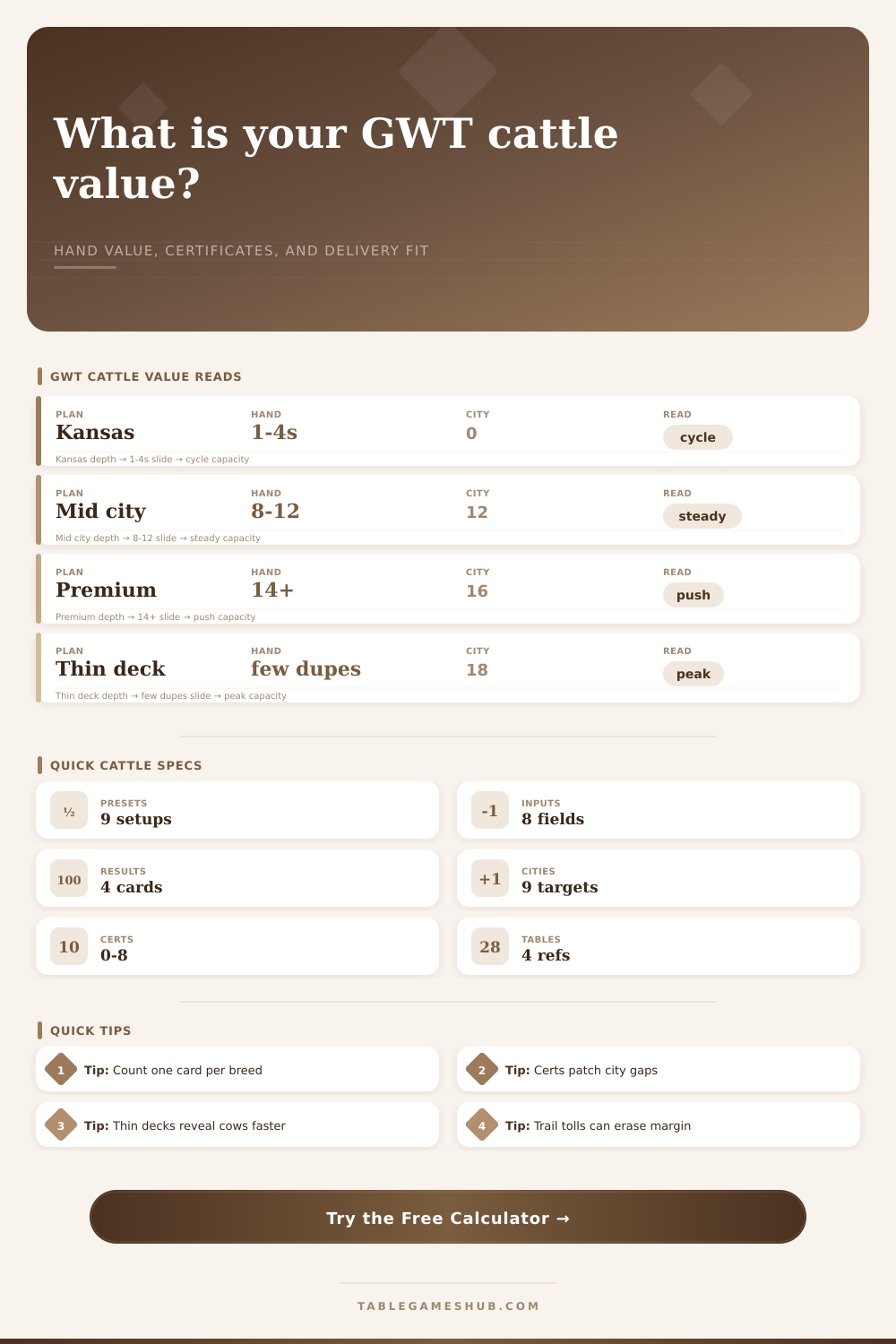
| Kansas City | 0 | 0 VP reset | Dump a weak hand and improve cycling |
| Wichita / Topeka | 6 to 8 | Penalty to break-even | Early deliveries before premium cattle arrive |
| Santa Fe / Colorado Springs | 10 to 12 | Low positive VP | Midgame hand with one certificate patch |
| Albuquerque / San Diego | 14 to 16 | Strong VP row | Premium hand, station aid, or certificate engine |
| Sacramento / San Francisco | 18 to 20 | Peak delivery row | Thin deck with several high-value unique breeds |
| Hand shape | Typical cattle values | Calculator cue | Planning read |
|---|---|---|---|
| Starter-heavy | 1, 1, 2, 2, 2 | Low counted value | Use Kansas City or a low city while thinning |
| Mixed market | 1, 2, 3, 4, 5 | Healthy unique count | One certificate often reaches a mid city |
| Duplicate premium | 3, 4, 4, 5, 5 | High raw, some waste | Strong only if the duplicate breeds are separated |
| Clean premium | 2, 3, 4, 5, 6 | High counted value | Push upper cities if toll drag is controlled |
| Lever | Modeled effect | When it matters | Watch item |
|---|---|---|---|
| Temporary certificates | +1 value each | Closing a 1 to 3 point city gap | Spending too many can weaken a later peak |
| Station master push | Value plus VP | Upper city attempt with exact hand value | Train tempo still affects toll pressure |
| Depot chain | VP without hand value | Delivery already clears the target | Does not fix a city shortfall by itself |
| Certificate engine | Flexible value support | Thin deck cycling into repeat big deliveries | Certificate timing must match delivery turn |
| Cycling profile | Model factor | Purchase implication | Calculator read |
|---|---|---|---|
| Slow clogged deck | 0.85 | New cattle may miss the next delivery | Purchase drag stays visible |
| Steady normal draw | 1.00 | Market buys usually need one loop | Balanced delivery forecast |
| Fast hand churn | 1.12 | Premium cards appear sooner | Extra tempo credit |
| Thin premium deck | 1.25 | Duplicate waste drops sharply | Best repeat-delivery profile |
When you have a pile of pricey cattle all of same breed in Great Western Trail, it’s easy to panic. You think, “Oh man, I’m going to get so many of these! I can’t wait to deliver them!” And then the central mechanic comes back to you: only unique breeds add to your score.
But what is my chance of getting something? What will my actual scoring potential be? The card calculator does the math for you. You can plug in your hand and destinations to get an estimate of how much you might actualy score. It takes into account the wasteful nature of having multiple copies of a single card.
How to Score Better Points
This mechanism is what distinguishes efficient play from haphazardly purchasing livestock at random. To use it effectively, all you need to do is understand it. It take most of its trick from knowing what it’s really doing. Rather than simply looking at the total amount of raw value of each card in your hand, think about the variety of your herds instead.
When the tool forces you to deal with the waste caused by having multiples of the same thing in your hand, you’ll see just how much money you are losing out on by not diversifying early enough. Most players neglect this until it’s too late and they’re locked into their route: you also need to think about which city you choose. If you don’t have a strong hand, aim for San Francisco and you’ll fail. Dump a herd of expensive cards in Kansas City and leave points behind.
Use the reference tables in the tool… They give you an easy set of benchmarks for every destination so you can match up what cards you hold against best scoring tier. That way, you won’t make the common mistake of overcommitting to high-value cities without necessary station bonuses or certificate support.
Station bonuses and certificates is force multipliers. They’re good for something, but only when applied at the right time. Plug them in, along with the rest of the cards in your hand, and use the calculator to see if those bonuses can bridge the gap between your current value and a higher city target. A certificate could be just enough to nudge you from Topeka into Santa Fe territory. That’s how you transform an average score into a solid turn. But don’t go overboard on outside help; you don’t want to rely on it to strengthen your long-term plan. Ideally, you’ve built a deck that’s going to get you points by itself, and then these bonuses are the icing on the cake, not the cake itself.
Perhaps the least considered variable when guessing time-to-delivery is deck cycling rate. If you have a clogged deck and lots of low-value cattle, then you’ll spend ages waiting for those sweet-ass purchases that you’re so desperately trying to get into your hand. The tool shows the tempo drag on the clog, illustrating how slowly-cycling your deck decreases your actual income despite all of your good buys. Conversely, fast cycling result in a good loop: high-value cards show up more often, enabling repeat orders before the game runs out. Experienced players know why thin decks expose your cows sooner, it’s because they spend a large portion of the beginning game shedding their junk card.
Margin eaters are hazard losses and toll payments that eat up your margins. Say you scored twenty points with a delivery, but you also paid five points in tolls and lost three from a hazard event, now your net gain isn’t nearly as large. The calculator accounts for this drag, so you know how many virtual victory points you’re truly accumulating.
Does it make sense to risk it all for a potential big payout or is it better to stay closer to home with a more moddern score? Your total efficiency is also affected by purchase pressure. Spending coin on pricey cows means giving up an opportunity somewhere else. This tool turns the purchase cost into a form of VP drag. Does it pay off during this cycle or not? Did buying a cow mean you missed out on something else? Are you going to wait another cycle for that purchase to cycle through? That’s delay value with real cost pressure. You’re buying some other cow’s turns that might never materialize.
Great Western Trail is really about constraint management. How fast can you cycle? How much space do you have in your hands? How long before someone takes your spot? The calculator lets you use those constraints with a clear sense of where you’re at. Where do you sit compared to city goals? Are you getting closer to profitability or further into the red? Instead of making best guesses, treat every delivery as an informed decision. This move you from being a passive participant to a strategic one.
That isn’t to say we should of had lots of pricey cows; rather, we should have the proper combination of different breeds at the best moment. It’s about constructing a well-oiled machine that operates efficienty with minimal drag and waste… Yielding steady returns instead. Having a firm understanding of what your hand represents, down to the last bonus/penalty, provides a huge advantage against competitors who remain in the dark, guessing. Knowing this is worth more then one or two premium cards drawn from the market.