Golf Score Probability Calculator
Estimate your score band, target-beating odds, and round volatility from course setup, putting, wind, and penalty pressure.
| Band | Typical mean | Spread | Read |
|---|
| Profile | Stroke shift | Risk note | Best use |
|---|
| Hole type | Birdie/par mix | Bogey drag | Why it matters |
|---|
| Situation | Score cue | Chance cue | Action cue |
|---|
Probability is a tool that you can use to understand your golf score. Instead of focusing on your average score, probability help you to understand the range of possible scores that you can recieve during a round of golf. While many golfers focus on their average score, it is possible to be misleading with the average score due to a few very low scores offsetting many high score throughout a round.
By utilizing the concept of a scoring band or the range of possible scores that you can receive, you can understand the likelihood of shooting a specific score throughout your round of golf. The length of the course that you play will have an impact upon your golf score. The longer the course, the more strokes you are likely to take to complete the course.
How to Use Probability to Understand Your Golf Score
Long courses require more precise shot to complete the course in a stroke count that a short course is capable of achieving. Another factor to consider regarding course length is that of the average length of each hole. The average length of each hole will impact the type of club that you need to use to complete each of the holes on the course.
One factor that will have an impact upon your score is the amount of wind that is present while you are playing. The more the wind is strong in relation to your course, the more volatile your score will be. Courses with high winds will create high volatility in a player score.
Another factor that will impact your score is the level of pressure that you feel while you are playing the round of golf. High levels of pressure will increase the chance that you will score double-bogey on many of your holes. High levels of pressure will create tension in your body, which may increase your chance of rushing your putts.
Another way to protect your score is to increase your accuracy with your short putts. High accuracy in short putts will help you to maintain your score. Penalties will also have an impact upon your score.
Any penalty that you encounter will increase your average score, as well as the volatility of your score. By avoiding penalties, you will reduce the volatility in your score and maintain control over your scoring band. The different types of courses that exist require different types of strategies from golfers to achieve the best possible score for that round of golf.
Strategy on parkland courses rewards players for having good control over their game. On windy links courses, your score will increase, as well as your volatility. Tree-lined courses will punish you for any missed hole.
Resort courses are typically shorter and softer, allowing golfers to shoot lower score on the course. When tournament conditions are set, the golfers’ greens will be firm. Firm greens will increase the likelihood of three-putts, increasing your score for the tournament.
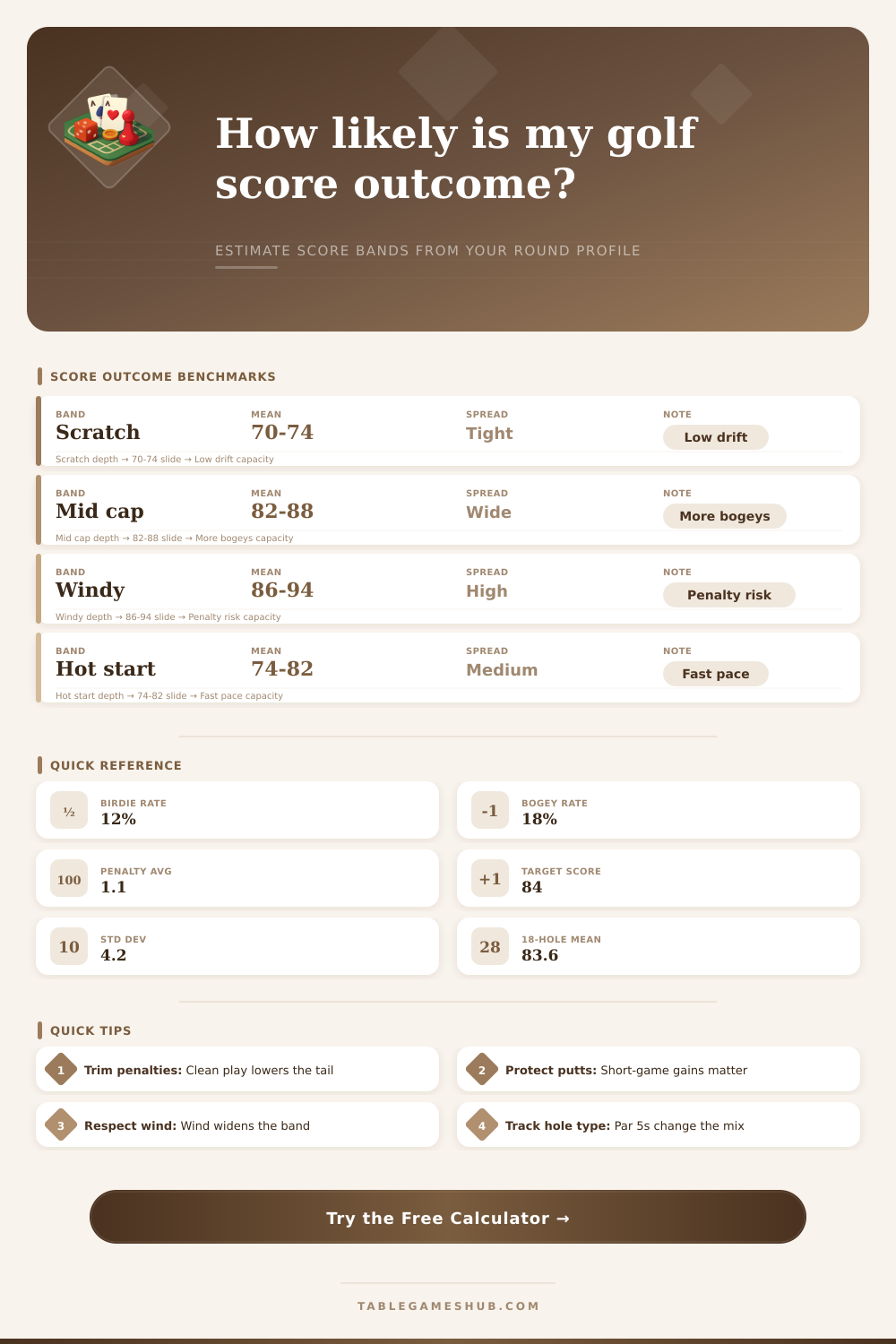
Reference bands can help you to compare your golf scores to other types of players. Scratch players will have a tight scoring band for their score and exhibit low volatility in their scores. Players with a mid-handicap will have a scoring band and volatility in their scores relative to scratch players.
Players scoring in high winds will have a wide band for their scores and high volatility in scoring. By understanding your scoring band, you are aware of your likely score and volatility in your score. Volatility can be expressed in standard deviation from your average score.
A low standard deviation in your score reflects that your scores are close to your average score. The type of hole that you play will impact the probabilities of your score for each hole. For example, short par 4 holes will require wedges and putts for each hole, resulting in fewer bogies scoring on these type of holes.
Reachable par 5 holes allow players to take risks and seek to score birdies on these types of holes. On the other hand, long par 3 holes will require golfers to avoid scoring a bogey on these holes, as a missed long par 3 hole will result in a double-bogey. Penalty holes will include hazard like water or thick rough.
Golfers will increase the risk of scoring high on these types of holes. As such, players should play conservatively on these types of holes to avoid penalties. You should avoid certain trap when analyzing your game.
One trap is to ignore your short game. By ignoring your short game, you will score more bogies. Another trap is to underestimate the impact that penalties will have upon your score.
Penalties will increase your average score. By tracking the number of penalties that you score over several rounds of golf, you will begin to see how penalties have an impact upon your mean score. Both wind and pressure will have an impact upon your score.
High levels of both will create high volatility in your score. Volatility will guide the decisions that you make when you play a round of golf. If you have a low level of volatility in your score, you should focus on scoring pars and birdies.
However, if you have high volatility in your score, you should focus on avoiding double-bogies. If there is a gap between your score and your target score, you will want to identify the adjustment that you need to make. Your target score may require that you reduce the number of penalties that you score, as well as improve your putting skill.
If the odds of you being able to beat your target score are below 50 percent, you should of reconsider the strategies that you employ for your round of golf. However, if the odds are above 70 percent, you should stick to your current game strategy.