Croquet Court Layout Calculator
Scale a 6-wicket or 9-wicket croquet court, then mark boundary setbacks, stakes, wickets, and playable clearance from one coordinate plan.
| Marker | Type | X coordinate | Y coordinate | Layout note |
|---|---|---|---|---|
| Calculate to generate the coordinate list. | ||||
| Layout | Common full size | Primary stake plan | Best use |
|---|---|---|---|
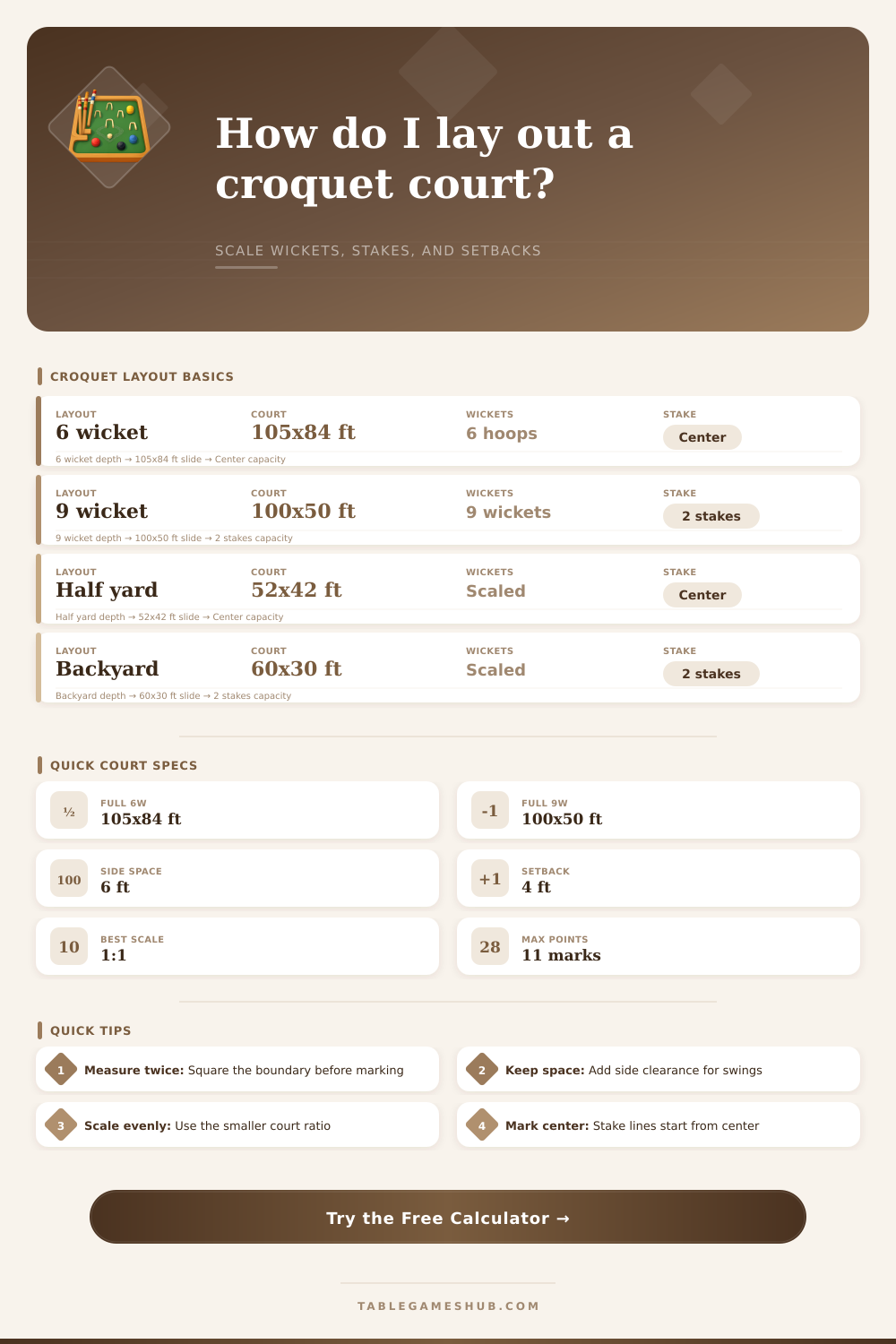
| 6-wicket | 105 x 84 ft | One center stake | Golf croquet and association-style marking |
| 9-wicket | 100 x 50 ft | Two end stakes | Traditional backyard double-diamond layouts |
| Half 6-wicket | 52.5 x 42 ft | One center stake | Practice lawns and compact clubs |
| Compact 9-wicket | 60 x 30 ft | Two end stakes | Backyard play with limited width |
| Feature | 6-wicket ratio | 9-wicket ratio | Scaling rule |
|---|---|---|---|
| Outer court | Length 1.25 x width | Length 2 x width | Use your marked boundary dimensions |
| Playable rectangle | Boundary minus setbacks | Boundary minus setbacks | Subtract both sides and both ends |
| Wicket spacing | Quarter-width columns | Centerline and quarter-width turns | Multiply ratios by playable size |
| Stake placement | Center of playable rectangle | Centered near each end | Keep stakes inside the setback line |
| Clearance item | Minimum | Comfortable | Use when |
|---|---|---|---|
| Outside side clearance | 3 ft | 6 ft | Players stand outside boundary lines |
| End clearance | 4 ft | 8 ft | End stakes sit close to the boundary |
| Boundary setback | 2 ft | 4 ft | Wickets should not crowd the edge |
| Wicket opening reference | 3.5 in | 3.75 in | Checking equipment before marking |
When you are beginning to set up a croquet courts, you must consider the shape of the available space. The shape of the available space will determine in what way the croquet court will functions. A common mistake when setting up a croquet court is to mark the outer fence line as the outer boundary of the croquet court rather than marking the croquet court to a playable rectangle that incorporates a boundary setback.
A boundary setback is used to ensure that the balls that are played across the croquet court do not continually hit the fences or hedges of the yard. If there is no setback established between the croquet court and the boundary of the yard, each measurement between the hoops will be incorrectly marked, rendering the game of croquet difficultly to play. The croquet court calculator will provide you with the mathematical value for the croquet court based off the length and width of the yard that you select for your court.
How to set up a croquet court
However, you must understand how the length and width of the yard will impact the layout of the croquet court. The length and width will determine the boundary where you will place the string or paint for the croquet court. The playing area will be established within a setback of the yard boundary.
A four-foot setback for croquet balls is preferred to a two-foot setback because the four-foot setback allows for the balls to not be hit too hard on the boundaries of the yard. Using the croquet court calculator, you can test these different setups to determine the best setback for your yard. The placement of the stakes will play a critical role in the layout of the croquet court, and the placement of the stakes will change based upon whether you select a 6-wicket court or a 9-wicket court.
For 6-wicket courts, one stake will be placed in the center of the croquet court boundary. For 9-wicket courts, there will be two stakes placed at the ends of the croquet court boundary rather than the center of the court. Because the stakes placement changes between 6-wicket and 9-wicket croquet courts, the croquet court calculator will change the coordinates of the croquet court to reflect these changes in stake placement.
Another factor to consider when setting up a croquet court is the amount of clearance that will be established outside of the boundary of the yard. The croquet court calculator will add to the total length and width of the croquet court to provide players with a clear view of the total space required to establish a croquet court. The amount of space required outside the croquet court will depend upon the number of player that will use the croquet court.
A six-foot clearance provides alot of space for players to stand outside of the croquet court boundary. A three-foot clearance may not provide enough space for players to stand, particularly if many players will be using the croquet court at the same time. These measurements will be visible on the croquet court calculator so that you can determine the amount of space that is required.
Another consideration in setting up a croquet court is the scaling of the court. Scaling of the croquet court will occur when the available space for the croquet court is less than the size of the standard layout for the croquet court. The scale factor will shrink each distance within the croquet court.
The pattern of the croquet court will remain the same for the players but will change in character due to the scaling of the court. For example, with a scaled croquet court, a single hit can move a ball through two wickets because the wickets are closer together at a scaled croquet court. The croquet court calculator will display the percentage of the scaling so that you can determine whether the scaled croquet court will be similar to the standard croquet game or whether it will be too small for use as a croquet court.
The width of the wicket opening will be indicated for reference on the croquet court calculator. However, the width of the opening will not change the coordinates for the croquet court. Standard wicket openings are three-and-three-quarter inches in width.
This dimension is relatively narrow for the croquet court game so that players must hit the balls with accuracy. The width of the wicket opening will not change the coordinates for the croquet court. You can adjust the width of the opening, but the changing width will not change the coordinates of the croquet court layout.
Additionally, you should inspect the wickets to ensure they are not bent so that the layout of the croquet court is not difficult to play with the croquet sticks. The reference tables on the croquet court calculator will provide you with the standard measurements for each type of croquet court. For instance, half-size 6-wicket courts are the same as full-size 6-wicket courts due to the same proportions of each croquet court.
Compact 9-wicket courts may be scaled differently than full-size 6-wicket courts since backyards are often not large enough to allow full-sized croquet courts so the compact size is better for these spaces. These reference tables allow you to quickly compare the size of your croquet court to other croquet courts that are commonly used in croquet clubs. Once you have marked the boundary for the croquet court, you must ensure that the corners of the croquet court are square.
The easiest way to ensure the corners of the croquet court are square is to measure each of the diagonals of the croquet court. If each diagonal of the croquet court has the same measurement, the croquet court is square. If the measurements of the croquet court diagonals are different, the croquet court is twisted which will impact the placement of the stakes for the croquet court.
Twisting the croquet court boundaries can usually be fixed by adjusting one of the corners of the croquet court. By fixing the corner before placing the croquet wickets in the ground, you can save yourself time from having to move the wickets once you have established the croquet court. One final factor to consider when setting up a croquet court is the surface upon which the croquet balls will travel.
For croquet balls to travel the greatest distances on the croquet court, the grass should be cut short and rolled so that the balls will travel quick across the croquet court. Short grass will allow croquet balls to roll further across the croquet court than balls rolling on long grass. Therefore, the length of the grass should be considered when establishing a croquet court.
The croquet court calculator does not calculate the length of grass, but you can use the scale factor to assist you in playing croquet on the grass-covered surface. The primary purpose of a layout tool for a croquet court is to eliminate the guesswork associated with the placement of the croquet court stakes. While the croquet court calculator will provide you with the coordinates necessary to properly establish a croquet court, you will still have to walk through the area that will be used for the croquet court and ensure that the ground is sloped appropriately.
Additionally, you will have to take the time to establish the stakes according to the layout table provided by the calculator. However, using this calculator will allow you to spend your time playing croquet instead of spending your time adjusting the stakes in the croquet court.