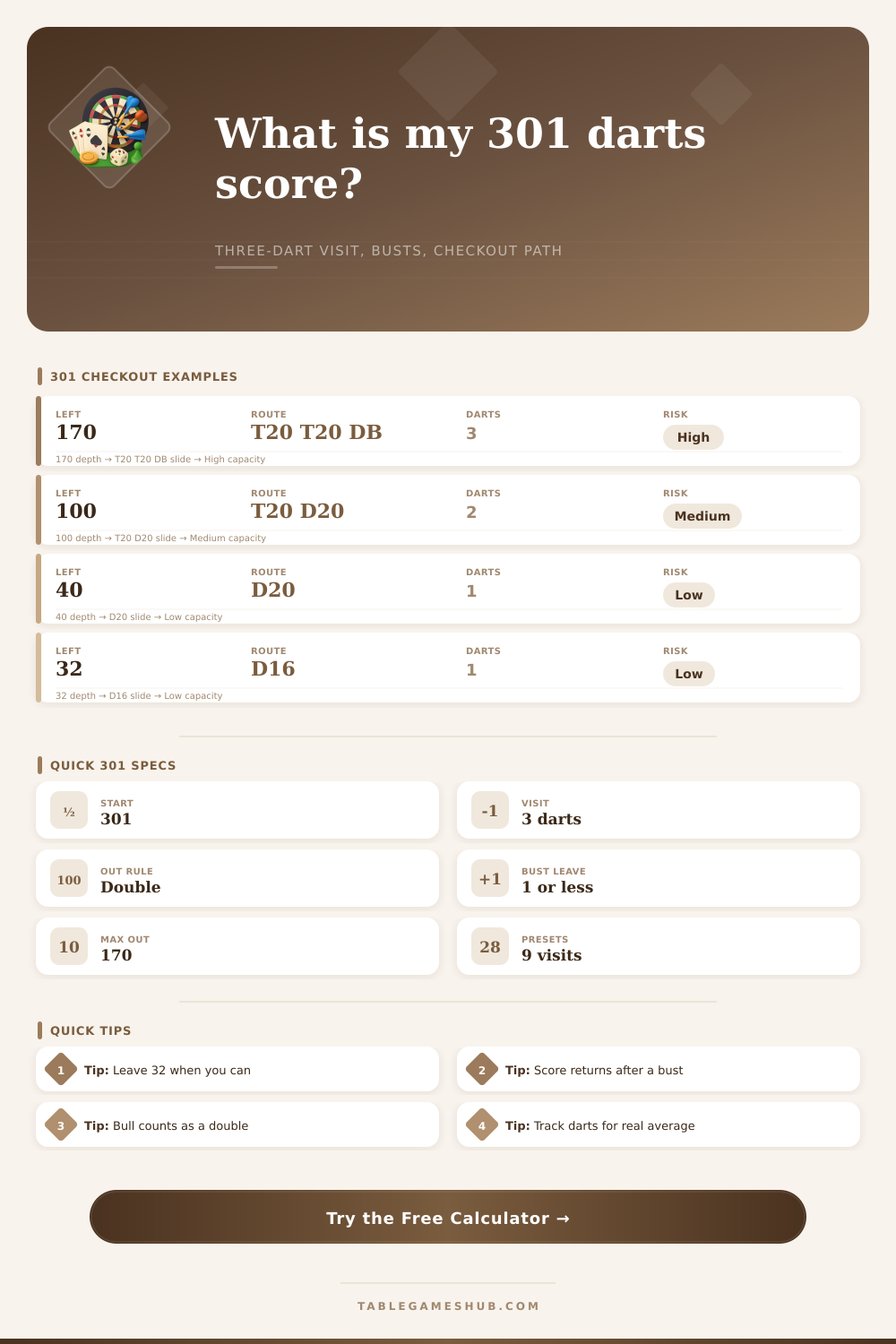
301 Darts Scoring Calculator
Score a three-dart visit, apply double-out bust logic, see the remaining score, and get a practical checkout route.
| Score Left | Preferred Route | Why It Works | Risk Note |
|---|---|---|---|
| 170 | T20, T20, DB | Highest legal three-dart checkout | Requires two treble 20s and bull |
| 121 | T20, T11, D14 | Uses the first dart to create a two-dart finish | Missing the treble usually becomes setup |
| 100 | T20, D20 | Classic two-dart finish through tops | Single 20 leaves 80 with two darts |
| 81 | T19, D12 | Clean odd-number route to a double | Single 19 leaves 62 |
| 64 | T16, D8 | Keeps the finish in the 16 lane | Single 16 leaves 48 |
| 40 | D20 | Tops is one dart when hit cleanly | Single 20 leaves D10 |
| 32 | D16 | Popular because misses split neatly | Single 16 leaves D8 |
| Situation | Double-Out Result | Remaining Score | Example |
|---|---|---|---|
| Score goes below 0 | Bust | Returns to visit start | 12 left, hit T5 |
| Score leaves 1 | Bust | Returns to visit start | 41 left, hit D20 |
| Score reaches 0 on a single | Bust | Returns to visit start | 20 left, hit S20 |
| Score reaches 0 on a double | Leg won | 0 | 32 left, hit D16 |
| Score reaches 0 on bull | Leg won | 0 | 50 left, hit DB |
| Entry | Segment | Score | Counts As Double? |
|---|---|---|---|
| S20 or 20 | Single 20 | 20 | No |
| D20 | Double 20 | 40 | Yes |
| T20 | Treble 20 | 60 | No |
| 25 or SB | Outer bull | 25 | No |
| 50, Bull, or DB | Inner bull | 50 | Yes |
| Miss or 0 | Missed dart | 0 | No |
| Points Per Dart | Three-Dart Average | Typical 301 Leg | Use This For |
|---|---|---|---|
| 10 | 30 | 30 to 34 darts | Casual scoring practice |
| 15 | 45 | 20 to 24 darts | Improving pub player pace |
| 20 | 60 | 15 to 18 darts | Strong league pace |
| 25 | 75 | 12 to 15 darts | High checkout pressure |
The game of 301 are a game in which the players must reach a score of zero. In order to win the game of 301, the player must reach a score of zero by either hitting a double or an bullseye. Thus, players cannot win the game of 301 by hitting a single number that would allow them to reach a score of zero.
Furthermore, if a player hits a number that leave them with a score of one, then the player has bust. By busting, the player has lost the game because there is no double that would have a value of one; thus, a score of one is impossible to finish the game with. When a player busts, their score return to the amount that they had prior to their bust.
Simple Rules and Tips for Playing 301
Thus, players must be mindful of their scores in order to ensure that they do not bust. One of the main strategies in the game of 301 is to begin the game with high scores, and to switch to the precision of aiming for doubles as the score nears zero. Many players begins the game with the intention of hitting the treble twenty (three times twenty are sixty) in order to quickly lower their score to a number that can be easily finished.
However, hitting the treble twenty isnt always the best strategy for players that are near the score of zero. Instead, players should aim to leave a number that can be broken down into doubles. For example, players often aim for a score of thirty-two.
If a player hits the double sixteen instead of the treble twenty (sixty), the player will have a score of sixteen. Sixteen can be hit as a double eight. Thus, aiming for thirty-two allow for a player to have a series of doubles that will allow them to finish the game more easy.
One of the many strategies in the game of 301 is the use of a scoring tool. These scoring tools will allow a player to input their current score and the score of their darts to determine if they have busted. Furthermore, the scoring tool can help players to determine checkout paths.
Checkout paths are paths of their darts that will allow them to reach zero in the fewest number of darts possible. Using a scoring tool will help a player to avoid any mental errors. Additionally, by using a scoring tool, players will recognize common patterns in the game of 301, and recognizing these pattern will help to players to memorize the checkout paths.
Another strategy for players to use is to track their points per dart. By keeping score of the points that they score per dart, players can determine the average score that they can score per dart. By knowing their average points per dart, they can calculate how many visits they will need to their dart board to score to the required finish score.
There are many ways that a player can bust in the game of 301. For instance, if a player busts, they will have a score that is lower than zero. Furthermore, if a player hits zero with a single dart, they have also busted.
When a player busts, any points scored during that turn is erased, and their score returns to their previous score. Thus, when playing the game of 301, players must aim for scores that are multiples of two. Players should aim for a score that allows for their opponents to miss a few darts without busting the game.
The highest possible checkout score in the game of 301 is one hundred seventy. One hundred seventy can be achieved by hitting two treble twenties and a bullseye. However, most players will have scores around eighty-one.
For instance, if a player has eighty-one as their score, they could hit the treble nineteen (three times nineteen are fifty-seven) and a double twelve (twenty-four) to finish the game. By learning the common checkouts that players will encounter during their games of 301, the mental calculations required to calculate those scores will become second nature to the player. Thus, players can focus on the physical aspect of 301 rather than the mental calculations necessary to win the game.
The goal of 301 require players to achieve precision in their aim and calculations. Thus, players that understand the logic behind the bust in 301 and the efficiency of checkout paths can achieve precision.