⚫ Go Game Calculator
Calculate territory, captures, komi, handicap & final score for any Go board size and ruleset
| Board Size | Intersections | Std Physical Size (in) | Std Physical Size (cm) | Avg Game Time | Skill Level |
|---|---|---|---|---|---|
| 7x7 | 49 | 10.5 x 10.5 | 26.7 x 26.7 | 5–15 min | Kids / Intro |
| 9x9 | 81 | 12.5 x 12.5 | 31.8 x 31.8 | 15–30 min | Beginner |
| 13x13 | 169 | 15.5 x 14.5 | 39.4 x 36.8 | 45–90 min | Intermediate |
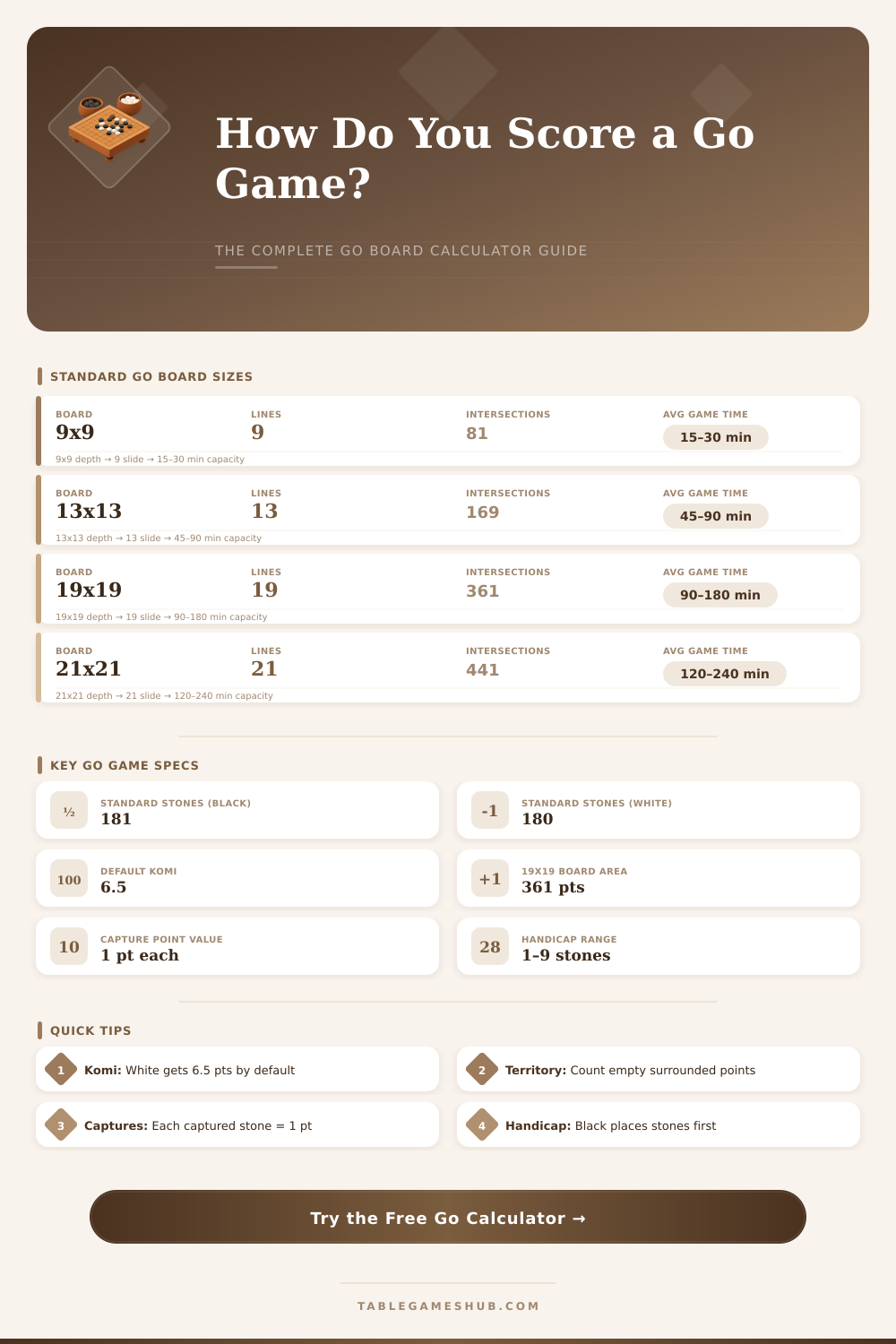
| 19x19 | 361 | 18.5 x 17.0 | 47.0 x 43.2 | 90–180 min | Standard / Pro |
| 21x21 | 441 | 21.0 x 21.0 | 53.3 x 53.3 | 120–240 min | Extended Play |
| Ruleset | Scoring Method | Komi (Even) | Prisoners Count? | Pass Stones? | Used In |
|---|---|---|---|---|---|
| Japanese | Territory | 6.5 | Yes | No | Japan, most of West |
| Chinese | Area (stones+territory) | 7.5 | No | No | China |
| Korean | Territory | 6.5 | Yes | No | Korea |
| AGA | Area or Territory | 7.5 | Yes | Yes (1 pass stone) | USA |
| Ing (SST) | Area | 8 (even) | No | No | Taiwan |
| New Zealand | Area | 7 | No | No | New Zealand |
| Board Size | Black Stones | White Stones | Total Stones | Stone Diameter | Stone Thickness |
|---|---|---|---|---|---|
| 7x7 | 30 | 30 | 60 | 7–8 mm | 3–4 mm |
| 9x9 | 50 | 50 | 100 | 8 mm | 4 mm |
| 13x13 | 100 | 100 | 200 | 20–22 mm | 7–9 mm |
| 19x19 | 181 | 180 | 361 | 22–23 mm | 8–10 mm |
| 21x21 | 230 | 229 | 459 | 22–23 mm | 8–10 mm |
| Setup | Board | Komi | Handicap Range | Time Control | Est. Duration |
|---|---|---|---|---|---|
| Casual Home | 19x19 | 6.5 | 0–9 | None / Clock | 1–3 hrs |
| Club Game | 19x19 | 6.5 | 0–6 | 30 min + 5x1 min byo | 1–2 hrs |
| Tournament Pro | 19x19 | 6.5 or 7.5 | 0 | 3 hr + byo-yomi | 5–8 hrs |
| Online Blitz | 9x9 / 13x13 | 6.5 / 7.5 | 0–4 | 10–30 sec | 5–30 min |
| Teaching Game | 9x9 | 0 or 5.5 | 4–9 | None | 15–45 min |
| Kids / School | 7x7 / 9x9 | 0 | 4–9 | 5–10 min | 10–20 min |
Go is a strategic board game for two players. The main goal is to cut bigger territory than the opponent. It was invented in China more than 2500 years ago.
Many think that it is the most ancient game that folks like today. It enjoys big popularity in China, Korea and especially in Japan Here professional games receive wide attention in newspapers and televised programs.
What is the game of Go?
One plays the game on a board. The standard size is 19×19, although folks commonly choose 9×9, 13×13 or 15×15 for faster games. The players lay their stones on the crossing points of the lines.
The basic idea is to surround empty area and sometimes risk the stones of the opponent to seize them. One deserves to pass, if one does not want to do a move. When both pass one after the otehr, the game ends.
The winner is the one that controls the most squares.
In China one knows Go as Weiqi, while in Korea it is called Baduk. Speakers of English commonly point to Japanese traditions, when they talk about it, and hence the word “Go” stayed in use in that language. The game does not have secret information, so all players can sea the whole board always.
Something truly gripping about Go is the contrast between the simplicity of the rules and the depth of the game. It ranks among the easiest by rules, but the actual strategy is very complex. The amount of possible valid sequences surpass far the number of atoms in the visible universe.
That truly is a thrilling idea.
For newcomers Go can seem a bit more challenging than chess to understand. It requires real practice just to grasp when the game ends and who truly won. Starting with a little board, for instance 5×5, will help anyone that starts.
When one player is more skilled than the other, the stronger takes the whites, and the black gets a handicap, that they both accept. That helps to keep the game fair and fun.
There are many sites to play Go online. Some websites allow games against computers or against folks on various board sizes. Online groups offer chats, game reviews, problems about Go, info about tournaments and lessons.
They welcome players of every level, from full beginners to masters. Some apps include interactive lessons and everyday puzzles called Tsumego in different grades of trouble.
Physical sets for Go are easily found. Some come as compact wooden boards with containers for the stones. Whether one plays online or at an actual table, the game values patient and thoughtful style.
Go belongs to those games, where progress feels like along adventure, and that truly is what makes it so attractive.