🎴 Gloomhaven Stamina Calculator
Calculate turns, rest cycles, loss cards, and exhaustion timing for any Gloomhaven class
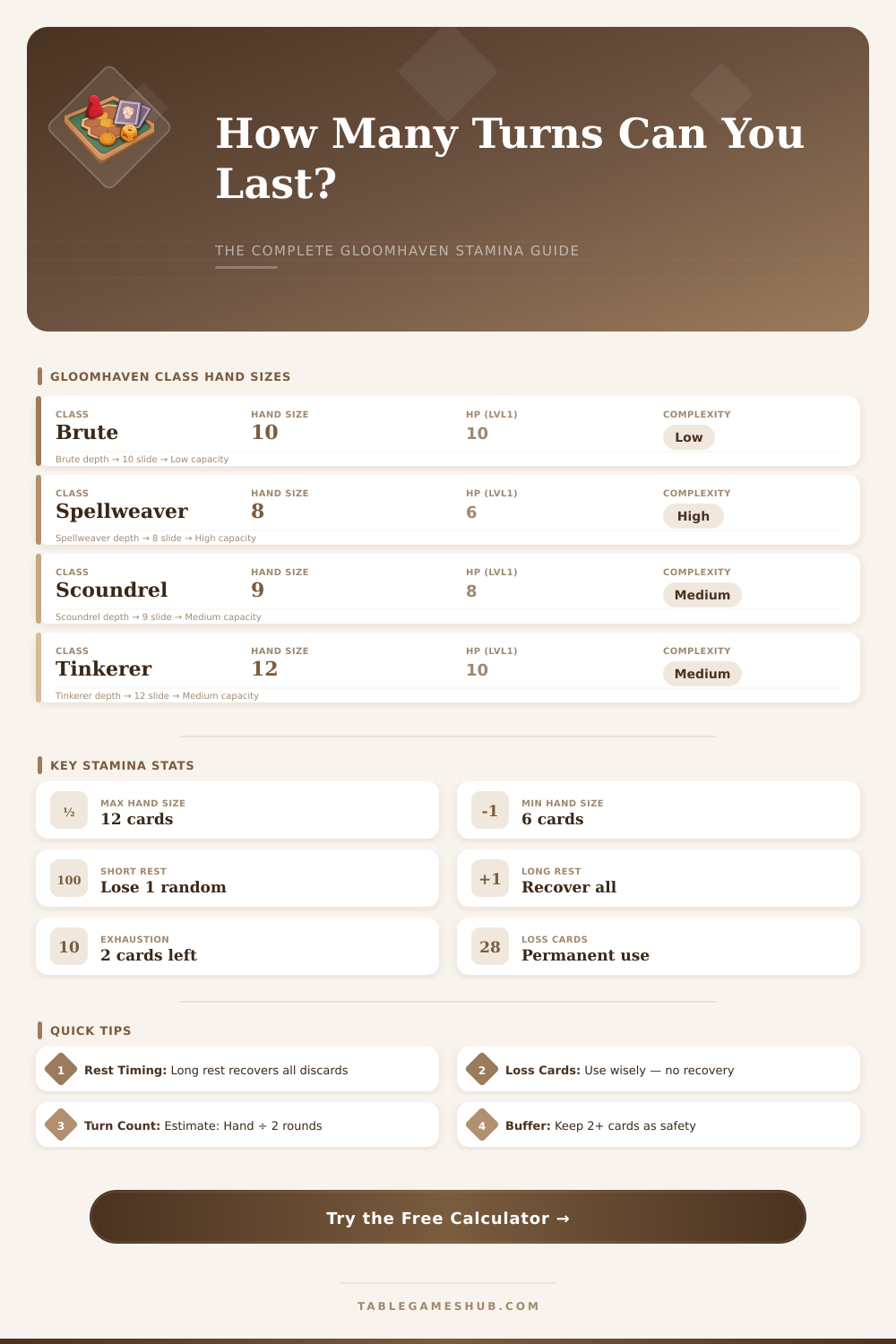
| Class | Hand Size | HP (Lvl 1) | HP (Lvl 9) | Max Turns (No Rest) | Complexity | Avg Game Length |
|---|---|---|---|---|---|---|
| Brute | 10 | 10 | 26 | 4 | Low | 2–3 hrs |
| Spellweaver | 8 | 6 | 18 | 3 | High | 2–3 hrs |
| Scoundrel | 9 | 8 | 20 | 3–4 | Medium | 1.5–2.5 hrs |
| Tinkerer | 12 | 10 | 22 | 5 | Medium | 2.5–3.5 hrs |
| Cragheart | 11 | 10 | 24 | 4–5 | Medium | 2–3 hrs |
| Mindthief | 10 | 6 | 18 | 4 | High | 2–3 hrs |
| Sunkeeper | 10 | 10 | 26 | 4 | Medium | 2.5–3 hrs |
| Quartermaster | 11 | 10 | 24 | 4–5 | High | 2.5–3.5 hrs |
| Sawbones | 10 | 8 | 20 | 4 | Medium | 2–3 hrs |
| Soothsinger | 12 | 6 | 18 | 5 | High | 2.5–3 hrs |
| Diviner | 10 | 6 | 18 | 4 | Very High | 2.5–3.5 hrs |
| Rest Type | Cards Recovered | Cards Lost | HP Gained | Turn Cost | Best Used When |
|---|---|---|---|---|---|
| Short Rest | All discards | 1 random discard | None | None (end of round) | Mid-combat, urgent |
| Long Rest | All discards | 1 chosen discard | +2 HP | 1 full turn | Between rooms |
| Stamina Potion | 2 discards | None | None | None (item action) | Emergency recovery |
| Card Ability | Varies (1–3) | None | Varies | 1 action | Class-specific |
| Hand Size | No Rest | 1 Short Rest | 2 Short Rests | 1 Long Rest | Mixed Strategy |
|---|---|---|---|---|---|
| 8 cards | 3 turns | 5 turns | 7 turns | 4 turns | 6 turns |
| 9 cards | 3–4 turns | 6 turns | 8 turns | 5 turns | 7 turns |
| 10 cards | 4 turns | 7 turns | 9 turns | 5–6 turns | 8 turns |
| 11 cards | 4–5 turns | 7–8 turns | 10 turns | 6 turns | 9 turns |
| 12 cards | 5 turns | 8–9 turns | 11 turns | 7 turns | 10 turns |
Stamina in Gloomhaven twists around how many times a character gets to keep going before running out of cards. The system of cards in hand works as a measure for energy. When a card is in the hand, one can use it.
After cards are lost, the hero is tired out. That system allows every class to have its own style of skills, without need to note that they have limited use, because if the card is in hand one simply plays it.
How Stamina and Potions Work in Gloomhaven
A simple example explains the basic rules about how everything works. A character with 4 cards can do 4 actions. After the first rest stay 3 cards, so 3 more actions.
Rest a second time gives 2 cards for two more actions. Later comes the exhaustion. Use lost cards or those that block damage, and you spend energy more quickly, so timing matters in the game.
There are tools that count how many actions a character has before tiring out. They look at the size of the hand, how many cards already burned early, whether one uses short or long rests and options for recovery. Some of them use casual guessing to show the range of possible results, including the best and the worst situations.
Stamina potions form a big advantage. The Minor and Major Stamina Potions together rank between the most useful items of the game. The Minor Stamina Potion returns 2 dumped cards, while the Major returns 3.
Because the game includes built-in time, skipping such a potion is hardly worth it. It simply adds actions that otherwise wood lack. Some players said that they managed to get 8 cards back only thanks to potions, what seems almost too strong in long adventures.
But the real force does not limit to those extra actions. It means players reuse strong cards to help the team and beat opponents.
The Major Stamina Potion takes the place of a small item and becomes open at Level 4. Items that allow a player to refresh a used item are also strong, especially because they can again bring the Major Stamina Potion for more use.
Here is where everything becomes interesting. The Stamina potions changed in newer games. In Frosthaven and the computer version of Gloomhaven, potions give one fewer cards.
So the Minor gives 1 card and the Major gives 2. A future printing of Gloomhaven will bring a rule that requires players to swap old potions for the weaker versions. However the makers made sure that in the current second printing the original values of Stamina potions stay unchanged.
There is even a setting for the computer game that restores the original values for those wholike them.
Saving lost cards for later use usually matters more, but only if the function stays the same through different times. When a big area-attack also works in the first room or in the final, keeping it makes sense. Even so team makeup and the particular adventure always weigh more than some simple guidelines.