🎲 Gloomhaven Monster Movement Calculator
Determine monster focus, movement path, hex distance, attack positioning, and action outcomes for any scenario
| Monster Name | Move | Attack | Range | HP (Normal) | HP (Elite) | Type |
|---|---|---|---|---|---|---|
| Bandit Guard | 3 | 2 | Melee | 6 | 9 | Walk |
| Bandit Archer | 2 | 2 | 4 | 4 | 6 | Walk |
| Inox Guard | 2 | 3 | Melee | 10 | 14 | Walk |
| Inox Archer | 3 | 2 | 3 | 5 | 8 | Walk |
| Living Bones | 3 | 2 | Melee | 6 | 10 | Walk |
| Living Corpse | 2 | 2 | Melee | 8 | 13 | Walk |
| Vermling Scout | 4 | 2 | Melee | 4 | 7 | Walk |
| Earth Demon | 2 | 3 | Melee | 9 | 14 | Walk |
| Flame Demon | 3 | 2 | 3 | 7 | 11 | Walk |
| Night Demon | 3 | 2 | Melee | 7 | 11 | Walk |
| Frost Demon | 3 | 2 | 3 | 6 | 9 | Walk |
| Ooze | 1 | 2 | Melee | 5 | 7 | Walk |
| Cave Bear | 4 | 3 | Melee | 11 | 16 | Walk |
| Giant Viper | 4 | 2 | Melee | 5 | 8 | Walk |
| Hound | 4 | 2 | Melee | 5 | 7 | Walk |
| Movement Type | Obstacle Handling | Trap Handling | Difficult Terrain | End Hex Rules |
|---|---|---|---|---|
| Walk (Normal) | Cannot pass through | Triggers on entry | Costs 2 hexes | Must be unoccupied |
| Flying | Can fly over freely | Not triggered mid-path | No extra cost | Cannot end on obstacle |
| Jump | Can jump over | Not triggered mid-path | No extra cost mid-path | Cannot end on obstacle |
| Priority | Condition | Tiebreaker Rule | Notes |
|---|---|---|---|
| 1st | Fewest hexes moved to attack | Lowest initiative card | Primary focus rule |
| 2nd | Shortest total path distance | Lowest initiative card | If movement equal |
| 3rd | Closest proximity | Lowest initiative card | If path equal |
| 4th | Player chooses (tie unbroken) | N/A | Rare edge case |
| Scenario Level | Trap Damage | Gold Conversion | Bonus XP | Monster HP Scale |
|---|---|---|---|---|
| Level 0 | 2 | 2g each | +0 | ×0.75 |
| Level 1 | 3 | 2g each | +1 | ×0.88 |
| Level 2 | 3 | 3g each | +2 | ×1.00 |
| Level 3 | 4 | 3g each | +2 | ×1.13 |
| Level 4 | 4 | 4g each | +3 | ×1.25 |
| Level 5 | 5 | 4g each | +3 | ×1.38 |
| Level 6 | 5 | 5g each | +4 | ×1.50 |
| Level 7 | 6 | 5g each | +4 | ×1.63 |
Monsters in Gloomhaven often are hard to control well. Only during its turn a monster can move, if the drawn card has a move action. When the card does not show move, the monster simply stays there where it is.
The same happens with attack: without mention of attack, it does not attack. Every round one draws one card for the kind of monsters, and they do exactly that, what is written on the card, from the top to the bottom, without extras.
How Monsters Move in Gloomhaven
The drawn card can show changes like “Move -1, Attack +1”, that apply to the base stats of the monster during that round. Other cards include separate effects, for instance that of the Undead, that orders “Move +1, paralyse and confuse one next enemy“.
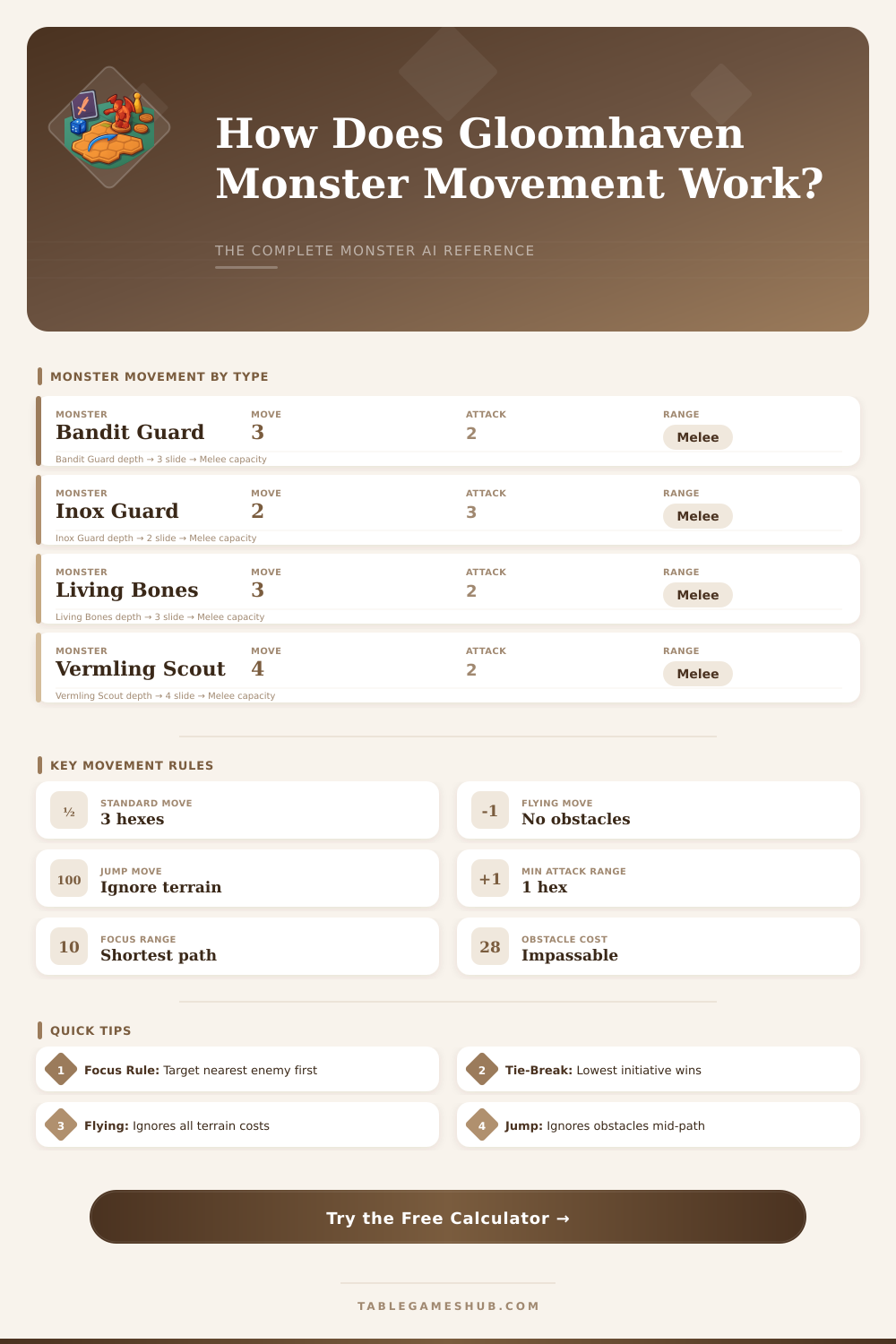
Before the move of a monster, it first chooses focus. Focus means one clear enemy, that it wants to reach and attack. Monsters always choose teh enemy, that they can reach by means of the least move.
This counts even if the monster truly does not have enough move points to arrive there. To find the focus, one assumes, that the monster has endless motion, to find the ideal hex, from which it could attack. Then it moves as close to that hex, as far as its real move allows.
It must always end its move closer to that target hex than at the start.
When monsters choose their path, they treat bad hexes like traps and dangerous areas as obstacles. They prefer safe steps of any distance rather then ways with bad hexes. Even longer safe steps are always preferred over shorter, but risky ones.
All bad hexes count the same… A trap with one damage counts the same as one with five damage and wound. Even a trap, that heals, still counts as bad for monsters.
Monsters pass through such hexes only when there is absolutely no other way to arrive at the target.
Monsters with range act a bit different. If it has ranged attack, it moves only to a hex, where it stays in range for the strongest possible attack. A ranged monster, that stands right beside an enemy, will use the smallest number of spaces, to escape to lose the advantage.
In short, the monsters of Gloomhaven are very strict about this.
When two possible focus targets are equally far by move, one uses tiebreakers in the game. The enemy in the least range from the starting spot of the monster wins. If it still ties, the one with the lowest effort gets the focus.
If after all this stays tied, the playerschoose themselves.
Learning Monster Movement well is truly important. Planning around how enemy moves can pull monsters into traps is one of the rewards for managing the systems of the game well.