Giant Jenga Block Size Calculator
Size each block, plan the layer count, add kerf and sanding allowance, estimate total stack height, and check finished material weight.
| Set style | Finished block | Common layers | Starting height | Best use |
|---|---|---|---|---|
| Tabletop giant | 6 x 2 x 1.2 in | 15 to 18 | 18 to 22 in | Indoor table play |
| Classic yard | 7.5 x 2.5 x 1.5 in | 18 | 27 in | General backyard use |
| Bar set | 8 x 2.67 x 1.6 in | 18 | 29 in | Pub or patio tables |
| Large lawn | 10.5 x 3.5 x 1.5 in | 18 to 20 | 27 to 30 in | Outdoor groups |
| Event oversize | 12 x 4 x 2 in | 18 to 24 | 36 to 48 in | Supervised events |
| Material | Typical density | Feel | Durability | Weight note |
|---|---|---|---|---|
| Cedar | 23 lb/ft³ | Light | Outdoor friendly | Easy to carry |
| Pine | 30 lb/ft³ | Medium light | Good all-rounder | Common DIY choice |
| Spruce/Fir | 28 lb/ft³ | Medium light | Soft edges | Sands quickly |
| Poplar | 35 lb/ft³ | Medium | Smooth pulls | Noticeably denser |
| Oak | 44 lb/ft³ | Heavy | Very durable | Use lower heights |
| Cutting setup | Kerf per cut | Sanding per face | Rough length add | Use when |
|---|---|---|---|---|
| Fine miter blade | 0.094 in | 0.020 in | 0.040 in | Smooth boards |
| Standard circular blade | 0.125 in | 0.030 in | 0.060 in | Most DIY sets |
| Rough lumber cuts | 0.140 in | 0.050 in | 0.100 in | Twisted stock |
| Heavy roundover | 0.125 in | 0.080 in | 0.160 in | Kid-friendly edges |
| Play setting | Starting height | Stop height | Block weight | Supervision note |
|---|---|---|---|---|
| Kids low stack | 18 to 24 in | 36 in | Under 0.6 lb | Close supervision |
| Family yard | 24 to 30 in | 48 to 60 in | 0.6 to 1.1 lb | Clear fall zone |
| Adult party | 30 to 36 in | 60 to 72 in | 1.0 to 1.8 lb | Flat surface only |
| Event display | 36 to 48 in | 72 in | 1.5 lb plus | Managed area |
Small blocks make a lighter set, shorter starting tower, and easier storage. Use a lower layer count for tabletop play.
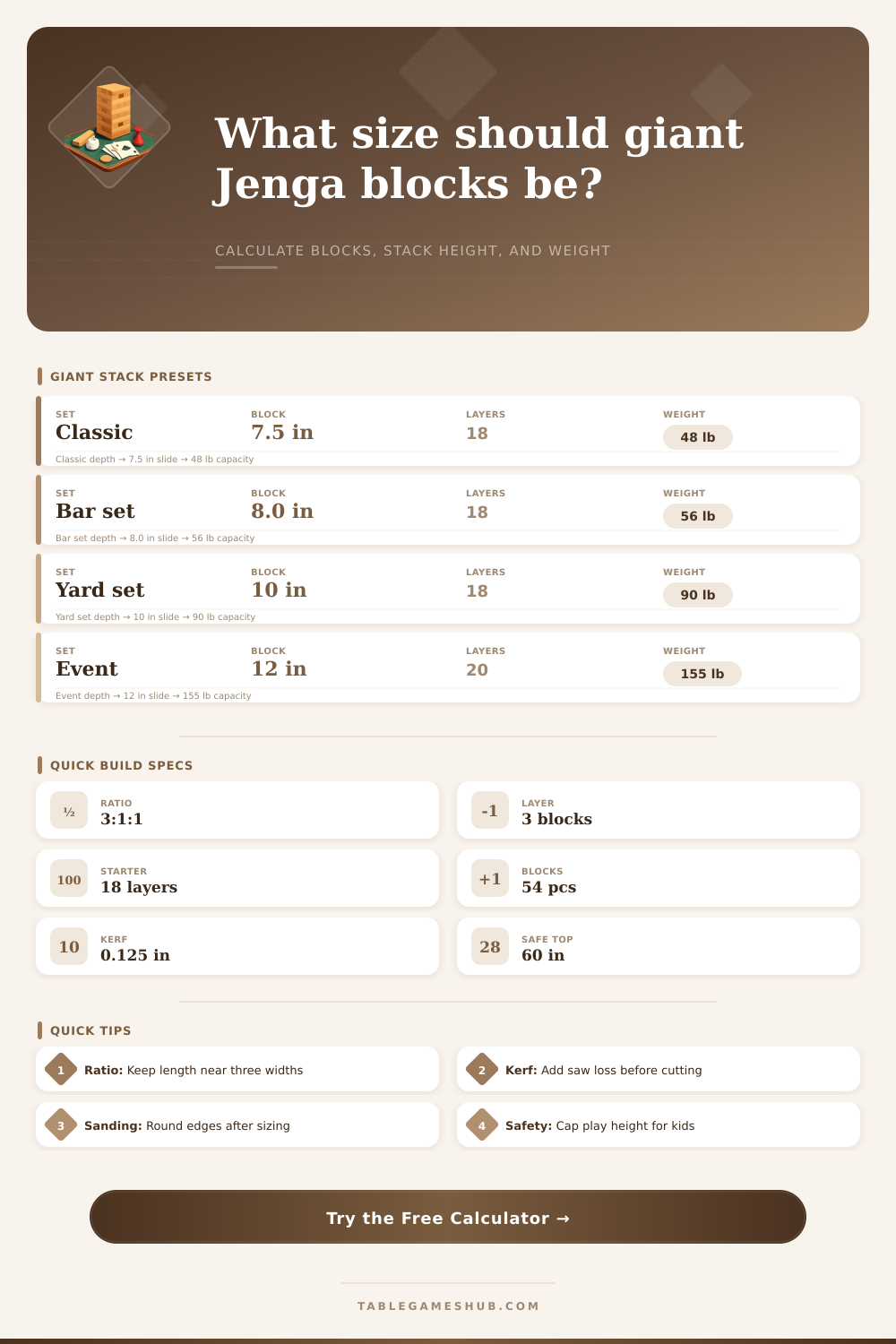
A 3:1 length-to-width block with 18 layers keeps the familiar pull feel while staying manageable outdoors.
Extra layers raise the starting tower fast. Check stop height because play height can exceed the starting height by a lot.
Dense hardwood improves durability but adds impact weight. Keep corners rounded and stop play earlier.
Building an giant Jenga set requires a decision to be made about the dimensions of each Jenga block. The dimensions of each block will determine in what way the giant Jenga set will functions. For example, the size of each block will determine whether the giant Jenga set feel solid, the size of each block will determine the maximum height of the towers, and the size of each block will determine whether the weight of the set is light enough to carry.
Many peoples will attempt to use the lumber that is available to them. However, using available lumber may result in a Jenga tower that is wobbly or tips too early. The ratio between the length of each Jenga block and its width is another critical factor in building the giant Jenga set.
How to Choose Block Size, Wood, and Height for a Giant Jenga Set
The ratio for Jenga blocks is three times as long than the block is wide. This dimension ensures that each layer of blocks forms a square footprint. A square footprint will ensure that the blocks lie flat on the layer below them.
An incorrect ratio for the length and width of each block may cause the layers to either become twist or form overhangs in relation to the block beneath them. These overhangs will make it more difficult to build a succesful giant Jenga set. However, the calculator that comes with this project will help you determine the dimensions of each block.
This calculator will help you avoid guessing whether a specific length will work with a specific width. The density of the wood will determine the total weight of the giant Jenga set. The weight may also impact how the Jenga set feel when moved.
If you use pine and spruce for the set, then the wood will be of a mid-range density. The woods is light enough to carry but has enough stability when the Jenga set becomes very tall. However, cedar is a lighter wood than pine and spruce.
Using cedar will make it easier to move the giant Jenga set but may make the blocks feel too light once the set is partially built. Hardwoods such as oak are durable but will make the blocks heavier and the sound of a block falling loud. Additionally, the amount of moisture in the wood can affect the density of the wood.
Moisture will change the weight of the wood and may also impact how the giant Jenga set handles the wood. Another variable to consider is the kerf and sanding allowance of the wood. These will determine whether you have enough wood for your giant Jenga set.
Every time the saw cuts the wood, the saw removes a strip of wood called the kerf. Additionally, sanding the wood will remove additional wood from the surface. If you do not account for the kerf and sanding of the wood, you may not have enough wood to complete your project.
However, the calculator will separate the kerf and sanding allowance to show you how much additional wood you will have to purchase for your giant Jenga set. The saw blade for the wood may change the kerf. A different kerf in the wood will change how much wood you will need to purchase for your project.
The height of the giant Jenga set is another important factor. A low height will make the giant Jenga set easier for the children to play with. Additionally, the game will move at a quicker rate with a lower height.
However, a tall giant Jenga set will allow for more drama when a block falls but will also create more momentum in the falling direction. You can preset the safety height for the giant Jenga tower in the calculator prior to cutting the wood. This will tell you if the height of your giant Jenga tower will remain within your desired height.
The calculator will also allow you to preset the estimated height for playing with the giant Jenga set. The estimated height is usually taller then your starting height of the blocks. A mistake may be made building the giant Jenga set if the builder does not understand how each dimension may impact the other dimensions of the project.
For example, changing the height of the blocks will change the total weight of the tower. Additionally, adding more layers without considering the safety height of the tower could become a hazard for the players when a block falls. The reference tables will allow you to see how others has balanced these factors.
Another factor that may impact the building of the giant Jenga set is the environmental factors of where it will be played. For example, grass that is not even may cause the base of the Jenga tower to shift. Additionally, the sun and rain that may fall on the wood over time will impact the structure of the wood.
These factors will require the sanding of the blocks again after several month of playing with the giant Jenga set. Additionally, the edges of the blocks should be rounded to reduce the number of splinters on the blocks. Rounded edges will also make it easier to remove the blocks from the giant Jenga tower.
A successful giant Jenga set will be one in which each block sits square to the layer below it and the total weight is easy to manage. You can also see the success of the set in the height of the tower remaining within the parameters you set for yourself building the set. The calculator will remove the guesswork of building the giant Jenga set and allow the creator to focus on the factor that will impact how the Jenga set will be played.