⏰ Board Game Sand Timer Calculator
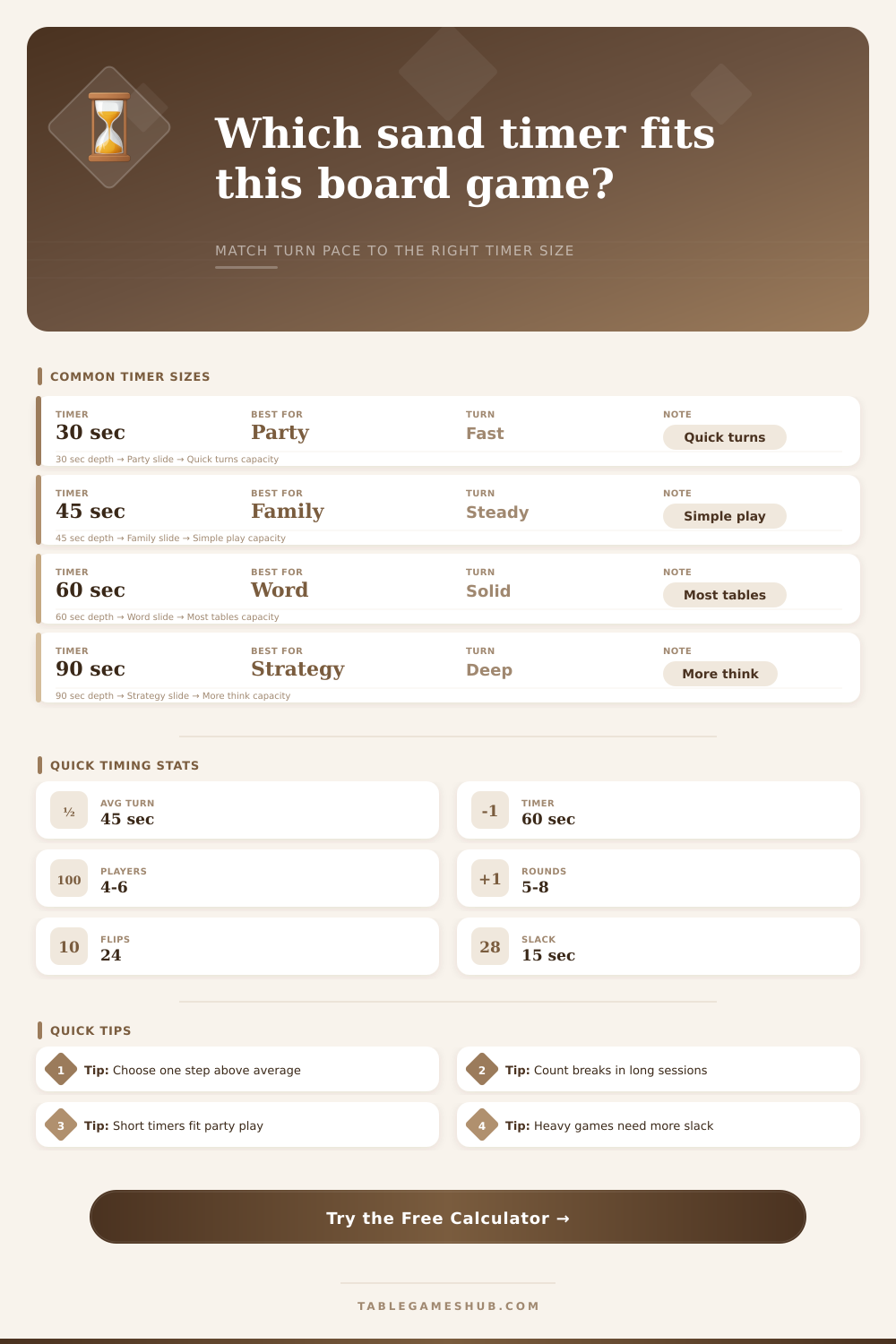
Match turn pace to the right sand timer, then estimate total table time, flip count, and session slack.
📍Timer Presets
⚙Timer Inputs
📈Result Summary
📊Full Breakdown
| Measure | Value | Formula | Read |
|---|
🎯Sand Timer Component Grid
📐Reference Tables
| Timer | Best for | Average turn | Notes |
|---|---|---|---|
| 30 sec | Party play | 10-25 sec | Fast and loud |
| 45 sec | Family play | 20-35 sec | Easy default |
| 60 sec | Word and trivia | 30-50 sec | Most flexible |
| 90 sec | Light strategy | 45-75 sec | More planning |
| 2 min | Thinky turns | 75-110 sec | Safer buffer |
| 3 min | Negotiation | 90-180 sec | Conversation heavy |
| 5 min | Deep games | 2-4 min | Very roomy |
| 10 min | Marathon play | 4+ min | Rarely needed |
| Game style | Typical timer | Turn pace | Table read |
|---|---|---|---|
| Party | 30-45 sec | Quick | Keep it moving |
| Family | 45-60 sec | Steady | Most seats fit |
| Word | 45-60 sec | Clue based | Short bursts |
| Trivia | 30-60 sec | Answer fast | Low downtime |
| Strategy | 90-120 sec | Thoughtful | Plan ahead |
| Negotiation | 2-3 min | Talk heavy | Allow table talk |
| Kids | 15-30 sec | Very quick | Short attention |
| Heavy | 3-5 min | Deep | Big decisions |
| Slack band | Fit | Flip use | Read |
|---|---|---|---|
| -30 sec or less | Too short | Multiple flips | Timer is tight |
| -15 sec | Short | 2 flips | May rush turns |
| 0 to 15 sec | Balanced | 1 flip | Good match |
| 15 to 45 sec | Comfortable | 1 flip | Room for thought |
| 45 to 90 sec | Loose | 1 flip | Slow but safe |
| 90 sec+ | Very loose | 1 flip | Much more slack |
| Under 1 min | Fast pace | 1-2 flips | Party style |
| 3 min+ | Deep pace | 1 flip | Heavy session |
| Players | Rounds | Session time | Use case |
|---|---|---|---|
| 2 | 5 | Short | Duel or head-to-head |
| 3 | 5 | Medium | Fast set |
| 4 | 5 | Standard | Most board games |
| 5 | 6 | Long | More discussion |
| 6 | 6 | Longer | Party nights |
| 4 | 10 | Very long | Deep session |
| 6 | 10 | Marathon | Extended table |
| 8 | 8 | Huge | Big crowd game |
💡Tips
Pick the next timer up
If average turns flirt with the timer limit, move to the next standard size so the table does not feel rushed.
Add round overhead honestly
Small resets add up fast, so include score checks, shuffles, and cleanup when you estimate the full session.
This board game sand timer calculator matches turn length to a timer size, estimates full session time, and shows when a longer timer will keep play moving.
Sand timers is tools that are used in board games to manage the time allotted for each turns. The sand timer help to regulate the pace at which players has to complete each turn. Sand timers allow sand to fall through a narrow opening.
The amount of sands remaining in the sand timer provide visual representations of the time remaining for that turn. If a sand timer is set to be to short for each turn, it may make the players feel rushed as they are unable to complete their require tasks for that turn. However, if a sand timer is set to be too long for each turn, the energy created during the games may decrease.
Pick the Right Sand Timer for Your Game
In this situation, it is important for a game’s organizer to choose a sand timer that best match the needs of that game and its players. To determine the appropriate sand timer for a game, it is first important to determine the lengths of a single turn. A turn may include reading a card, discuss a move, or sketching a clue.
Each of these activities should be accounted for when calculating the length of a turn. Additionally, the number of players and rounds for the game should also be considered. For instance, party games may have short sand timers of 30 second each as the games usually take place rapidly.
However, long sand timers of 90 seconds may make party games lose some of they energy. On the other hand, family games usually require a medium length sand timer as they need to include some steady turn but not too many as it may make them paralyzed in making decisions. Other time should also be accounted for when using sand timers: overhead time.
Overhead time include any time spent for resets, score tallies, or breaks. The game might last longer than initially planned with these breaks. Games that include negotiations may require more time than others as there may be extra conversation during the game.
Positive slack refers to the extra time for a player to check a rule or have a second thought about the action they are taking. However, negative slack means the sand timer have to be constantly flipped as there is not enough time for a player to think through their actions. The slack required for sand timers can differ according to the size of the group.
For instance, a game for six players will have tighter sand timers than a game for four player. Some mistake that can occur when players use sand timers include underestimating the length of a turn. Players may forget that the length of a turn include possible rule questions or do-overs.
Another mistake is ignoring the dynamics of the players. One player that may take longer to make a decision may impact the length of turn of others in the game. Time should be provided for these different type of players.
Additionally, the environment for the game should also be considered. For instance, loud groups may enjoy short sand timers while quiet groups may need more time to avoid uncomfortable silence during the game. The use of a sand timer can be adjusted according to the type of players that will play the game.
For instance, children usually have short attention span so short sand timers are best for them. Players in negotiation games may need longer sand timers so as not to ruin any alliances that have been made. However, players in bluffing games may prefer a one minute sand timer so that there is enough time for the players to bluff appropriately.
Additionally, the sand timer can be adjusted during the game, especially for the first game played with a new sand timer. If the players feel that the sand timer is not correct for the game, it can be adjusted during play.