Flamecraft Buildings Calculator
Total a Flamecraft town from shop enchantments, artisan dragon placement, fancy dragon cards, goods, companion dragons, reputation, building abilities, and endgame scoring bonuses.
1Flamecraft Building Presets
Load a recognizable town state, then adjust the building mix, dragon cards, stored goods, reputation, and endgame rows to match your final score sheet.
2Building Score Inputs
3Flamecraft Spec Grid
4Reference Tables
| Profile | Use when | Shop value | Ability note |
|---|---|---|---|
| Balanced town | Several shop types score | 4 per building | Moderate building ability lift |
| Artisan lane | Many artisan dragons are placed | 3 per building | Artisan density adds late value |
| Enchantment market | Enchantments drive the score | 3 per building | Highest enchantment multiplier |
| Fancy plaza | Fancy dragon cards define the endgame | 3 per building | Fancy cards get a stronger estimate |
| Goods square | Leftover goods are unusually high | 2 per building | Goods conversion is emphasized |
| Companion route | Companion dragons and gifts matter | 3 per building | Companion row carries the bonus |
| Dragon line | Calculator input | Modeled value | Check before recording |
|---|---|---|---|
| Artisan dragons | Placed in buildings | 1-2 points each by profile | Do not count dragons still in hand as placed artisans. |
| Fancy dragons | Endgame scoring cards | 4-6 points each by profile | Use printed card scoring first if it is known. |
| Companion dragons | Companion and ability row | 0-22 point package | Count each companion once even if several abilities trigger. |
| Festival cluster | Companion route plus gifts | 14 point package | Best for towns that converted gifts late. |
| Band | Goods or coins | Reputation track | Score interpretation |
|---|---|---|---|
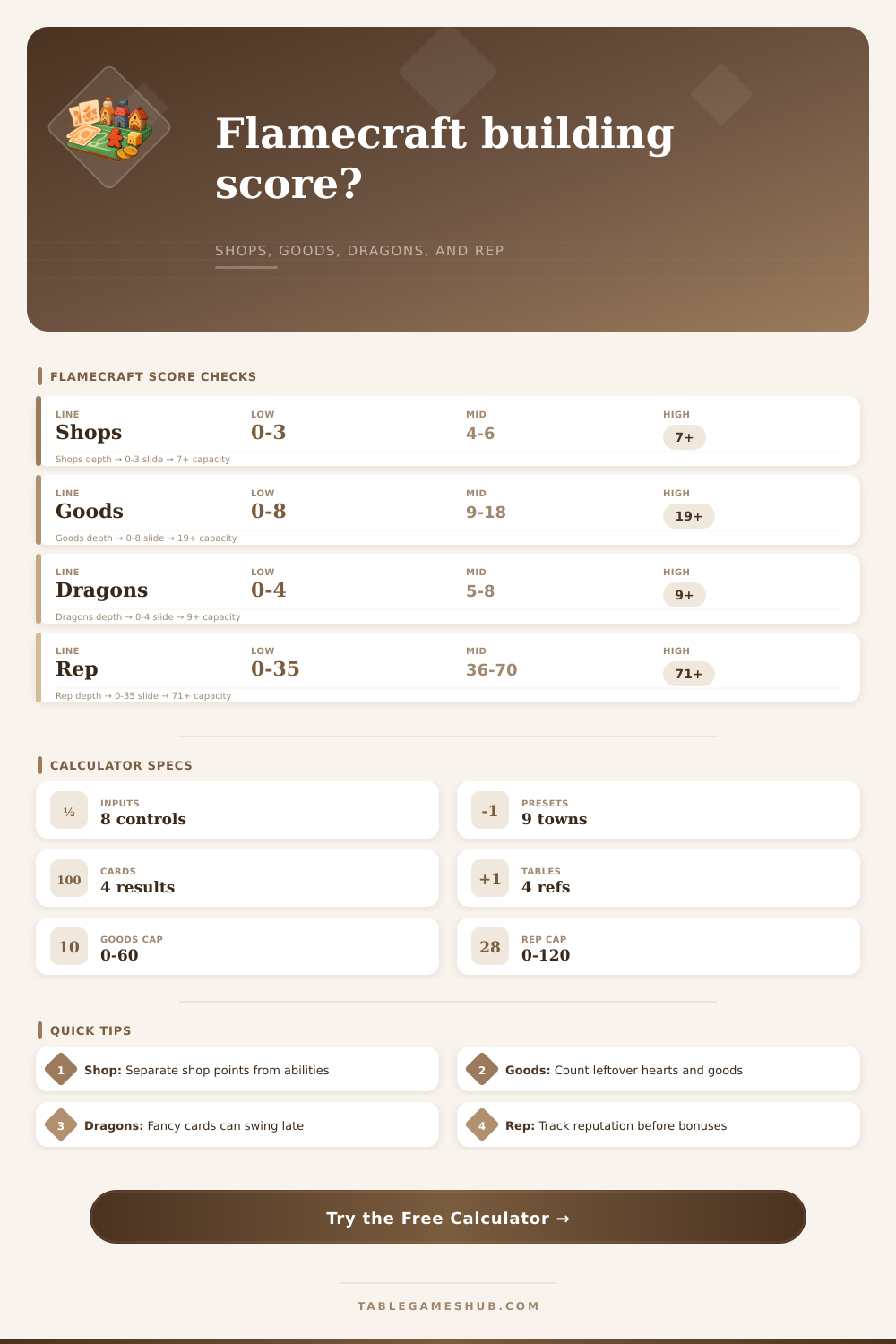
| Starter hearth | 0-8 leftovers | 0-35 reputation | Most points should come from buildings or dragons. |
| Busy market | 9-18 leftovers | 36-70 reputation | Balanced score with a healthy shop engine. |
| Overflow stall | 19-32 leftovers | 71-95 reputation | Goods conversion can swing the final total. |
| Festival finish | 33+ leftovers | 96+ reputation | Confirm caps and avoid double-counting bonus goods. |
| Building focus | Common goods | Best matching preset | Endgame watch |
|---|---|---|---|
| Bread Bungalow | Bread and coins | Bread Bungalow Hearth | Low goods can still score if enchantments landed. |
| Iron Anvil | Iron and gems | Iron Anvil Artisan Row | Artisan placement matters more than leftovers. |
| Crystal Cavern | Crystals | Crystal Cavern Fancy Stack | Fancy cards should be audited one by one. |
| Potion Parlor | Potions and plants | Potion Parlor Enchant Chain | Enchantment totals drive the shop score. |
| Coin Foundry | Coins | Coin Foundry Reputation Climb | Track reputation before adding endgame bonuses. |
5Scoring Tips
Keep the building row clean. Record printed shop points, enchantment points, and ability bonuses as separate lines so the same building never gets counted twice.
Audit dragon cards last. Artisan, fancy, and companion dragons often overlap in theme, but they score from different rows; enter each group once before adding reputation.
In Flamecraft, running a town is less about building things and more about managing an orchestra where every instrument want to play a solo. There are piles of goods accumulating faster than you can sell them; there are dragons demanding special jobs; and there are shops that require magical enchantments. And by the final round, when it all comes together, your score sheet will resemble nothing so much as a frantic scramble of half-forgotten bonuses and scribbled-upon numbers.
How do you make sense of this chaos and translate it back into a solid number without sacrificing your sanity. Or your ability to compete?
How to Calculate Your Score in Flamecraft
That’s where the buildings come in to play for the first layer of scoring; not all shops score the same way. And it’s not just the number of shop you have. What kind of shops do they have? If you’ve been focusing on getting spells for your enchantment market profile, then you know those enchantments realy add up. Every one of them will contribute far beyond a single shop point because of the multiplier.
This calculator breaks apart the layers of scoring so you can see precisely how much each building type contributes vs. Other sources. For example, if you specialize in a certain lane (either for a balanced approach or some kind of specialization), we applies the appropriate modifier to the raw build numbers.
The game gets complicated when we get to the dragons, which have many uses. Fancy dragons in your hand give you points directly; artisan dragons in your shop boost your building engine; and companion dragons interacts with both your gifts and your ability rows (another level of complication!). Without a way to track this, it’s very easy to double count these resources. The tool separates dragon values into separate categories: fancy cards, artisan dragons, and companion packages. Since dragons contributes in unique ways, we can value them based off what they provide.
For example, having a lot of artisan dragons isn’t necessarily great for an endgame score if you don’t have a good fancy dragon hand.
All of this rests on the foundation of goods and reputation. These goods turn into points at a steady rate, but your real strength comes from how you use them to build your reputation. Ninety rep points makes a big difference to a town compared to thirty: not only does it look different in the final tally, but it also unlocked more opportunities along the way. Looking back at the leftover goods can tell you where you fell short and spent less than ideally… Whether that was a wasted opportunity or if you had an efficient conversion rate. Use the reference tables on this page to see what the bands mean for your leftover goods and whether you missed chances to spend early. Or do you have a good conversion rate?
The other thing that many people mess up on is ignoring building abilities until last minute. You have to track these during the game, not just at the end. This lets you trigger them correctly. Doing so could of swing a twenty point difference one way or the other. The calculator has built-in preset scenarios for typical town states, so you can see how various ability triggers affects your total before you commit to a final count. This will come in handy especially when making decisions about whether to do a festival cluster versus a companion route, where the bonus structure is quite different than.
Knowing how it works isn’t as important as being disciplined about scoring. Print out all your points, abilities, enchantments, ability bonuses, and so forth. Then write them down on different lines so they don’t overlap. Finally, check your dragon cards last (ensuring that artisans, fancy dragons, and companions aren’t being counted in each other’s categories). Give the calculator a set of clear inputs (separate numbers for every category) and let it do the math for you; there’s no need to hold a dozen variables in your head at once.
A high score in this game isn’t a matter of blind luck; it’s a result of good planning. Does that mean climbing your way up the reputation ladder? Does it mean flooding the streets with goods? It doesn’t really matter: How do your resources line up with your dragons’ placement? How does what you’re doing match up with which buildings you choose? That’s what makes the whole thing click, and what this tool does so well, it shows you how all the parts fit. Instead of a jumbled mess at the end, it becomes an inspection of your own actions. What worked out? Where did the points come from? With that knowledge, you can plan better going forward to your next town.