Roll for the Galaxy Ambition Calculator
Audit an Ambition-era position by combining faction or home world profile, dice phase pressure, developments and worlds, goal tiles, credits, VP chips, and the likely end trigger.
Load a specific late-game shape, then adjust the eight scoring inputs to match the tableau and chip pile on your table.
| Phase emphasis | Best when | Tempo factor | Calculator meaning |
|---|---|---|---|
| Explore cash and tile search | You need credits or one last scoring tile | 0.85 per die | Increases flexibility and lowers stall risk. |
| Develop pressure | Your hand has high-VP developments ready | 1.15 per die | Pushes the 12-tile trigger while adding printed VP. |
| Settle and world placement | Worlds or military discounts are the clearest points | 1.10 per die | Scores through worlds and accelerates tile count. |
| Produce goods setup | Goods are needed before a large consume turn | 0.95 per die | Builds the next VP chip burst instead of scoring now. |
| Ship consume and VP chips | Your goods engine can convert dice into chips | 1.35 per die | Raises chip pressure and can threaten the VP pool trigger. |
| Mixed wild dice coverage | You are splitting dice across uncertain phases | 1.00 per die | Balanced read for joker dice and flexible reassignment. |
| Profile | Engine lean | Credit posture | Ambition watch |
|---|---|---|---|
| Galactic Reserves | Flexible reassignment | Comfortable | Can pivot between goal and chip pressure. |
| Alien Research Team | High development value | Hungry | Variable developments should be audited carefully. |
| Doomsday Economy | Credit burst turns | Strong | Credits may hide a sudden final tile push. |
| Rebel Miners | Settle and ship | Moderate | World-heavy goals often decide the final margin. |
| Imperium Lords | Military worlds | Lean | Count world VP before assuming strength is score. |
| Trade League | Ship consume | Stable | Chip pressure can end the game before tile twelve. |
| Goal line | Common source | Typical VP | Calculator entry |
|---|---|---|---|
| First placement | Race-style milestone | 3 VP | Add to goal tile VP once claimed. |
| Most condition | End-state majority | 5 VP | Add only if still held at the audit point. |
| Chip award | Ambition bonus chip | 1-3 VP | Add chips to VP chips, not goal tile VP. |
| Shared tie | Equal condition | Varies | Use the table agreement for split awards. |
| Trigger read | Tile count | VP chips | What to audit |
|---|---|---|---|
| Build | 0-8 tiles | Low chip pile | Score engine and goal route, not end timing. |
| Close | 9-11 tiles | Medium pile | Check if the next develop or settle ends the game. |
| 12 tiles | 12 or more | Any pile | Final score immediately after the round resolves. |
| VP pool | Any count | Pool thin | Ship and goal chip awards may be decisive. |
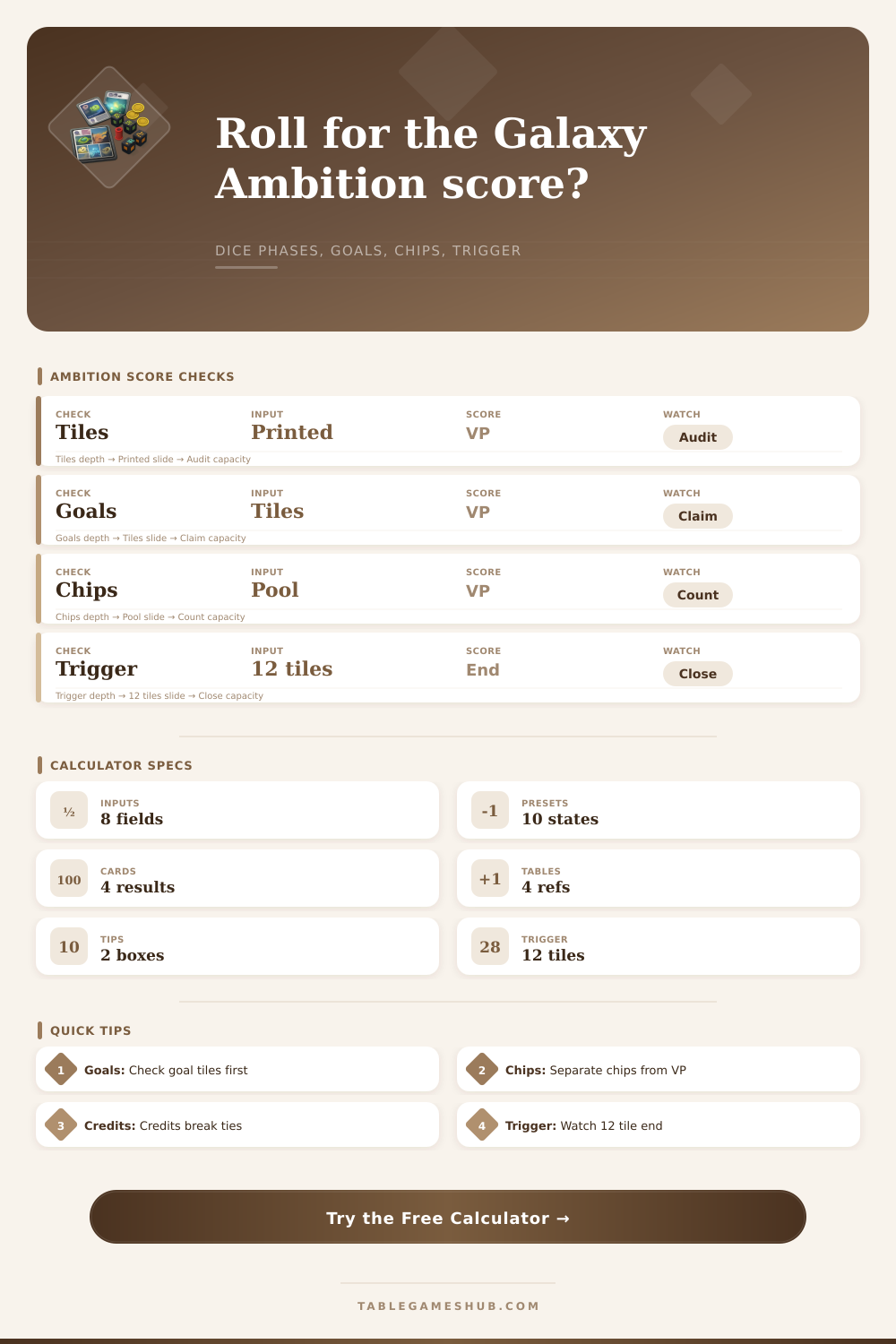
Separate score types. Put printed development and world VP in the tile field, Ambition goal awards in the goal field, and consume awards in VP chips.
Audit the trigger before the last phase. If you are at 10 or 11 tiles, one develop or settle phase can end the game before another ship turn pays out.
Roll for the Galaxy: Ambition is when games is won or lost. Eventually, you hit a sweet spot with your engine running like clockwork, churning out credits constantly, but twelve-tile limit is a ticking clock to watch out for. Now you’re no longer just building; you’re harvesting. Enter the calculator. Plug in state of your board and let the calculator do the work.
No longer need to guess whether to push for one last development or cash out on VP chips now. Instead it encourages consideration of whole board rather than just what’s in your hand. Players tend to over-analyze what happens in their current turn while underestimating how each action influence the final conditions of game. A player may hold a highly useful world card that they place at exactly wrong time, causing era to close before they can acquire any goal tile. So now that card is wasted.
How to Use the Game Calculator
The tool divides your VP into printed points, your goal awards, and your chip reserves. These differences are important because these values is based off different game phases with varying degrees of risk. The value of those tiles never changes (it’s a point you’ve locked down). And the value of those chips will vanish unless the game last long enough to draw them.
Finally, think about dice pressure. The calculator asks which phase your dice are targeting. It’s more than admin; it measures tempo. When you fire a lot of dice to the Ship phase, you’re chasing chips. That carries big reward but low safety. You are gambling that this game won’t end before you pick up your payout. Each phase is assigned a tempo factor in the reference table. It indicate how aggressively you play versus the risk of getting stopped too soon.
This is where faction identity comes in too. With a Galactic Reserves, for example, you’ve got more options than other players. If the board changes, they can shuffle their dice. For an Alien Research Team, they might be hogging high-value developments, but they’re burning credits to do it. These profiles aren’t directly additive; the calculator doesn’t add points here. Instead, it notes them to help you understand what shape your engine take and how healthy it may be. Are you fast but fragile? Are you rich but slow? That will tell you whether you can take a chance on something or should of hunkered down.
The wild card is goals. You might be sitting on ten points of unclaimed goal awards. While your opponent may be ahead of you on tile victory points, they could be sitting with ten points of unclaimed goal awards. That is a lead that could easy develop. The tool lets you input your goals separately so you don’t forget them in final tally. Until the very last second, it’s easy to forget about a goal, then have someone swoop in and claim it while you were distracted by your hand. Early checks of your goal pressure will avoid such mistakes.
What about credits? Credits aren’t points; they’re choices: You have five credits in reserve, and now you can respond to what your opponent does or purchase a discount. Flexibility masquerading as currency. We track them on the calculator so that you know what all of your resources are at any given time, not just your score.
Lastly, keep an eye on the end trigger. Does it tell you if adding a tenth tile means one more development ends game? Or does it remind you that at eight tiles, you still have room to breathe? How far are you from that dreaded twelve-tile limit? The tool tells you. It reminds you that this is the age of timing out. You’re trying to squeeze as much value from each turn but don’t snap the timer closed too soon.
It is not about one perfect play, but about knowing how to weigh risk versus reward. The calculator gives us information; we make choices. Count out your chips. See what tiles you’ve got. Consider your goals. Are you building long-term or taking a chance? That’s where the great player sets himself apart from good.