Drop Highest Dice Calculator
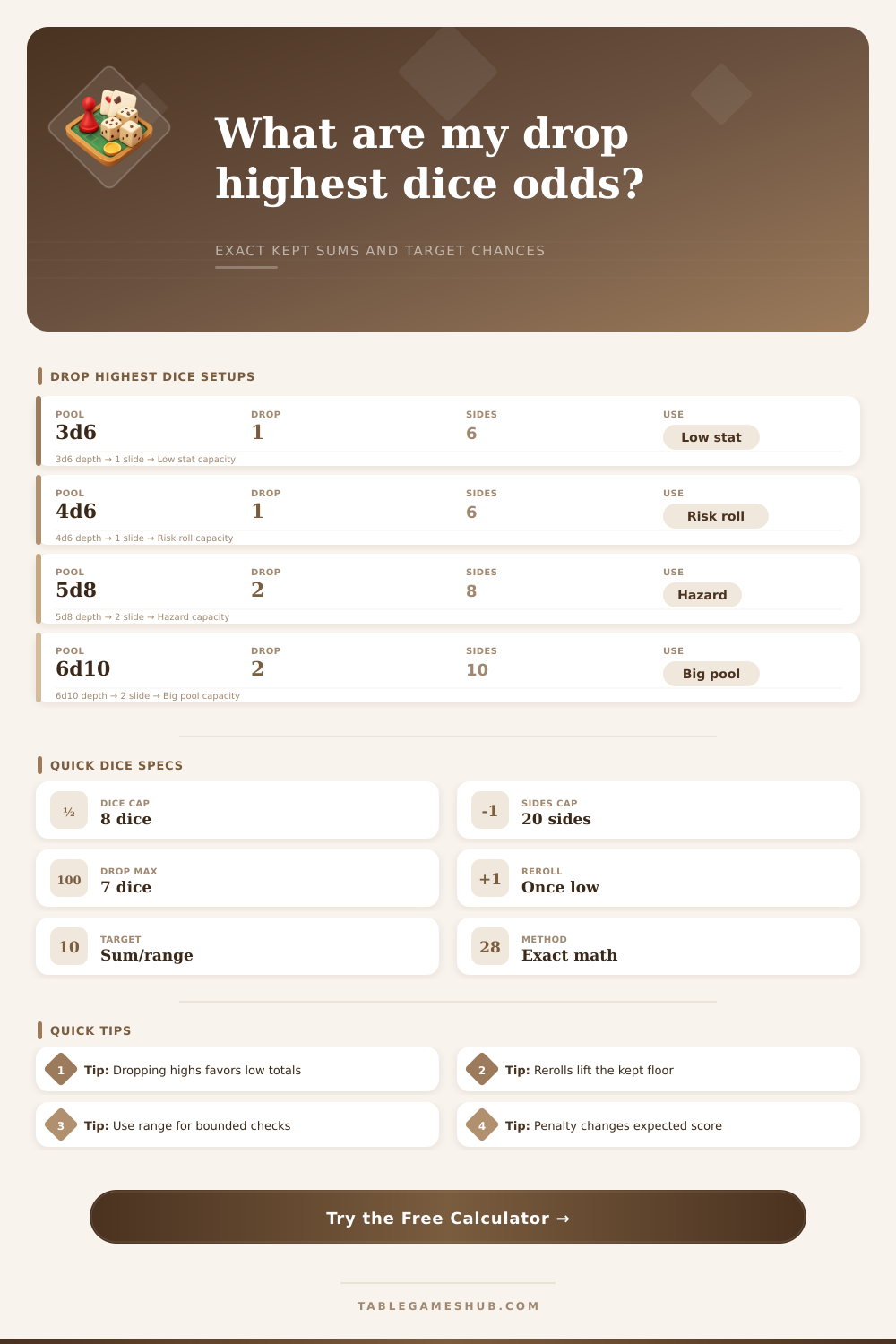
Calculate exact kept-sum odds when the highest dice are removed, including die sides, target ranges, modifiers, one-time low rerolls, and table penalty modes.
| Final sum | Chance | Cumulative low | Target result |
|---|---|---|---|
| 10 | 16.20% | 50.00% | Pass |
| Step | Math item | Current value | Why it matters |
|---|---|---|---|
| 1 | Dice pool | 4d6 | Sets ordered roll count |
| 2 | Drop rule | Highest 1 | Removes top face first |
| 3 | Kept dice | 3 | Defines kept sum range |
| 4 | Target | At least 10 | Flags passing totals |
| Roll format | Kept dice | Kept range | Table use |
|---|---|---|---|
| 3d6 drop 1 high | 2 dice | 2 to 12 | Low ability or setback roll |
| 4d6 drop 1 high | 3 dice | 3 to 18 | Harsh character stat variant |
| 5d6 drop 2 high | 3 dice | 3 to 18 | Risk-heavy challenge pool |
| 2d20 drop 1 high | 1 die | 1 to 20 | Keep-low d20 check |
| Penalty mode | Applies when | Expected value change | Best for |
|---|---|---|---|
| No failure penalty | Never | Raw final sum only | Pure probability checks |
| Subtract 2 or 5 | Target fails | Flat deduction from failures | Small table consequences |
| Subtract missed margin | Below or outside target | Scales by distance | Degree-of-failure scoring |
| Bust above high to 0 | Over high bound | High rolls can collapse | Push-your-luck caps |
| Reroll rule | Affected originals | Low face chance | Expected die lift |
|---|---|---|---|
| No reroll | None | Equal faces | Baseline die average |
| Reroll 1s | Original face 1 | Reduced but possible | Small lift before dropping |
| Reroll 1-2 | Original faces 1 and 2 | Lower tail thins | Moderate lift |
| Reroll 1-3 | Original faces 1, 2, and 3 | Lowest band thins most | Strong lift on d6 pools |
| Target mode | Uses low | Uses high | Passing totals |
|---|---|---|---|
| At least target low | Yes | No | Final sum greater than or equal to low |
| At most target high | No | Yes | Final sum less than or equal to high |
| Between low and high | Yes | Yes | Final sum inside the closed range |
| Exactly target low | Yes | No | Final sum equals low exactly |
At least initially, it seems counterintuitive to drop highest dice in a pool: after all, most table top mechanics is built around rewarding higher rolls! They’re symbolic of power and success. What you have here is an exercise in reversing that idea and asking yourself what a number represent in the fiction of your game. Is this something you roll for damage with smaller numbers being better? Maybe you’re simulating some form of stress, and a lower number mean you remained cool under fire.
Defining your parameters are the hard part; after that, the calculator above take care of the complicated counting for you, no need to hand-crank through combinations of result. It’s an easy concept that mathematicaly becomes surprisingly deep. Basically you take a few dice and just keep rolling them until you find the ones with highest values, then throw those away completely. Then add up whatever was left behind.
Why Dropping High Dice Makes Games More Steady
What it does is flatten out the statistical curve in a way that seems far more grounded than traditional average rolls. The most extreme outcomes becomes less common since the top numbers are routinely thrown out of the running prior to their ability to pull overall result into wild extremes. This is why it has become such a popular method for making character attributes or settling a check when consistency beats raw power spikes.
How does it feel with larger number? What about your die-pool? A single roll of 3d6-1 (drop one) gives a result from 2-12, clustered heavily towards the center. You don’t often see the extremes, so it feels like things is steady and predictable. Bump that up to five dice and drop two (keep 3 dice), and it narrows back down again. The randomness smooths out into a tighter range, and the math guarantee us our results won’t be far outside this smaller band.
This is great for a game where you’d prefer not to have lots of wild swings and need to balance tension without having to go through narrative whiplash each turn. It’s also great for games where you don’t want the luck of the draw to matter as much; you want players to depend on their skills instead.
There’s one more wrinkle to account for: reroll conditions. If you can choose to reroll ones and twos prior to dropping the high dice, it effective takes out worst case scenario from consideration. This slightly boosts the expected value, creating a safety net that protects you from a bad roll. Basically, it simulates an advantage or an expenditure of effort, but without any assurance of success. You may still get screwed even with the reroll; the chance is just much lower.
To calculate this, engine treats the reroll as its own chance event. It then applies the drop rule to result in precise odds instead of estimates. It’s not as easy as “pass/fail” systems where modifiers aren’t nearly as significant. With that tighter distribution, a flat change either way have an exaggerated impact on your chances of succeeding. If you’re just barely over the top with a 50/50 chance, adding two will swing it almost certainly toward a win. On the flip side, subtracting two could knock your good roll into failure territory fast.
With the calculator, you can dial in modifiers and see the shift in probability on the fly to get an idea of how tight things are at various difficulty settings. You can use it to tweak house rules or encounters and see exactly how far you has to go to make something really work out for players.
Risk enters the calculation with failure penalties. Certain systems penalize failed rolls in some way (by reducing your score or causing a negative consequence). In these cases, the produced expected value consider that penalty, and spits out an average that’s adjusted to reflect actual cost of taking risks. This is important because there are still games where failing forward isn’t free. By knowing the numbers ahead of time, you can weigh the risk against possible reward, which will let you decide whether it’s worth it to take the chance.
You should of known this. In conclusion, dropping high dice mean preferring consistency over variance. Understanding this shift in distribution help you make more informed choices when creating a new system (or simply analyzing the probability before rolling the dice during a critical moment around the table). The numbers does the work here, but it’s what those numbers mean to your narrative that matters most. It ensures that the outcomes feel earned instead of random. This grounds the story and makes it more interesting for everyone involved.