Cascadia Salmon Run Calculator
Model a salmon chain, repair pressure, isolated runs, wildlife card version, nature tokens, habitat support, opponent denial, and remaining draft chances before you lock the river line.
| Card version | Best shape | Risk to watch | Calculator bias |
|---|---|---|---|
| Card A | One clean straight salmon run | Branches break the premium line | Rewards length and penalizes breaks hard |
| Card B | Flexible small and mid runs | Over-investing in one awkward chain | Gives isolated runs more value |
| Card C | Multiple useful runs | Running out of clean endpoints | Balances chain and isolated run value |
| Card D | Dense mid-length salmon route | Excess length with poor support | Peaks around a controlled 4-6 length line |
| Card E | Endgame route conversion | Late denial and no nature tokens | Values drafts and tokens more strongly |
| Run state | Typical action | Good signal | Bad signal |
|---|---|---|---|
| Length 1-2 | Draft salmon only if tile also helps habitat | Open endpoints | Forced isolated animals |
| Length 3-4 | Protect clean line and avoid forks | One repair token available | Opponent can deny the connector |
| Length 5-6 | Score pressure is real, trim branch risk | Strong habitat support | Two or more branch breaks |
| Length 7+ | Stop extending if each tile adds little | Card A or E is active | Late draft count is low |
| Factor | Current input | Modeled impact | Read |
|---|---|---|---|
| Drafts | 0 | 0 | Waiting |
| Preset | Chain | Card | Best use |
|---|---|---|---|
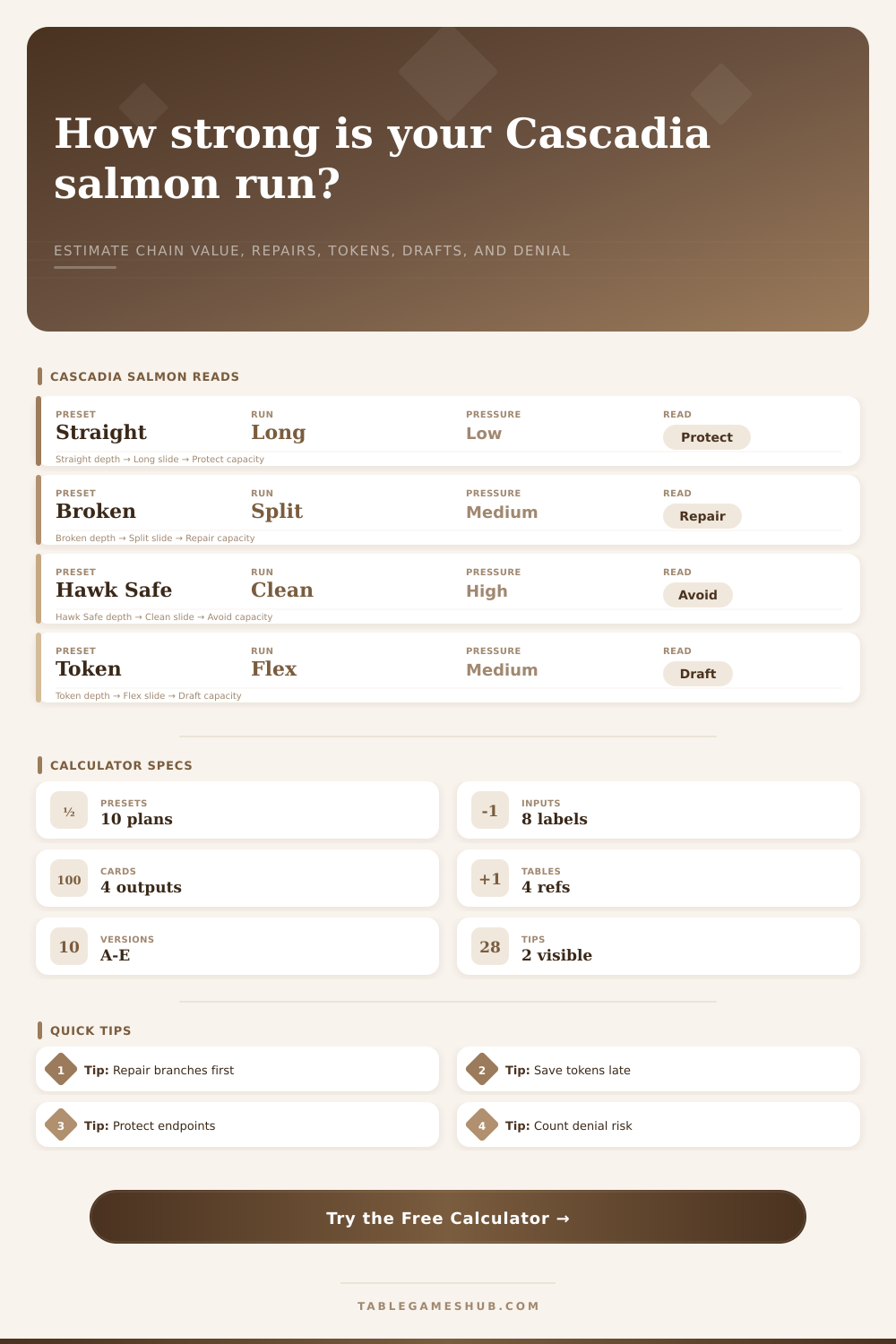
| Straight Salmon Run | 6 clean | A | Protect a high value line |
| Broken Chain Repair | 4 with breaks | C | Decide whether repair beats new scoring |
| Hawk Conflict Avoid | 5 clean | D | Keep wildlife types from colliding |
| Nature Token Draft | 3 flexible | E | Use tokens to buy the connector |
| Endgame Wildlife Card A | 7 late | A | Audit final salmon payoff |
Building a salmon chain in Cascadia feels less like engineering and more like herding cats made of plastic tiles. Rather its building a chain. It is like seeing a line form, identifying a connection several steps ahead, and then watching someone block your path just as your fish need to swim through.
It’s frustrating as long runs gets you big points. But often that mean sacrificing other things in the hope that your opponent doesn’t slow you down. If you don’t want to keep track of each variable at a time, this online calculator will do it for you, just enter your metric data and let the system crunch numbers (link is above).
How to Play Cascadia Better
In effect, you’re juggling four different concerns: 1) The sheer amount of line extending out into lake; 2) How much structural integrity does your connected line possess? In other words, how many ugly gaps/awkward forks must be sewn shut with your next move? 3) What do you lose if you ignore another piece of habitat/wildlife goal? 4) What’s the chance that your opponent could jam up your extension during his/her next turn?
Most anglers manage only one concern (the first one). This is why their game unravels during last few rounds. Your starting line is your potential, given your existing chain length. Six fish on Card A in a straight run is a solid play: the scoring multipliers reward clean lines, not necessarily long ones.
That changes when you’re down to your final nature token and need it to join two separate piece. Isolating runs and accounting for branch breaks is where the calculator shines; it can help illustrate this trade-off. For instance, an 8-fish line may be lower scoring than a 6-fish one, even if the 8-fish line is messy and the 6-fish one is clean. If the card version penalizes fragmentation heavily. Knowing that informs how you plan through middle of the game.
You also deal with denial pressure. You can’t play Cascadia in a vacuum either. Your opponents aren’t just sitting on their hands; they’re looking at those river banks too. If they spot you pushing for a long salmon line, they’ll make sure to draw the right connectors or block the tiles you require.
The calculator asks you to guesstimate how much opposition you face. This may seem abstract, but giving yourself a number for active denial makes you think about whether your plan is strong enough to withstand interference. If denial comes back high on the model, and it says your draft odds are low, it’s telling you to pivot. Perhaps you’d do better securing some smaller but safer scoring opportunities elsewhere rather than chasing something that hinges on five perfect tiles in a row.
Then there’s the addition of nature tokens. These are tokens of currency for flexibility. If you keep your nature tokens and spend none you can acquire certain cards later on, or even buyout the remaining pool. But if you spend your tokens too early you may be caught off guard at the end game with no way to defend yourself.
The tool features presets which show some typical usage cases such as how you use tokens to fill gaps in high denial rounds. It’s not an exercise in math; it’s a question of timing. How much do I need to stay liquid, so I can respond to changes on the board without being wedded to any one plan that could suddenly go stale?
Those are broken out on the page through reference tables, breaking them down card version by card version. For example, Card E values endgame routes higher, which shifts the whole math of cards like that. So your late game strategy will differ if you have Card A out vs having Card E out. Maybe you take short runs earlier so you can keep your options open for later. Defend and consolidate instead of aggressively extending.
So how do you play Cascadia? Ultimately, you play by reading the entire ecosystem, not individual scoring zones on the board. You also look at the board as a snapshot of that ecosystem at any point in time. You translate what you think should of happen into a probability. Use it to test your assumptions, not replace them.
If you feel like your salmon line is too risky, the numbers will likely confirm it. Chances are the numbers will prove out. Is an extra fish worth the risk if it leaves you open? No. Don’t worry about one more when protecting those endpoints matters more.
Watch for the hawks. Keep the river flowing. Know that while a clean run may be great, it’s only as great as the tiles remaining in the box to complete it. Actually, it’s just hard to manage the moddern layout. It would of been easier if there was less rules.