Frisbee Throw Distance Calculator
Estimate carry distance, flight time, apex height, and lateral drift from release speed, angle, disc lift, spin, and wind.
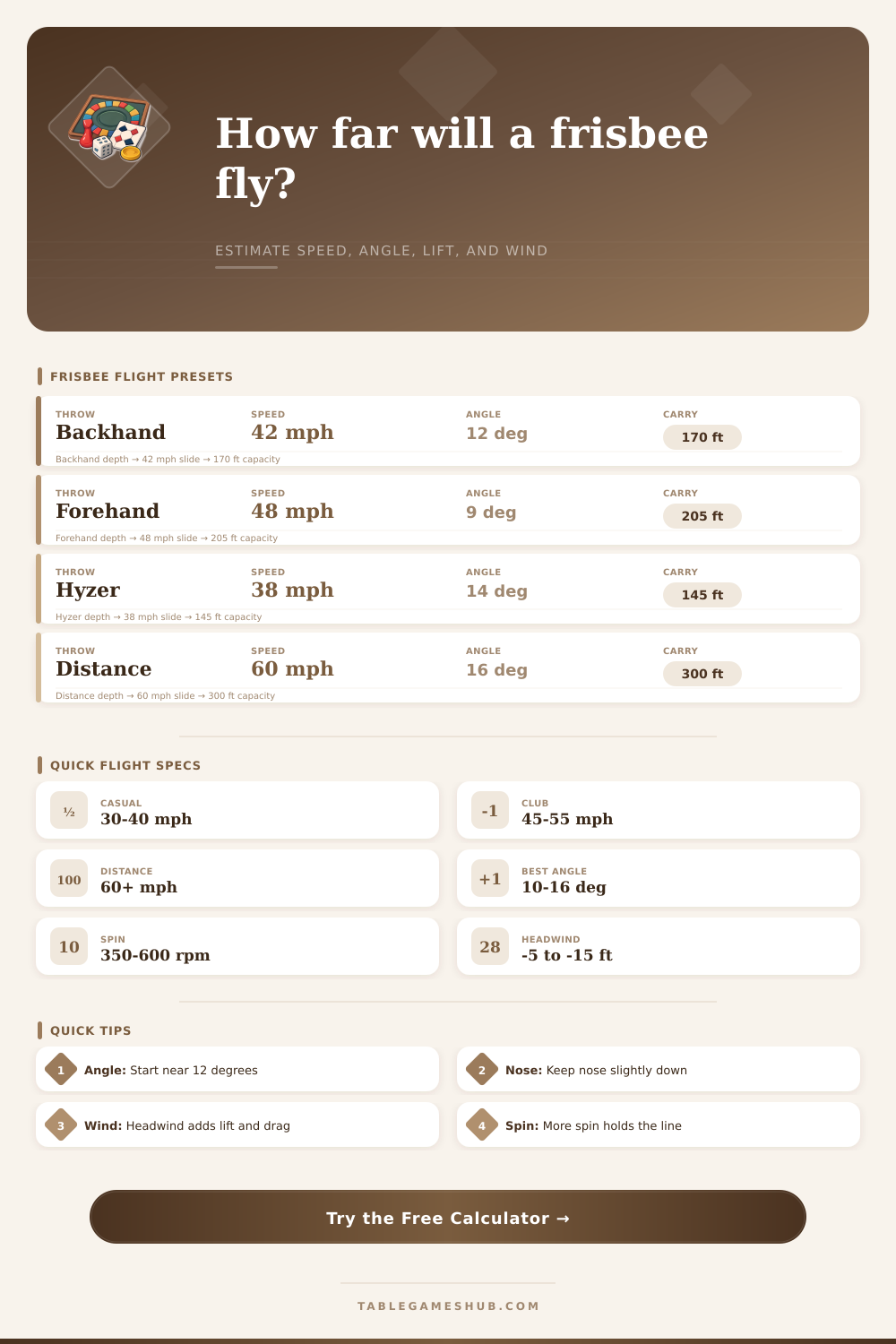
| Release Type | Typical Speed | Useful Angle | Expected Carry |
|---|---|---|---|
| Learning backhand | 22-32 mph | 12-20° | 60-120 ft |
| Recreational backhand | 32-42 mph | 10-16° | 110-180 ft |
| Club forehand | 42-55 mph | 7-13° | 170-250 ft |
| Distance pull | 55-70 mph | 12-18° | 260-400 ft |
| Disc Type | Mass | Glide Behavior | Best Use |
|---|---|---|---|
| Ultimate disc | 175 g | Neutral, stable | Long flat throws |
| Light catch disc | 110-145 g | Floaty, wind-sensitive | Soft casual tosses |
| Distance driver | 165-175 g | Fast, low drag | High-speed distance |
| Midrange disc | 170-180 g | Moderate glide | Controlled carry |
| Putter disc | 170-175 g | Slow, stable fade | Short straight lines |
| Wind Condition | Distance Effect | Flight Shape | Input Adjustment |
|---|---|---|---|
| Calm | Baseline | Predictable glide | Use normal speed |
| Headwind 5-10 mph | Often shorter | More lift and drag | Lower nose angle |
| Tailwind 5-10 mph | Can carry farther | Less apparent lift | Add a little height |
| Crosswind 5-10 mph | Similar carry | Noticeable sideways drift | Account for lateral push |
| Variable | Too Low | Efficient Range | Too High |
|---|---|---|---|
| Release angle | Grounds early | 10-16° | Stalls upward |
| Nose angle | Dives quickly | -4 to 1° | Pops and fades |
| Spin rate | Wobbles | 350-650 rpm | Usually fine |
| Release height | Less carry time | 4.5-7 ft | Depends on thrower |
Throwing a frisbee involve several different variables that can help to determine the distance that the frisbee will travel and the movement of that frisbee through the air. The calculator located on this page allows you to enter different variables to help you to understand how those different variables can impact the flight of the disc. Because the calculator can evaluate these different variables, the calculator can help to show how changes to one variable can have an impact upon other variables of the throw.
The first of the variables to consider is the release speed of the disc. The release speed of the disc is the velocity of that disc as it leaves the hand of the person who is throwing the disc. For instance, a casual backhand frisbee throw may have a release speed of thirty-five miles per hour, but a distance throw may have a release speed of sixty miles per hour.
What Affects a Frisbee’s Flight
The speed at which the disc is released has a significant impact upon the distance that the disc will travel, but does not necessarily ensure that the frisbee will travel that distance if other variables are not utilize correctly. Therefore, the person must enter the release speed into the calculator to establish the starting point for calculating the potential distance of that throw. The angle of release of the disc and the nose angle of the disc are two different variables that help to control the flight of the disc.
The angle of release is the angle of the disc as it is released from the hand of the thrower, and a twelve-degree angle of release is often utilized when attempting to increase the distance that the disc will travel. Angles that are too steep can cause the disc to stall, but the correct angle will create lift for the disc. The nose angle of the disc is the angle of the leading edge of the disc, and this angle can help to control how the lift impacts the disc.
Angles that are nose down, such as an angle of negative two degrees, will help to prevent the disc from catching too much air. Each of these two variables can be adjusted in the calculator to determine how that adjustment will impact the flight of the disc. The spin rate at which the disc is thrown is another variable that can help to impact the distance and the movement of the disc through the air.
For instance, most disc throws have spin rates between three hundred fifty and six hundred revolutions per minute. Spin rates that are too low will result in the disc wobbling during its flight, and can lead to the disc losing it’s intended line. High spin rates will allow the disc to fight against crosswinds.
Therefore, the user can enter the spin rate of the disc into the calculator to determine how high or sloppy spin rates may impact the distance of the throw. The impact of the wind is another variable that can impact the flight of the disc. For instance, headwinds will both increase the lift and drag forces upon the disc, which may help to extend the time that the disc is in flight but will impact the distance that it travels.
Tailwinds will increase the distance that the disc travels, but will reduce the amount of lift that the disc creates. These variables can be entered into the calculator to help evaluate how each of these variables will impact the flight of the frisbee. Understanding the impact of the wind upon the flight of the disc is beneficial for those who would like to calculate the distance that a disc will travel, but which is a variable that the thrower cant control.
Finally, the type of disc that is used and the release style of the disc are two additional variables that may impact the distance and movement of the disc through the air. A heavy training disc has more momentum, but it takes more speed to keep a heavy training disc in the air for longer durations. A light catch disc can float in certain conditions but a crosswind easily moves it.
Releases made with the forehand will create a different drift pattern than when the disc is released with the backhand as the torque of each of these actions works in different directions. The calculator takes into account the type of disc and the release style used to calculate the outcome of a throw. The different comparison sections on the calculator can allow a person to compare different types of throws.
For instance, one can compare the club forehand drive to the casual park backhand throw. These different comparisons will allow a person to see that the speed with which a disc is thrown will not always result in the disc traveling the longest distance. Experienced frisbee players focus on their technique and creating repeatable setups for their throws as this will allow them to survive the small variations in the flight of their discs.
One common mistake that beginners make with frisbees is treating every throw as a contest for the maximum distance the disc can travel. However, most throws do not require maximum distance. For instance, using a lower angle of release for the frisbee and adding a nose-down tilt to the disc will allow it to remain on a set line even in the presence of a headwind.
The calculator takes into account these variables separately from the distance the disc will carry. Using the calculator, a person can see how a shorter distance the disc travels will result in a straighter flight of the disc, which is desirable when throwing a disc around obstacles. Another mistake with frisbees is ignoring the release height of the disc.
Releasing a frisbee from chest height results in a different flight to that of a disc released from waist height. The calculator takes into account the release height of the disc as an input for its calculations as the release height impacts the amount of lift the disc can create before it hits the ground. Using the calculator, a person can see which variables they can control in the flight of their disc.
For instance, they can control the angle of the disc, the nose angle of the disc, and the spin rate of the disc. Although a player cannot change their arm speed when throwing a disc, they can increase their spin consistency. By noting the effect that each of these variables has on the flight of the disc, a person can focus their training on improving these variables.
In some locations, changing weather affects the flight of the disc. For example, a disc might travel two hundred feet under calm weather conditions but only carry one hundred sixty feet in the presence of a headwind. The flight time for the disc may also increase in a headwind due to the extra lift created by the headwind.
By understanding the effect that the headwind will have on the flight of a disc, a person can plan where they wish for the disc to land. The calculator also allows a person to turn their feelings about the flight of their disc into comparisons. For instance, they might use the calculator to decide if adding spin to their disc is more effective then increasing their throwing speed.
The calculator can also help them determine if adjusting the nose angle of their disc will help to prevent it from stalling during its flight. These types of comparisons will eventually develop the intuitions that a player feels when throwing a disc. After repeated use of the calculator, the numbers will match the feelings that a player feels in their hand and in their shoulder when throwing a disc.
Overall, the flight of a disc results from the interaction of each of the variables: speed, angle, spin, and wind.