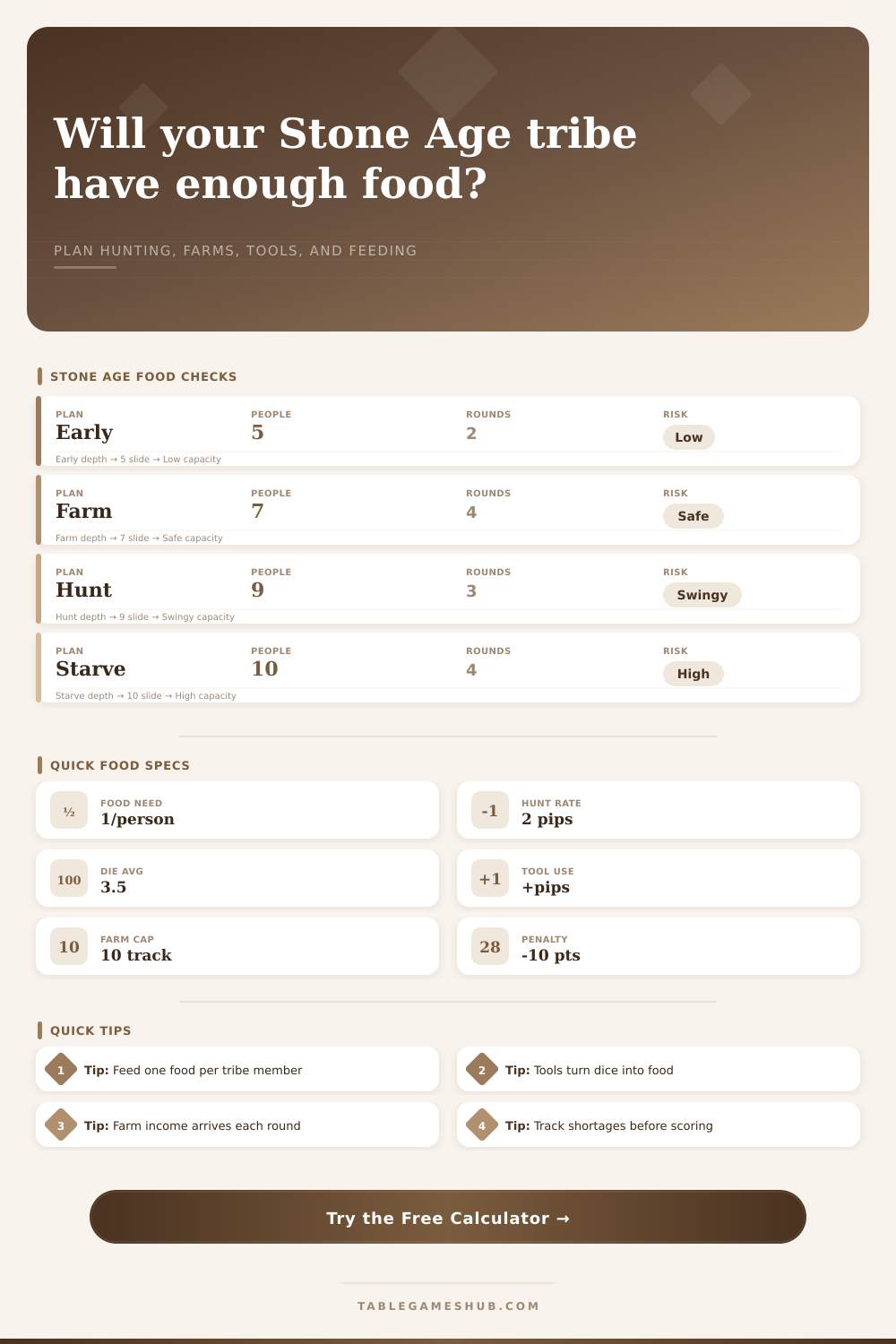
Stone Age Food Supply Calculator
Estimate whether your tribe can feed across upcoming rounds using current food, agriculture income, hunting dice, tools, card food, and starvation penalties.
| Tribe Size | 1 Round | 3 Rounds | 4 Rounds | Pressure Read |
|---|---|---|---|---|
| 4 members | 4 food | 12 food | 16 food | Easy to cover with farms |
| 5 members | 5 food | 15 food | 20 food | Early growth baseline |
| 7 members | 7 food | 21 food | 28 food | Needs steady income |
| 10 members | 10 food | 30 food | 40 food | High risk without farms |
| Hunters | Average Roll | With 3 Tools | Expected Food | Use Case |
|---|---|---|---|---|
| 1 die | 3.5 pips | 6.5 pips | 3 food | Small patch |
| 2 dice | 7 pips | 10 pips | 5 food | Normal hunt |
| 4 dice | 14 pips | 17 pips | 8 food | Big burst |
| 7 dice | 24.5 pips | 27.5 pips | 13 food | Emergency load |
| Agriculture | Round Income | Best Tribe Fit | Shortfall Before Food | Safety Read |
|---|---|---|---|---|
| 0-1 farm | 0-1 food | 4-5 people | High without hunts | Fragile |
| 2-3 farms | 2-3 food | 5-6 people | Manageable | Stable |
| 4-6 farms | 4-6 food | 7-8 people | Low with stored food | Safe |
| 7-10 farms | 7-10 food | 9-10 people | Minimal | Very safe |
| Missed Food | Standard Hit | When It Appears | Recovery Signal | Planner Note |
|---|---|---|---|---|
| 0 food | 0 points | Covered round | Keep surplus | Safe scoring line |
| 1 food | -10 points | Small overreach | One hunt fixes it | Worth checking |
| 2-3 food | -20 to -30 | Growth too fast | Tools plus dice | Danger zone |
| 4+ food | -40 or more | No food engine | Farm or cards | Severe exposure |
All board games will ultimately hinge on one question: Will your tribe survive? Starve or eat. That tension reaches its peak in the feeding stage of Stone Age. You have spent three rounds hunting mammoths, improving your tech, and having more kids; now, you’re going to pay. Every player consume one food token each turn. Running out can be disastrous.
If the math scares you, no worries, the calculator does it for you. But knowing why numbers work out makes you less likely to freak out during dice-rolls that don’t go your way. On the surface, it’s easy to see food as a matter of subtraction: Count your tokens; count your heads; hope the stack is tall enough. In reality, though, income sources aren’t all the same. Hunting rewards big numbers (with some wild variance), whereas agriculture offers reliable output every turn. That difference alters your planning and expectations. Farms? You’ll get this amount. Hunting? You’re gambling on chance.
Why You Must Manage Food in Stone Age
A rising tribe will also eat through your resources at an alarming rate. That seventh family member look great for making progress on the civilization track. Congratulations! But it instanty increases your food consumption by a whole point. And there’s where the misunderstanding occurs: instead of thinking about expansion’s price in maintenance, most players only think about its gains in points. A tribe of ten consumes no less then 30 food tokens across only three rounds. That’s a huge logistical expense. You’re literally robbing Peter to pay Paul to survive now. You are hoping you can repay that debt with future good luck.
But then there’s hunting. Hunting add chaos to what would otherwise be a perfectly ordered economy. Each die rolled represents roughly three and a half points of average output. That die can turns into food at a rate of two-to-one. By smoothing out these uneven dice rolls, tools adds flat values to the mix. It’s a tiny detail, but so important when you’re teetering on the brink of starving to death. Having a tool could mean the difference between rolling a 1 or eating. Commiting a tool to hunting is buying insurance against poor dice rolls. You sacrifice the chance for additional points somewhere else in the game to stabilize the amount of food coming in. And during the mid-game, with your tribe still large but no farms having come online, this trade-off is often worthwhile.
The starve penalty are nasty though. Starving will hit you hard. Each missed food token incurs a penalty of -10 points. That’s enough to wipe out hours of careful scoring. It’s also why you should of always have a buffer. You can’t be right on the edge of resources and expect to do well. You can’t do that in this game.
The tool’s safety readings shows how that works in practice. It shows when expected intake is more than enough, leaving some wiggle room. And it flags when you’re taking risks with your standing. If you get a safe read here then relax a little and focus on something else. If you don’t… then everything is loaded dice.
Finally, it’s all different at the end game. The closer you get to running out of rounds, the less valuable those long term investments are (like building up your high level farms). The need for quick food becomes more desperate. Your huge farm can be churning out tons of produce, but now your tribe is too big to survive off what’s in reserve. That’s when cards, both bonus and one-off hunting, come into play. It gives you a fast flow of currency just to close that gap from regular earning to the very last meals to go around. If you plan ahead you won’t have to scramble at the end and realize: how will I feed everyone?
And so it boils down to this: in Stone Age, it’s not so much about getting as many points as possible, but rather reducing as much risk as possible. You don’t just want something that can generate points well, you want something that can work even if you have a bad run of the dice. A little bit from farming every turn combined with using tools to stabilize your food supply make for a solid machine. It lets you go out on limbs all over the board while knowing you won’t be completely sunk if things go south. The tool shows that balance visually and lets you know where you might run into trouble before it becomes an issue. So keep hunger at bay and keep your surplus fat; the points will come. Only a full belly stands up under pressure.