Carcassonne City Size Calculator
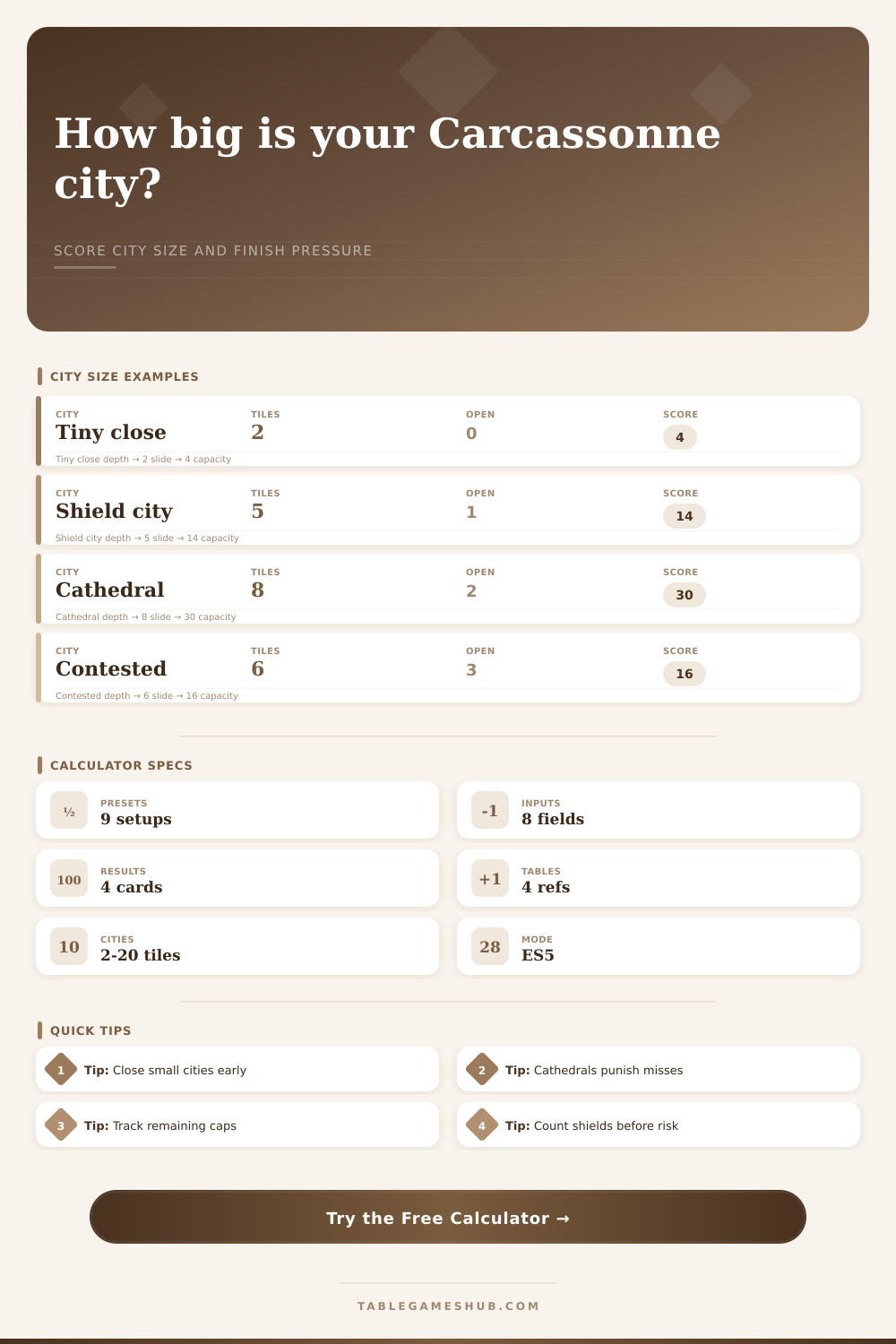
Estimate city score, unfinished value, closure pressure, and majority risk for normal cities, shield cities, cathedral builds, and contested walls.
The result will appear here.
| City state | Tile value | Shield value | Calculator use |
|---|---|---|---|
| Complete city | 2 points | 2 points | Base completed score |
| Incomplete city | 1 point | 1 point | Fallback value |
| Complete cathedral | 3 points | 3 points | High reward score |
| Incomplete cathedral | 0 points | 0 points | Miss penalty |
| Preset | Tiles | Open edges | Typical read |
|---|---|---|---|
| Two-tile city close | 2 | 0 | Take the simple points |
| Shield city | 5 | 1 | Strong tile efficiency |
| Cathedral mega-city | 10 | 3 | Huge swing with risk |
| Contested wall | 6 | 3 | Majority matters most |
| Open edges | Closers left | Pressure | Planning signal |
|---|---|---|---|
| 0 | Any | Closed | Score is locked |
| 1 | 3+ | Low | Good finish path |
| 2-3 | 2-5 | Medium | Watch tile tempo |
| 4+ | 0-3 | High | Avoid cathedral misses |
| Control state | Score share | Risk label | Calculator treatment |
|---|---|---|---|
| Sole majority | 100% | Secure | Your full score |
| Tied majority | 100% | Shared | Full score for tied players |
| One meeple behind | 35% | Contest | Partial control estimate |
| Opponent controls | 0% | Denied | No direct city points |
For example if there are only 3 closers still in the deck and lots of open edges, it’s risky. You need to see what is coming up next. Just type in how many tiles there are, count your shields, and count your open edge. Each shield act as a point multiplier for the city. Shields don’t actually add any physical segments, just multiply their points.
Every edge that is open create a dependency on your next draw. So if there are 2 closers left for 3 edges, then that change the equation against you. This puts pressure on your city, the calculator will rate that pressure as a warning that this city has become a liability.
How to Use Math to Win the Game
The way you score changes greatly with cathedrals. When finished, a cathedral score three points for each tile. If not, it’s worth none. Half point for open cities at the end of the game. This safety net goes away with cathedrals. A binary result shift the math toward conservative play over aggressive expansion.
Risking adding a cathedral segment is a gamble when there are few closing tiles. Draw the right cap and win big; otherwise, risk zero. That’s reflected in the reference tables: Is the upside worth the downside? That’s where meples come into play, adding complexity beyond geometry.
Sure, I’m the largest city, but my opponent own me. Oh, we’re one meeple apart? Then this is a game about position, not value. The calculator accounts for that with its view of expected value. How much of the possible score go to you? What does it show when you tie someone else? Does a shared majority count as split points or full points for everyone involve? Those are important distinctions in the endgame.
You may feel pressure to add a meeple, but that eats up an action and limit flexibility elsewhere. More often, late-game strategy is about denying other players as opposed to scoring yourself. If a city have four edges open without any closers, it’s a trap. By spotting the dead features early, you can switch to fields or roads which return predictably and consistantly.
That’s where you play the percentages; you stop chasing huge cathedral scores. Pressure on a closure tells you when that feature shift from promising to dangerous. When the pressure is high, you know to drop out of finishing that particular city.
Players who consistently win consider not just each tile, but also how that tile fit into the overall layout off the board. They see connections before they are made. They know which cities will score well on their own. Emotion is removed from the equation when you quantify those things.
Did the opportunity cost of using that turn outweigh it’s likely gain in expected value? The difference between reacting and calculating is what sets casual players apart from winning player. You leave open incomplete features if the odds are in your favor for returning. When do I build? When do I walk away? How do I manage incomplete features? These are all questions that comes from calculation instead of reaction.