Dice Keep Highest Probability Calculator
Calculate exact probabilities for roll NdS keep highest K pools, target totals, single-die targets, exploding dice, and advantage-style pool comparisons.
| Pool | Typical use | Average kept total | At least target example |
|---|---|---|---|
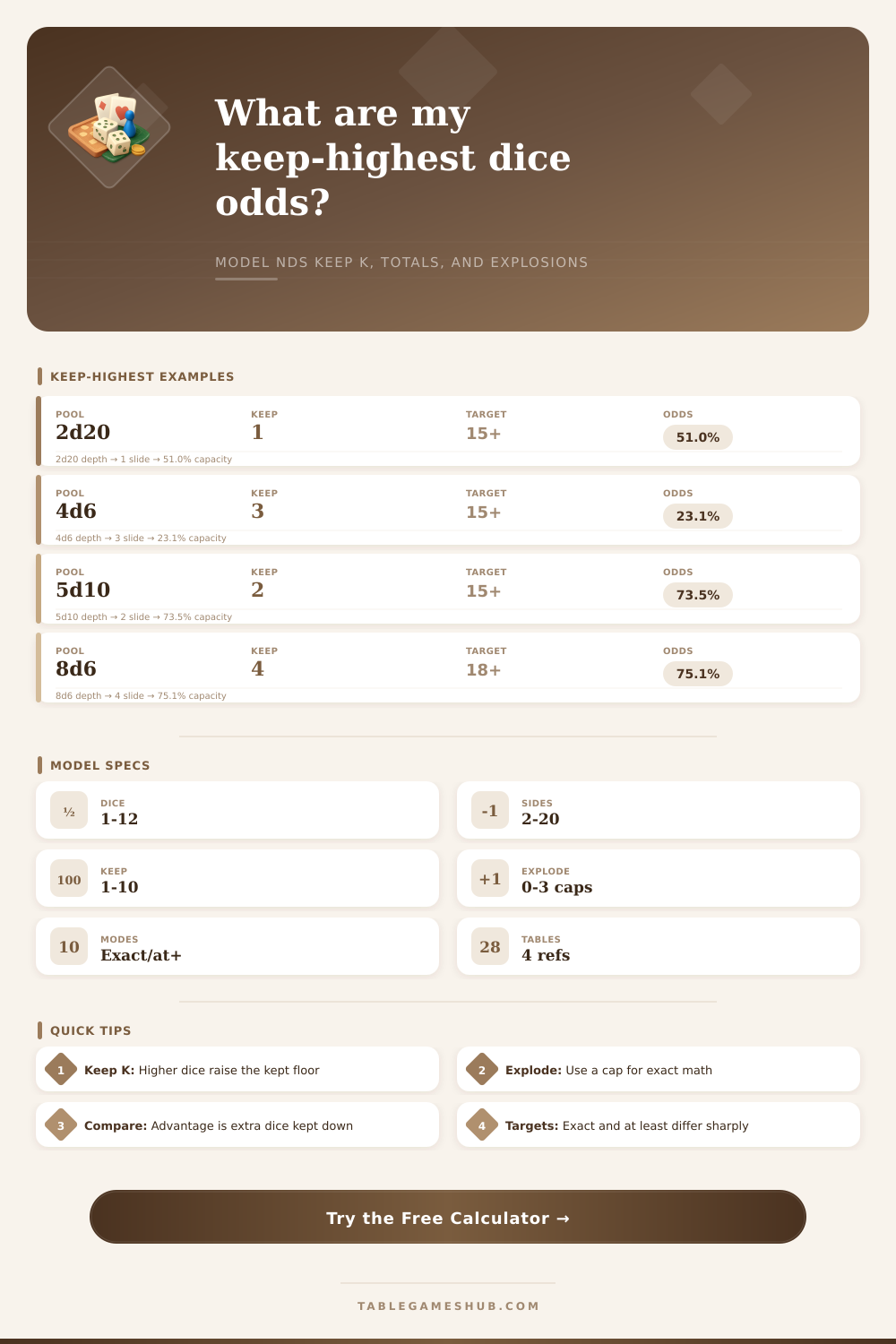
| 2d20 keep 1 | Advantage style high d20 | 13.82 | 15+ is 51.0% |
| 1d20 keep 1 | Plain d20 target check | 10.50 | 12+ is 45.0% |
| 4d6 keep 3 | Ability-score style total | 12.24 | 15+ is 23.1% |
| 5d10 keep 2 | Roll-and-keep target pool | 15.83 | 15+ is 73.5% with exploding cap 2 |
| Explosion cap | Single d6 max | Single d10 max | What the calculator does |
|---|---|---|---|
| 0 extra rolls | 6 | 10 | Standard non-exploding die distribution |
| 1 extra roll | 12 | 20 | Max face adds one more die result |
| 2 extra rolls | 18 | 30 | Two repeated max faces can both add value |
| 3 extra rolls | 24 | 40 | Deep explosion cap for high-tail checks |
| Mode | Question answered | Uses the distribution how? | Best for |
|---|---|---|---|
| Exactly target | How often is the kept sum equal to T? | Reads one total bucket | Point totals and exact score checks |
| At least target | How often is the kept sum T or more? | Sums all buckets from T upward | Difficulty classes and success thresholds |
| At most target | How often is the kept sum T or less? | Sums all buckets through T | Low-roll risk and failure checks |
| Single die hit | Does any kept die reach the face target? | Checks final kept dice states | Critical faces, raises, and special triggers |
| Preset | Main pool | Target | Comparison idea |
|---|---|---|---|
| D20 Advantage | 2d20 keep 1 | 15+ | Compare against one plain d20 |
| Ability Roll | 4d6 keep 3 | 15+ | Add one extra d6 for heroic rolling |
| Exploding d10 | 5d10 keep 2 | 15+ | Check high-tail lift from explosions |
| Skirmish Pool | 4d8 keep 2 | 12+ | Compare against 5d8 keep 2 |
Dice systems based on the keep highest mechanic allow a player to roll a pool of dice, and then select a specific numbers of the highest results from those dice to use as the total result of that roll. Players often utilize dice systems based on the keep highest mechanic because they desires to produce high results from a pool of dice, but also dont wish for low numbers within the pool to reduce the total result that is produced. Such systems are considered to be fair systems in that they reward players for rolling more dice, but still ensure the mathematical outcomes of the system remain within a predictable range.
However, the probability of success with these systems often changes based off the number of dice within the dice pool, the number of dice that are kept, and the target number for those dice. Adding more dice to a pool increase the probability that the kept dice will roll a high number. However, the increase in the number of dice is not linear; an extra die is added to a pool of dice that are kept provides more significant increases to the probability of achieving high results than it would provide to a pool in which many of the dice are kept.
How Keep Highest Dice Pools Work
This is due to the fact that the lowest values of the dice within a pool are typically discarded; thus, an extra die can only increase the result of a pool if that extra die rolls a value that is higher than the values of the kept dice. Thus, an individual can utilize a calculator to determine the trade-off between the number of dice within a pool and the number of dice that is kept. Exploding dice allow for the player to roll a die again if a specific number is rolled with that die.
Because of this possibility of rolling again, exploding dice complicate the mathematics of the dice pool; it is possible for a single die to contribute significently to the total number of points for that pool. The impact of exploding dice is more significant for dice pools that only keep a small number of dice; a high result from an exploding die will contribute to the total if any number of dice are kept. Additionally, exploding dice increase the possible total results that can be rolled with a dice pool; the impact of exploding dice is upon the probability of rolling a total that reaches a specific target, or clears a threshold target total.
Exploding dice can be limited to only occur a certain number of times within a single roll, which will limit the complexity of the mathematics necessary to calculate the probability of the exploding dice pool, yet still allow for the primary benefits of exploding dice to be realized. It is essential to distinguish between targets that apply to the total of a dice pool, and targets that apply to each of the individual dice within a pool. Each target have a specific meaning within the game; targets for the total of the kept dice require that the total of the values of each of the kept dice reaches a specific number, while targets for each of the individual dice within a pool require that at least one of those dice rolls has a value that is equal to or higher than a specific value of the die.
Each of these targets can be used to introduce special game effects; using a single-dice target for an effect rather than a total target means that the effect can occur even if the total of the dice in a pool does not reach the same target. Thus, it is possible for a dice pool to have a low total result, yet have a high chance of producing at least one of its dice to have a high value if exploding dice are included for each of those dice. Advantage and disadvantage allow for the comparison of two different dice pools against the same target total.
Advantage is most often used to describe the rolling of one extra die for a given number of kept dice, and disadvantage indicates that one fewer die should be kept out of the total of the rolled dice. Advantage increases the total of the kept dice by an expected value, which also increases the chances of rolling a threshold total that is cleared by that roll. The value of advantage, however, decreases with the size of the initial dice pool; a single die of 20 sides (d20) will gain more value from advantage than a pool of four dice each with six sides (d6) that keeps three of the highest numbers rolled.
This difference in value of advantage can be calculated with the use of a calculator for two different dice pools. Many people often misjudge the probabilities of outcomes with dice pools that use the keep highest mechanic. Many individuals focus upon the average result that can be achieved with the dice pool, yet do not consider the distribution of the results that can be achieved with that type of pool.
Two different dice pools may have the same average result, yet one dice pool may produce extreme high results more often than the other. The distribution of the results of a dice pool can be more important than the average result of that pool; a dice pool that rarely rolls below a minimum value has more value than a pool that has a higher average result but rolls low results more often. In play of the dice pools, there are many factors that influence the outcome of the rolls that cannot be accounted for in any mathematical calculation.
For instance, players tend to remember the results of rolls that had high values of each die, rather than those that had even rolls for each die; thus, a dice pool that has a chance of producing high values for one or more of its dice will be considered more exciting than a pool that has an average result that is more desirable. Another of these factors is the speed at which the dice pools are rolled. A pool of ten dice will take longer to sort and discard the low dice values than a pool of four dice; thus, players can use this factor in their calculations of the value of each of the possible dice pools.
The most practical dice pools are those that provide the desired probabilities for the outcomes of the rolls, yet also maintain the speed at which the game session runs. The target for a roll of dice will also influence the type of dice pool that is used in the game. Targets for the total number of dice indicates that the total of each of the values of the dice that are kept must reach a specific total, while targets for each of the dice indicate that at least one die within the pool must have a value that reaches that target.
Each of these target types will impact the type of probabilities that are used within the game; changing the target mode will change the types of targets that are shown within a calculator for each type of dice pool, and change which of those dice pools have the most benefits to them. In testing dice pools, there are some suggestions for the types of tests that should be performed. Rather than determining that a specific type of dice pool is the ideal type for a game, testing of several similar types of dice pools can reveal significant differences in probabilities.
Testing of two or three different types of dice pools will allow a player to determine the impact of each change to the dice pool; using these results, a decision can be made that balances the benefits of the calculation with the other factors that influence the game. The keep highest dice pool is successful in providing probabilities to players due to the fact that each player can control the types of probabilities that are created for each roll of the dice. The number of dice that a player rolls, and the number of dice whose values are used as the total result of that roll can be controlled by the player; thus, the player can control the probabilities of those results.
These probabilities can be calculated by the calculator, giving the player insight into the probabilities of that type of dice pool; the use of the calculator allows for a player to make a more deliberate decision about the types of dice pools that are used, rather than simply making a hopeful decision about which pools to use.