Free For All Bracket Calculator
Plan multiplayer pods, advancing players, empty seats, table waves, finals, and schedule time for free-for-all tournaments.
| Round | Active Players | Pods | Advancers | Empty Seats | Waves | Round Time |
|---|
| FFA Scenario | Common Pod | Advance Slots | Planning Note |
|---|---|---|---|
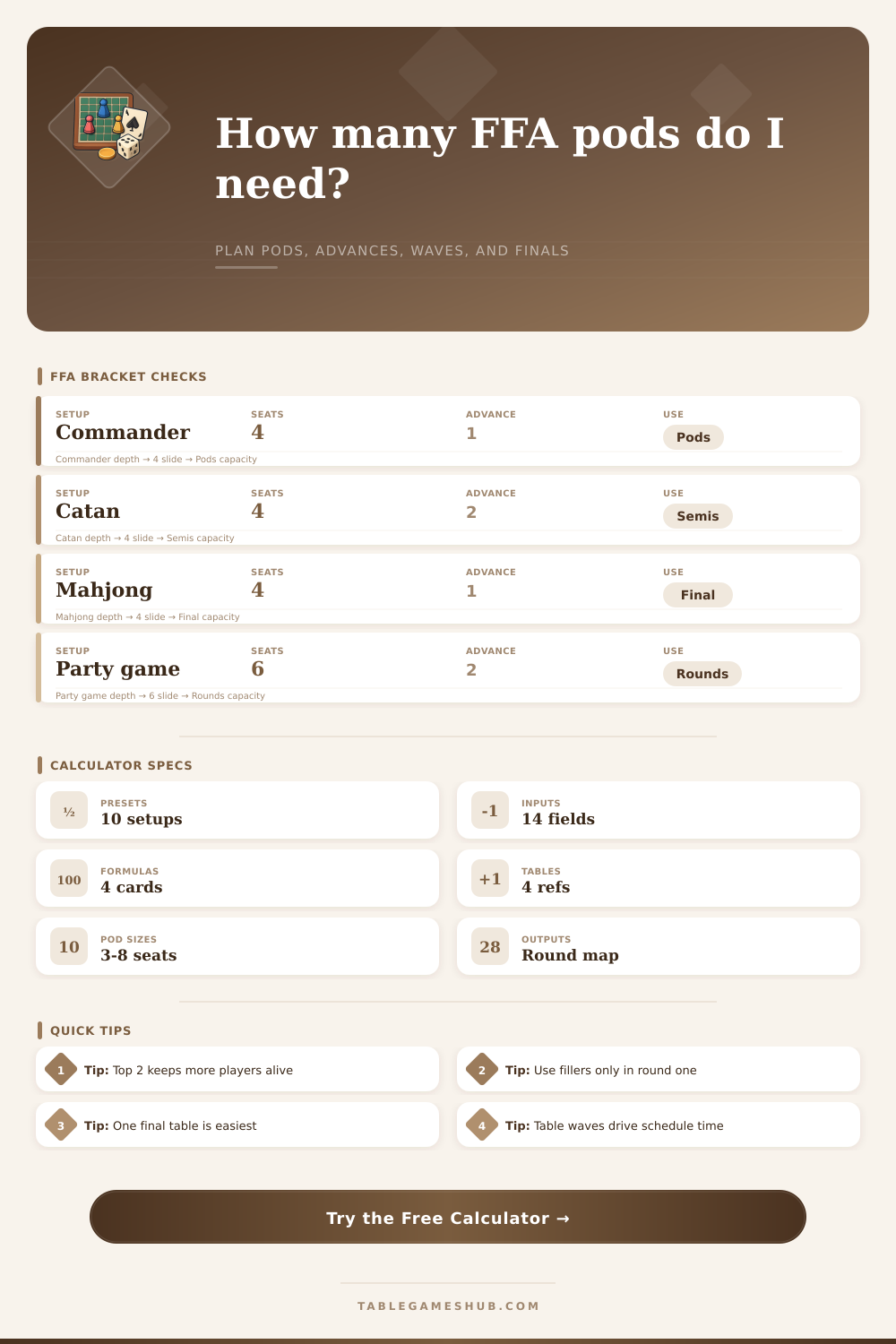
| Commander card pod | 4 players | 1 winner | Clean winner-to-next-round bracket |
| Catan-style qualifier | 4 players | 1 or 2 | Top 2 reduces early elimination |
| Party game heat | 5 to 8 players | 2 or 3 | Use score tiebreakers before finals |
| Mahjong table event | 4 players | 1 table winner | Seat balance matters across rounds |
| Pod Size | Top 1 Chance | Top 2 Chance | Best Use |
|---|---|---|---|
| 3 players | 33.3% | 66.7% | Small leftover groups |
| 4 players | 25.0% | 50.0% | Most board and card games |
| 5 players | 20.0% | 40.0% | Flexible party games |
| 6 players | 16.7% | 33.3% | Large table games or heats |
| Entrants | 4-Seat Top 1 | 4-Seat Top 2 | Expected Final Path |
|---|---|---|---|
| 16 players | 4 pods to final | 4 pods, then semis | 2 to 3 rounds |
| 32 players | 8 pods, 2 semis | 8 pods, 4 semis | 3 to 4 rounds |
| 48 players | 12 pods, 3 semis | 12 pods, 6 semis | 3 to 4 rounds |
| 64 players | 16 pods, 4 semis | 16 pods, 8 pods, 4 semis | 3 to 5 rounds |
| Tiebreaker | Best For | Data Needed | Organizer Check |
|---|---|---|---|
| Game points | Victory-point games | Final score | Verify scoring sheet totals |
| Finishing place | Race or elimination games | Placement order | Record exact exit order |
| Strength of pod | Seeded brackets | Opponent ranks | Avoid punishing hard pods twice |
| Margin or VP spread | Area-control games | Score margin | Cap blowout incentives if needed |
That’s the sort of panic that comes from having a board game tournament that isn’t large enough for a convention center, but too large for living room. Thirty-two players, four tables, everyone want to do Commander. What happens? How many rounds of this thing are going to happen on a Saturday afternoon? Enter the free for all bracket calculator. It’s like a schedule-maker for chaotic multiplayer elimination math. Tell it how many people and tables you have, and it’ll tell you how long the entire event is, how fast things progress through the elimination stages, and who goes where. You can leave the nitty-gritty logistics to it while you work on Wi-Fi stability and snacks.
Most tournament organizers makes the same mistake at the start: selecting pod sizes according to their comfort levels, not their flow. For example, for games such as Magic: The Gathering Commander or Catan, four players per pod is common. This leaves you with a floating player or an awkward third seat when your field size don’t divide evenly. An empty seat in round one changes the advancement probability and can lead to fairness issues, as solo player might feel he is at a disadvantage. Do you want to go with fillers? Accept a smaller pod size? It’s a decision that has to be made early, and the calculator enables you to visually see exactly how many empty seats you have throughout your waves. If it’s high, then you’ll want to either tweak your total entrants or adjust your pod size so that load evens out.
How to Plan Your Game Tournament
The other key factor that nearly everyone neglect until after they’ve broken their brackets is advancement style. Do you want to advance just one player per pod? You’ll have fewer players involved for longer, but there’s a steep elimination curve. Or do you want to go with a top-two advancement? That will soften elimination early and keep more players alive longer. Significantly, it will also affect your total number of matches, as half the field gets eliminated every round in a top-one bracket, creating a quick path to a final table. In a top-two bracket, more players stays involved, so you need more rounds to whittle them down. The reference tables on this page show that a set of 32 might need three rounds in one format and four or five in another. And that added hour means something if you’re paying by the night for venue space.
Table availability is physical constraint that derails even the best laid plans. Even if you mathematically have a perfect bracket, if you need 10 pods in round one and all you’ve got is 6 tables, you’re staring down two waves to get this thing going. Every wave take time to reset, which is typically underestimated. Resetting a game means getting people seated, talking about tiebreakers, dealing with the inevitable latecomer or two, and sorting out score disagreements. Smart move; add an extra 10 to 15% on top of the time estimate for resetting games. That’s accounting for the fact that one table will always take forty-five minutes longer than the others. He’s the guy playing the crazy interaction he found online five minutes before round started.
With this you can get a clear view based off how much time per round and how many active pods there is in each round. Take a close look at the breakdown, does your max round require more tables than what you have? If so, you might consider reducing the number of players before they sign up, or adding another wave. Better to turn down 10 players today then 32 standing in line during breaks. Remember: The calculator will also help you measure room footprint, does it physically make sense that your tables fits into the space before booking the venue? A bit of planning ahead goes a long way toward preventing a bunch of stress later. When all the dust has settled, the winner is crowned, and everyone goes home, you don’t want them to remember the event by its bad scheduling. Keeping the timeline honest and keeping the bracket tight ensures everyone walks away with a smile (or at least without resentment for the person who scheduled).