🃏 SET Card Game Probability Calculator
Estimate table set odds, expected sets, known visible sets, and refill draws from the 81-card SET deck.
| SET Structure | Count | Combinatoric Meaning | Calculator Use |
|---|---|---|---|
| Deck cards | 81 | 3 to the 4th power | Base population |
| Features | 4 | Number, color, shading, shape | Defines each card |
| Values per feature | 3 | All same or all different | SET test rule |
| Total sets | 1080 | C(81,2) divided by 3 | Full-deck set count |
| Cards On Table | Triple Combos | Expected Sets | Approx At Least One |
|---|---|---|---|
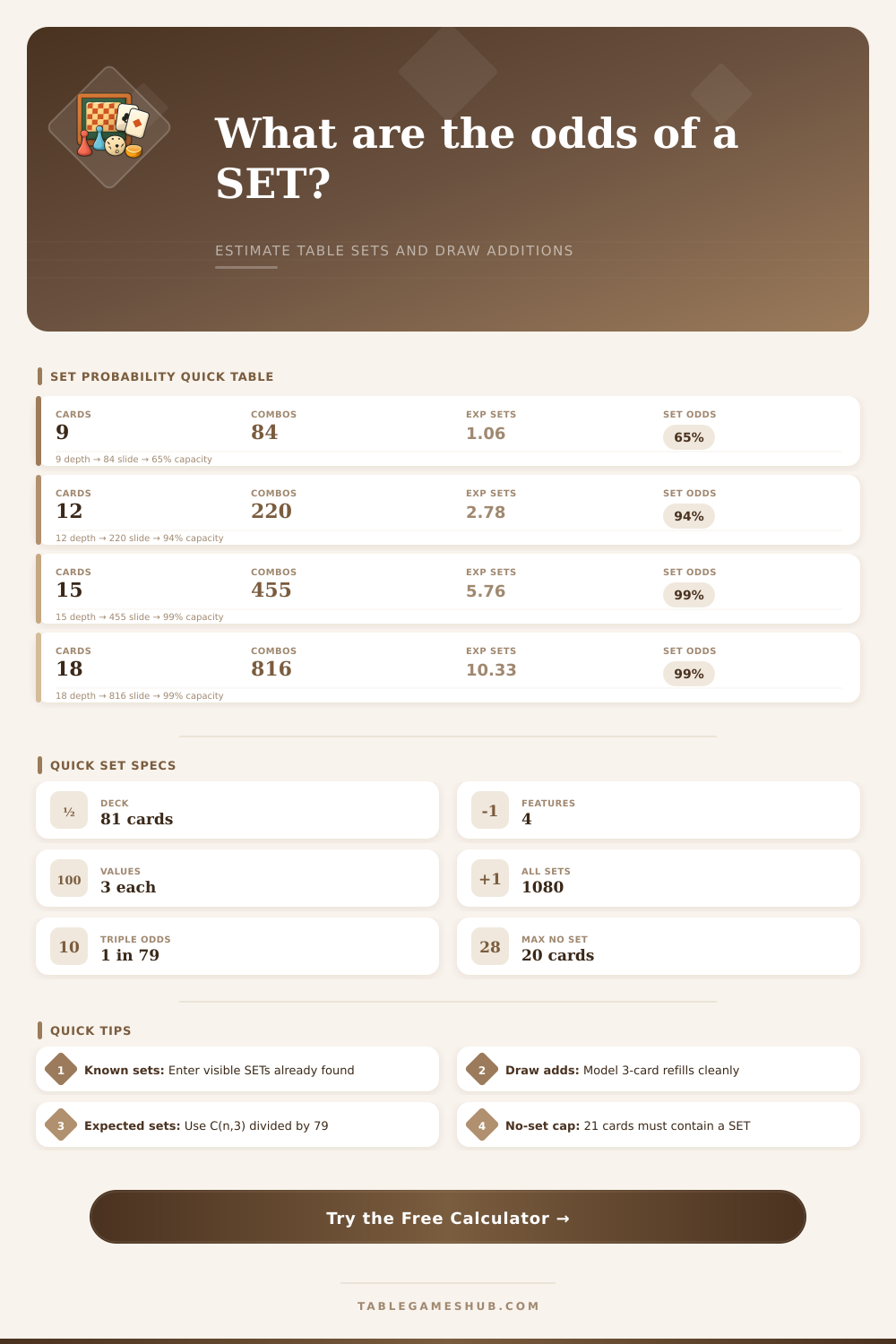
| 9 cards | 84 | 1.06 | 65.5% |
| 12 cards | 220 | 2.78 | 93.8% |
| 15 cards | 455 | 5.76 | 99.7% |
| 18 cards | 816 | 10.33 | 99.9%+ |
| 21 cards | 1330 | 16.84 | Forced by cap |
| Starting Table | Added Cards | New Triple Combos | Expected New Sets |
|---|---|---|---|
| 12 cards | 3 | 235 | 2.97 |
| 12 cards | 6 | 596 | 7.54 |
| 15 cards | 3 | 361 | 4.57 |
| 18 cards | 3 | 514 | 6.51 |
| Combinatoric Fact | Formula | SET Result | Why It Matters |
|---|---|---|---|
| Any two cards | One completion | Unique third | Pair determines set |
| Random triple | 1 / 79 | 1.27% | Expected set rate |
| Full deck sets | C(81,2) / 3 | 1080 | Global count |
| Set-free ceiling | Max cap set | 20 cards | 21 forces a set |
Tip 1: Separate known sets from random odds
If you have already counted visible sets, use Known current table mode so the calculator treats those sets as a floor before modeling added cards.
Tip 2: Add cards in SET-sized refills
For normal play, model additions in groups of three. That keeps the final table size aligned with the usual 12, 15, 18, and 21-card states.
The SET card game is a game that utilizes mathematical probability in its structure to determine the likelihood of finding a set of three card. A set is created with a group of three cards that either share every single feature of the three cards, or that differ in every single feature of the three cards. The deck contain eighty-one distinct cards, and those eighty-one distinct cards exist due to the number of features of a SET card (four feature) and the number of values of each feature (three possible values for each feature).
Due to this mathematical structure of the SET deck, any two cards will indicate the third card that will create a SET with those two cards. Thus, the chance that three randomly selected cards will contain a SET is approximately one in seventy-nine. Within a game of SET, there are often twelve cards that are laid out on a table.
How the Number of Cards Changes the Chance of Finding a SET
These twelve cards contain a large number of possible combinations of three cards (the number of possible sets). However, despite the large number of possible SETs within the twelve cards on the table, the probability that at least one of those sets is visible on the table is greater than ninety percent. Consequently, it is possible for some layouts of twelve cards to contain numerous SETs on the table, but also for some layouts to contain few SETs that are visible on the table.
It is important to be able to differentiate between the SETs that are visible on the table and those that may be form in the future. If players dont make this distinction, it is likely that they will make incorrect decision regarding how many cards to add to the table. Additionally, when players decide to add more cards to the table, they typically add three cards at a time.
The addition of these three cards can lead to the formation of different numbers of SETs, depending upon the cards that are already on the table. For instance, adding three cards can significantly increase the number of possible SETs on the table, but adding three cards can also have a very small effect on the number of possible SETs if the added cards do not interact with any of the existing cards on the table. Furthermore, it is also important to consider how the number of cards on the table can impact the likelihood that at least one SET can be found.
For instance, if there are fifteen cards on the table, there are more possible combinations of three cards than there would be with twelve cards on the table. Additionally, if there are eighteen cards on the table, there are even more possible combinations of three cards than there would be with fifteen cards on the table. Thus, the probability of finding at least one SET increases with the increasing number of cards on the table.
Consequently, a table that contains twenty-one cards must contain at least one possible SET. It is also important to account for how many cards have been removed from the SET deck during the game. As the game proceeds, the number of cards that remain within the deck decrease.
As a result, the decreasing number of cards within the deck alters the probability of finding SETs within the remaining portion of the deck. Calculating the probability of finding SETs as if the cards are being drawn from a full deck of eighty-one cards will result in incorrectly calculated probabilities. It is important to calculate the probability of finding SETs based off the number of cards that have been removed from the deck thus far.
It is common for many individuals to believe that finding one SET within the table makes the remainder of the SET cards easier to find. However, finding one SET can actualy indicate that several other SETs are possible to find within the remaining cards on the table. SETs often contain shared cards with other SETs, which makes them cluster within the SET deck.
Consequently, it is not always certain which SETs are certain to be found within the table as opposed to those that are only probably to be found. It is important to know the current state and number of SETs within the table before adding any cards to the table. If there are already numerous SETs within the table with twenty-one cards, adding three more will likely lead to the formation of numerous new SET.
However, if there are few SETs within the table, adding three cards will have a different impact on the game. It is also important to recognize that the density of the SET deck can change as cards are added to or removed from the table. For instance, the density of the SET deck with twenty-one cards may be different than the density of the SET deck with fifteen cards, even if the individual cards within each table is similar to one another.
Thus, the game of SET rewards players who are able to keep track of the structure of the SET deck, and who understand the number of possible combinations of SETs that can exist within the table. Players who can keep track of the mathematical structure and possible combinations will be able to make decisions regarding when to call a SET and when to add more cards on the table.