Four D6 Sum Calculator
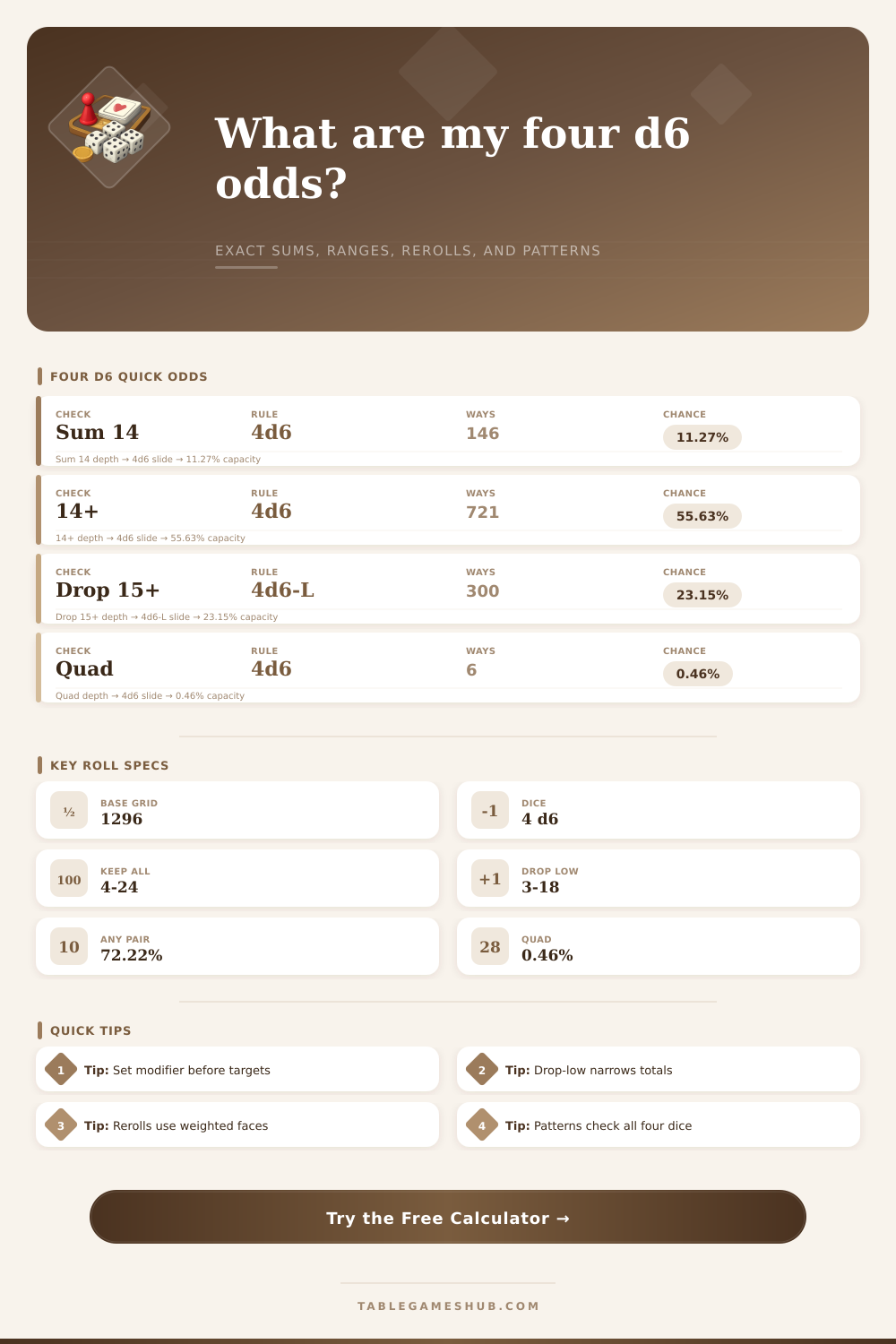
Model a four six-sided dice roll across the 1296 base outcomes, including exact sums, target thresholds, ranges, modifiers, one-reroll rules, drop-low rolls, doubles, triples, and quads.
Average waits for calculation
Mode waits for calculation
Pattern line waits for calculation
Face weights wait for calculation
| Adjusted focus | Raw sum | Ways | Exact chance |
|---|---|---|---|
| Low edge | 4 | 1 | 0.08% |
| Common lower | 10 | 80 | 6.17% |
| Mean center | 14 | 146 | 11.27% |
| High target | 18 | 80 | 6.17% |
| Top edge | 24 | 1 | 0.08% |
| Ability total | Ways | Exact chance | Chance at least |
|---|---|---|---|
| 8 | 62 | 4.78% | 85.65% |
| 10 | 122 | 9.41% | 72.84% |
| 12 | 167 | 12.89% | 48.77% |
| 15 | 131 | 10.11% | 23.15% |
| 18 | 21 | 1.62% | 1.62% |
| Pattern | Fair ways | Chance | Included dice state |
|---|---|---|---|
| All different | 360 | 27.78% | No double appears |
| Exactly one double | 720 | 55.56% | One pair plus two singles |
| Two doubles | 90 | 6.94% | Two different pairs |
| Triple or better | 126 | 9.72% | Triple and quad outcomes |
| Quad | 6 | 0.46% | All four dice match |
| Reroll rule | Die mean | P(final 6) | Calculator treatment |
|---|---|---|---|
| No reroll | 3.500 | 16.67% | All 1296 outcomes equal |
| Reroll 1 once | 3.917 | 19.44% | Weighted final faces |
| Reroll 1-2 once | 4.167 | 22.22% | Weighted final faces |
| Reroll 1-3 once | 4.250 | 25.00% | Weighted final faces |
But it’s not truly random. When you roll four six-sided dice, you get a bell curve pattern. If that sounds familiar, its probably from tabletop games in which you roll to determine your ability score. Are you going to be a strong character or a weak one? It depends how much those dice adds up.
And why does that matter? Because those dice rarely come up extreme numbers. The middle ones happen a lot more frequent. That means your rolls tend to group closely to the mean. Before you even make your roll, you can guess what might happen. This allows players and game designers alike to work out risk, turning chance into probabilitys.
How Dice Rolls Work
How do I know? Because this app looks at every single one of the twelve hundred and ninety six combinations. Here’s what it look like: This lets me tweak settings (such as the drop-low rule, or modifiers) to observe their impact on chances. Sliding the curve left or right adjust for a flat modifier. It doesn’t alter its shape: a +2 bonus favors higher thresholds; a penalty drags middling scores toward failure. Adjust the modifier first; then test your desired sum. Will it become easier or harder than to reach?
The drop low mechanics makes an already good system even better by taking away the crappiest die from consideration. Dropping the lowest die make the average go up. That cuts out your bad luck and it pulls the average upward. A lot of folks think they just subtract one die. They don’t. They concentrate the probability mass on the high end of the scale. You can see that in the calculator above. You can see how it shifts things dramaticly. Dropping the lowest die can make extremely low rolls nearly impossible. It can make high rolls very likely. This is why character creation systems does it.
Things get complicated with reroll rules that weight certain faces higher. In that case, rerolling ones will raise your average die result by replacing lower values with higher ones. They increase the likelihood of hitting high numbers such as eighteen and twenty. You has to factor that into game balance or else it break. These weighted probabilities are represented in reference tables on the page. As you can see, rerolling two or three also shifts the curve more heavily towards high end. A minor tweak to the mechanics have a big impact on overall probability. Rather than a classic bell curve, it becomes a skewed one. It very much favors the player over chance odds.
Here is another perspective on pattern recognition: maybe quads, triples, and doubles triggers specials from your game. Less than half of a percent of all rolls has quads. If their payoff isn’t epic, they’ll be more appropriate as epic fails then bonuses. Over seven tenths of all rolls contain a double. That means it’s boring to use them to trigger a lot of little bonus effects unless the payoff is large enough to make how often they happen worthwhile. Knowing which ones are any pair and which are exact pairs help set triggers appropriately. Not exactly what you want is something happening once out of every two rolls. Or never.
That’s where this gets really good: it lets you combine things and then model your scenario. Maybe you’ll drop the lowest die for character generation. Maybe you’ll add a skill bonus on top off that when checking something. Maybe you want to see if there’s any possibility that you roll doubles. With the calculator, you can layer those. It doesn’t treat each thing in isolation. Instead, it displays how they play together.
That helps you avoid some common errors. You won’t double up on probability nor will you fail to account for modifiers. It takes theoretical numbers and turns them into real expectations. These expectations feeds back into your tactics. Once I know the math of four dice, I no longer find random chance mysterious. A die roll is not simply some random act. It’s a predictable distribution with known bounds. Designing your own game system and calculating average characters become easy. Look at the numbers and there’s a clear story in them. The curve bends toward the center. If you add modifiers, the target moves around. There is a pattern to the noise. All you should of do is look at the proper data.