A Feast for Odin Score Calculator
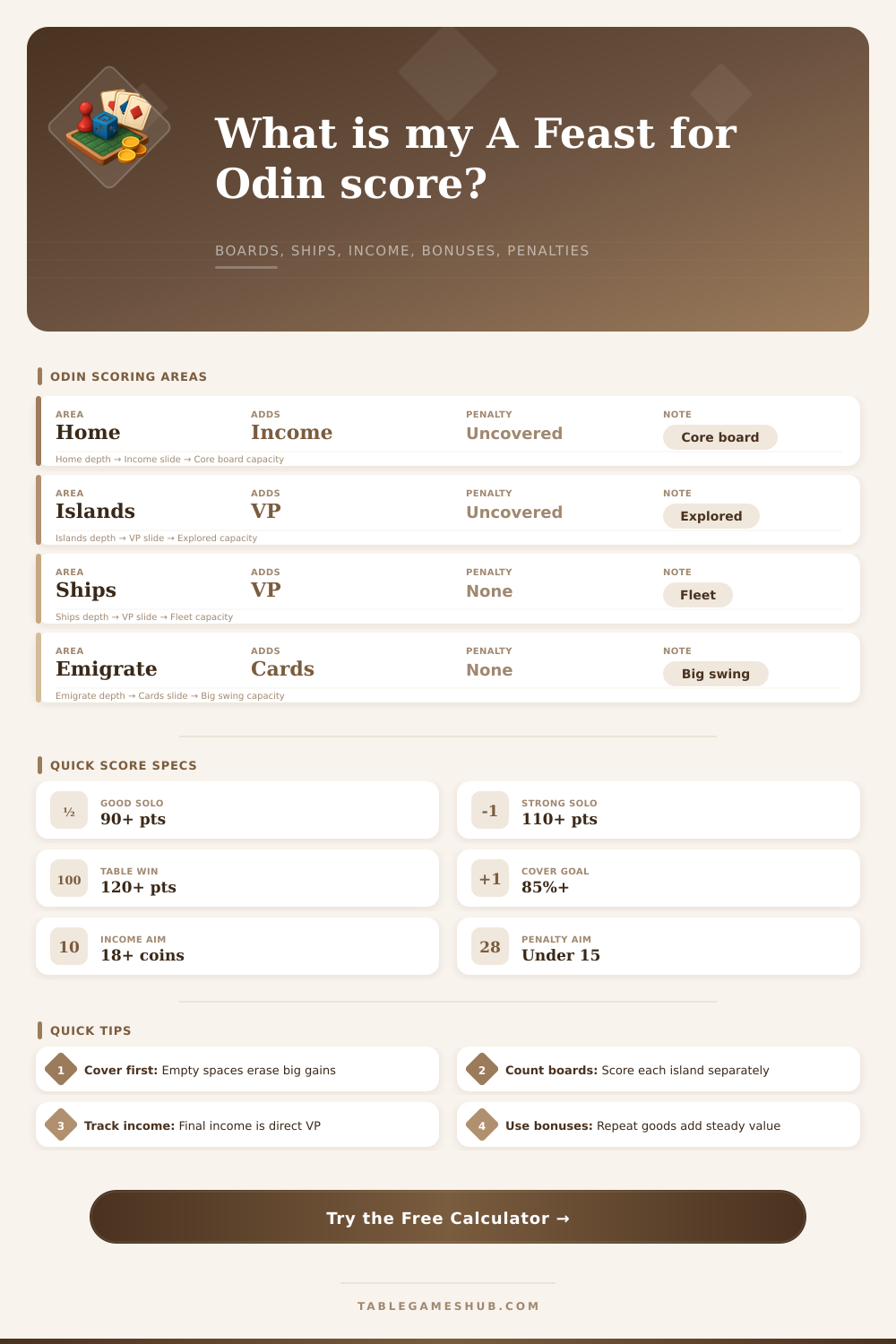
Total your home board, exploration boards, ships, emigration, income, bonuses, livestock, silver, and uncovered penalties.
Enter the scoring lines from your final board state. The calculator separates positive point engines from uncovered negative spaces so you can see whether your score is driven by income, expansion, emigration, or clean goods coverage.
| Score area | What to enter | Typical range | Calculation note |
|---|---|---|---|
| Home board coverage | Visible negative numbers | 0 to 40 loss | Subtract all uncovered printed penalties. |
| Islands and exploration | Printed board points minus open penalties | 8 to 70 net | Score each board separately before summing. |
| Houses and sheds | Printed points and uncovered negatives | 0 to 25 net | Bonus access is separate from printed VP. |
| Income and silver | Final income plus coin count | 5 to 35 points | Count final income directly as score. |
| Board plan | Strong signal | Watch item | Score profile |
|---|---|---|---|
| Home board income | 18+ final income | High open spaces | Stable, compact scoring |
| Exploration spread | 40+ island points | Island penalties | High ceiling, high cleanup need |
| Emigration rush | 25+ card points | Feast timing | Late scoring spike |
| House engine | Repeated bonuses | Small board gaps | Incremental point flow |
| Coverage level | Filled spaces | Penalty target | Endgame meaning |
|---|---|---|---|
| Loose finish | Under 70% | 25+ loss | Many points remain exposed. |
| Playable finish | 70% to 82% | 15 to 25 loss | Good for learning games and wide boards. |
| Clean finish | 83% to 92% | 6 to 14 loss | Most high-value gaps are patched. |
| Expert finish | 93%+ | 0 to 5 loss | Goods placement is nearly optimized. |
| Scoring band | Solo read | Table read | Likely driver |
|---|---|---|---|
| Under 70 | Learning result | Trailing | Coverage gaps or low income |
| 70 to 94 | Solid baseline | Competitive in low tables | One engine completed |
| 95 to 119 | Strong solo score | Often competitive | Clean board plus expansion |
| 120+ | Excellent finish | Win-range result | Multiple engines scored cleanly |
| Component | Score type | Direct input | Penalty interaction |
|---|---|---|---|
| Home board | Income, bonuses, penalty cleanup | Uncovered negatives, income | Every visible negative subtracts from total. |
| Exploration boards | Printed VP and extra income spaces | Island VP, uncovered penalties | Expansion only pays fully when covered. |
| Ships and emigration | Printed points and card points | Ship VP, emigration VP | No board penalty, but timing affects feast stability. |
| Houses and sheds | Printed VP, bonuses, storage space | House VP, house penalties | Small boards can leak points if left open. |
The game A Feast for Odin require that a person manage multiple game engine at the same time, as well as manage the gaps on the game board to avoid turning positive points value into penalties. The final score for the game isnt simply the sum of the number printed on the game board for each area; additional factor that must be considered for the final score are the number of spaces that were covered, the income that was generated on the last turn of the game, and whether the emigration cards or ship points were worth the time required to play them. Each of the game input can be understood in part because understanding each of them will indicate why one input is more important than another within the game.
One of the main factor to consider in the game is the coverage of spaces, and why this is an important factor for the game; each empty space on the home board or exploration island will reduce the final score for that player. The points that are subtracted for each empty space is often greater than the points that can be earned from the space of interest itself. The fields for covered spaces and open spaces will turn the player feeling about the board into a percentage, which will indicate if the player’s placement of their goods on the board was in accordance with their expansion of the board.
What affects your final score in A Feast for Odin
While empty spaces on the board may weaken a high score for an exploration island, a low score for that island will likely be considered more succesful. Income is another of the main factor that will impact the game score. Income both act as a resource that can be used to power the game’s actions, as well as contributes directly to the player’s final score.
Many player may focus on income as a resource rather than a contributing factor to the score; however, if players dont use income in this way, they may lose ten or fifteen points as a result. The game calculator will display the percentage of the score that came from income; this percentage will help players to decide whether they should focus on performing more whaling action to increase their score, or if they have enough ship to achieve their goal. Emigration cards and occupation effect will lead to changes to the final score for each player, and these effect feel as though they may contain points that are earned for free; however, players should consider the impact of focusing on these effect too heavy for their goals.
The game contains a field for recording whether the player had a thin supply of goods at the end of the game, which will allow them to record this without changing the math of their score. Additionally, the same logic apply to houses and sheds (each of which have small point values) because houses and sheds may unlock bonus tiles for the game. The bands of score that the score calculator establishes for A Feast for Odin are not strict goal that must be achieved; rather, they are reference points for players.
For instance, a 95-point score in a four-player game will not be the same as a 95-point score in a game where one player compete against the computer. The game does allow players to select the number of players that they are using in the game. Additionally, the game will provide a breakdown of the points that were earned on the board versus the points earned from the game engines.
Such a distinction is helpful in that it indicate in what area a player can focus their efforts to improve their score. It is easy for players to become enamored with the largest number in the game, and to focus on creating that large number; however, if players do not pay attention to other factor in the game, they may introduce error into their strategy. For instance, focusing on other aspect of the game different than the production of goods will lead to empty spaces on the home board; these empty spaces will reduce the player’s score.
Such a penalty is indicated in the game, showing the penalty load that the player will suffer; if the penalty load and the positive score are close together, the coverage of the home board was the determining factor for the game outcome. One of the most common error is to ignore how feast stability will impact the final round of the game. While feast stability does not impact the score that the game calculates, it does have an impact upon whether or not the player could of taken additional action during the final round.
Entering the player’s score information into the game worksheet will impact the way that they play the game over time. For instance, entering the score will allow the player to become aware of open space on the game board earlier in the game. Additionally, the player will become aware of the income that the player earns, and will use such knowledge to determine whether using an emigration card will help the player achieve their goal.
Additionally, while the calculation remain the same for the score, the player will have increased ability to read the numbers that are presented to them during the game.