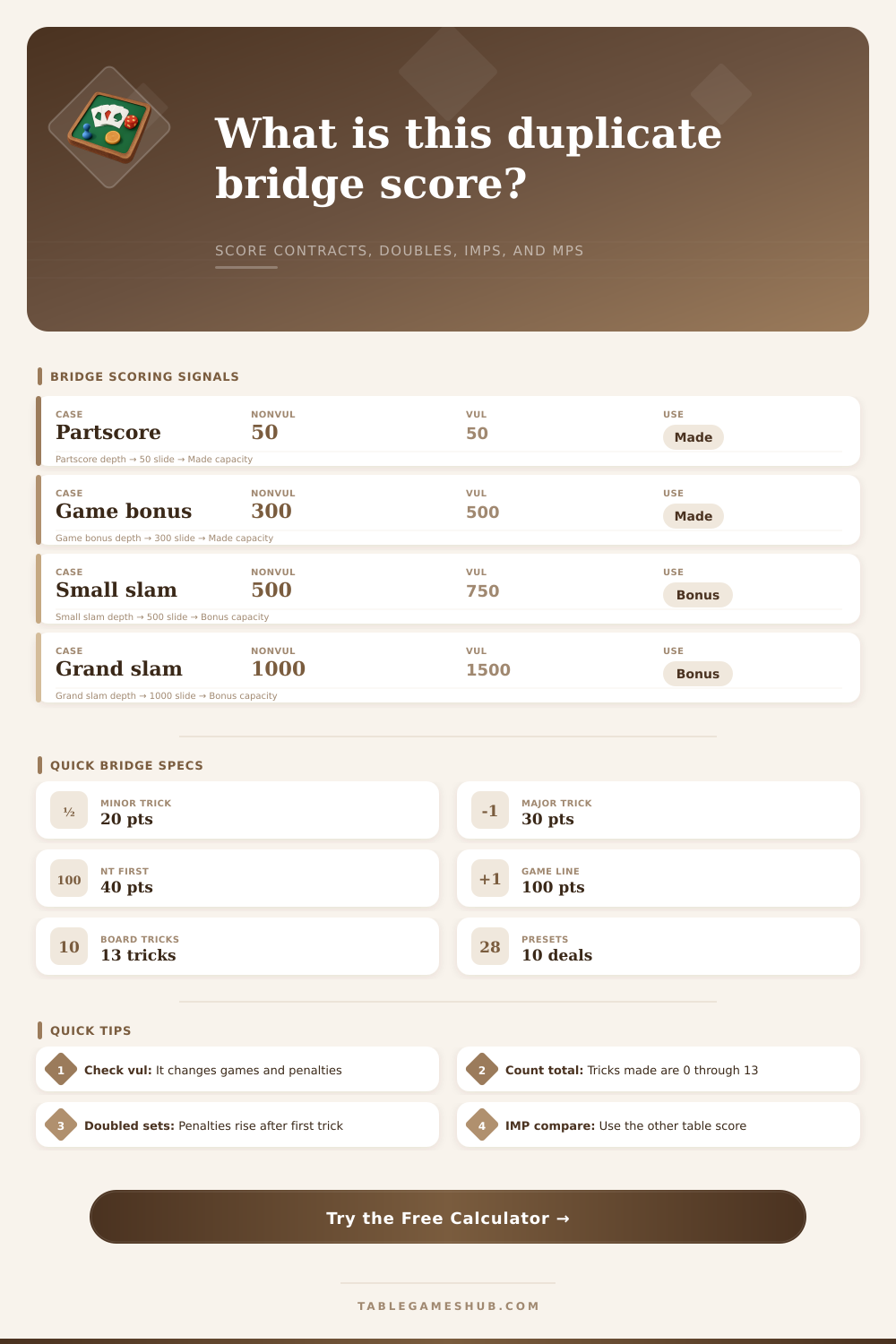
Duplicate Bridge Score Calculator
Score a contract from level, strain, vulnerability, doubling status, and tricks made, then compare the result with IMP or matchpoint references.
| Strain | Base trick value | Game at | Notes |
|---|---|---|---|
| Clubs | 20 per bid trick | 5 clubs | Minor suit game requires 11 tricks. |
| Diamonds | 20 per bid trick | 5 diamonds | Same score structure as clubs. |
| Hearts | 30 per bid trick | 4 hearts | Major suit game requires 10 tricks. |
| Spades | 30 per bid trick | 4 spades | Same score structure as hearts. |
| No trump | 40 first, then 30 | 3 no trump | First bid trick has the extra 10 points. |
| Made contract bonus | Not vulnerable | Vulnerable | Applied when |
|---|---|---|---|
| Partscore | 50 | 50 | Contract trick points under 100. |
| Game | 300 | 500 | Contract trick points are 100 or more. |
| Small slam | 500 | 750 | Level 6 contract is made. |
| Grand slam | 1000 | 1500 | Level 7 contract is made. |
| Doubled insult | 50 | 50 | Doubled contract is made. |
| Redoubled insult | 100 | 100 | Redoubled contract is made. |
| Undertrick case | Not vulnerable | Vulnerable | Penalty pattern |
|---|---|---|---|
| Undoubled | 50 each | 100 each | Simple penalty per undertrick. |
| Doubled first | 100 | 200 | First doubled undertrick. |
| Doubled second and third | 200 each | 300 each | Middle doubled penalties. |
| Doubled fourth plus | 300 each | 300 each | Additional doubled undertricks. |
| Redoubled | Double doubled penalty | Double doubled penalty | Redouble doubles all penalty bands. |
| Score difference | IMPs | Score difference | IMPs |
|---|---|---|---|
| 20 to 40 | 1 | 750 to 890 | 13 |
| 50 to 80 | 2 | 900 to 1090 | 14 |
| 90 to 120 | 3 | 1100 to 1290 | 15 |
| 130 to 160 | 4 | 1300 to 1490 | 16 |
| 170 to 210 | 5 | 1500 to 1740 | 17 |
| 220 to 260 | 6 | 1750 to 1990 | 18 |
| 270 to 310 | 7 | 2000 to 2240 | 19 |
| 320 to 360 | 8 | 2250 to 2490 | 20 |
| 370 to 420 | 9 | 2500 to 2990 | 21 |
| 430 to 490 | 10 | 3000 to 3490 | 22 |
| 500 to 590 | 11 | 3500 to 3990 | 23 |
| 600 to 740 | 12 | 4000 plus | 24 |
In duplicate bridge, the scoring for each round are based off how the outcome compares to the results of the other pair. In duplicate bridge, you dont only care about whether you have won or lost the hand, but also how your score compares to each of the other pairs that play the same hand. There are many different variable involved in calculating a score for duplicate bridge.
These variables include the vulnerability levels of the players, whether the contracts were doubled, and whether the contracts achieve a partscore or a game. Each contract in duplicate bridge has different reward based on the type of contract that is played. If a player choose to play a contract of a minor suit, they must win more tricks to reach the threshold of a game contract than if they had chosen to play a major suit or an no trump contract.
How Scoring Works in Duplicate Bridge
A player must define the level and strain of their contract to understand the risk of their hand. Vulnerability is a status for each pair that change the points that are awarded to each pair in the game. If a pair is vulnerable, then the penalties for failing to make the contract are increased, as are the bonuses awarded for making the contract.
Thus, vulnerability increases the risk of the hand for the player, but also increases the potential reward from the hand. The vulnerability of the pair will determine how many point that each pair scores or loses. Another variable in duplicate bridge is the doubling of the contracts.
A double to a contract increase the points that are awarded to a player if they make their contract, as well as the penalties that is applied to them if they fail to make their contract. Thus, if a player makes their doubled contract, the player earns a bonus point to their score. However, if they fail to meet their contract, the penalties to their score rapidly increases with each additional undertrick that their contract failed to achieve.
There are two primary way to translate a score into standings for duplicate bridge: through the use of matchpoints and International Match Points (IMPs). In matchpoint scoring, each player want to score higher than as many other pairs as possible. Thus, a score of 430 is considered higher than 420, even if the difference is minimal.
For IMP scoring, players wish to maximize the magnitude of their score. Thus, a large difference in score will result in a large swing in IMP points, but a small difference will result in a small swing in IMP points. IMPs are a relative measurement of the difference in scores between two different result for bridge rounds.
If each player makes the same contract as another player, the IMP difference are zero. Thus, the IMP difference is not based on the raw score that a player earns, but is based on the gap between their score than that of another player. Overtricks is a value awarded to a player when they win tricks beyond those required to fulfill their contract.
Overtricks can be important in determining standings in matchpoint bridge. For instance, winning thirteen tricks instead of ten will improve a player’s standing in that deal. However, overtricks are less important in IMP scoring.
For instance, the IMP score will not reward a player for attempting to win overtricks beyond fulfilling their contract. Many player may commit mistakes with the specific rules of duplicate bridge scoring. For instance, a player might forget the vulnerability of their opponents, or they might forget that the first trick in a no trump contract is worth a different number of point than the other tricks.
These types of error can be avoided with the use of reference tables, which provide a reminder of the scoring constants in duplicate bridge. Overall, understanding how duplicate bridge scoring works allow for players to bid with intention to maximize their scoring opportunity.