Dominion Intrigue Calculator
Total an Intrigue endgame with Estates, Duchies, Provinces, Colonies, Curses, Duke pairing math, Nobles, Harem, deck size, Action payload, and optional VP token or landmark points.
| Card or source | Score formula | Expansion context | Calculator field |
|---|---|---|---|
| Estate | Estates x 1 VP | Base Victory pile or starting card | Estate and Curse cards |
| Duchy | Duchies x 3 VP | Base pile that also feeds Duke | Duchies and Duke cards |
| Province | Provinces x 6 VP | Common game-ending Victory pile | Province and Colony cards |
| Colony | Colonies x 10 VP | Optional Prosperity-style ending | Province and Colony cards |
| Curse | Curses x -1 VP | Penalty card from attacks and kingdom effects | Estate and Curse cards |
| Intrigue card | Score rule | Common audit cue | Why it matters |
|---|---|---|---|
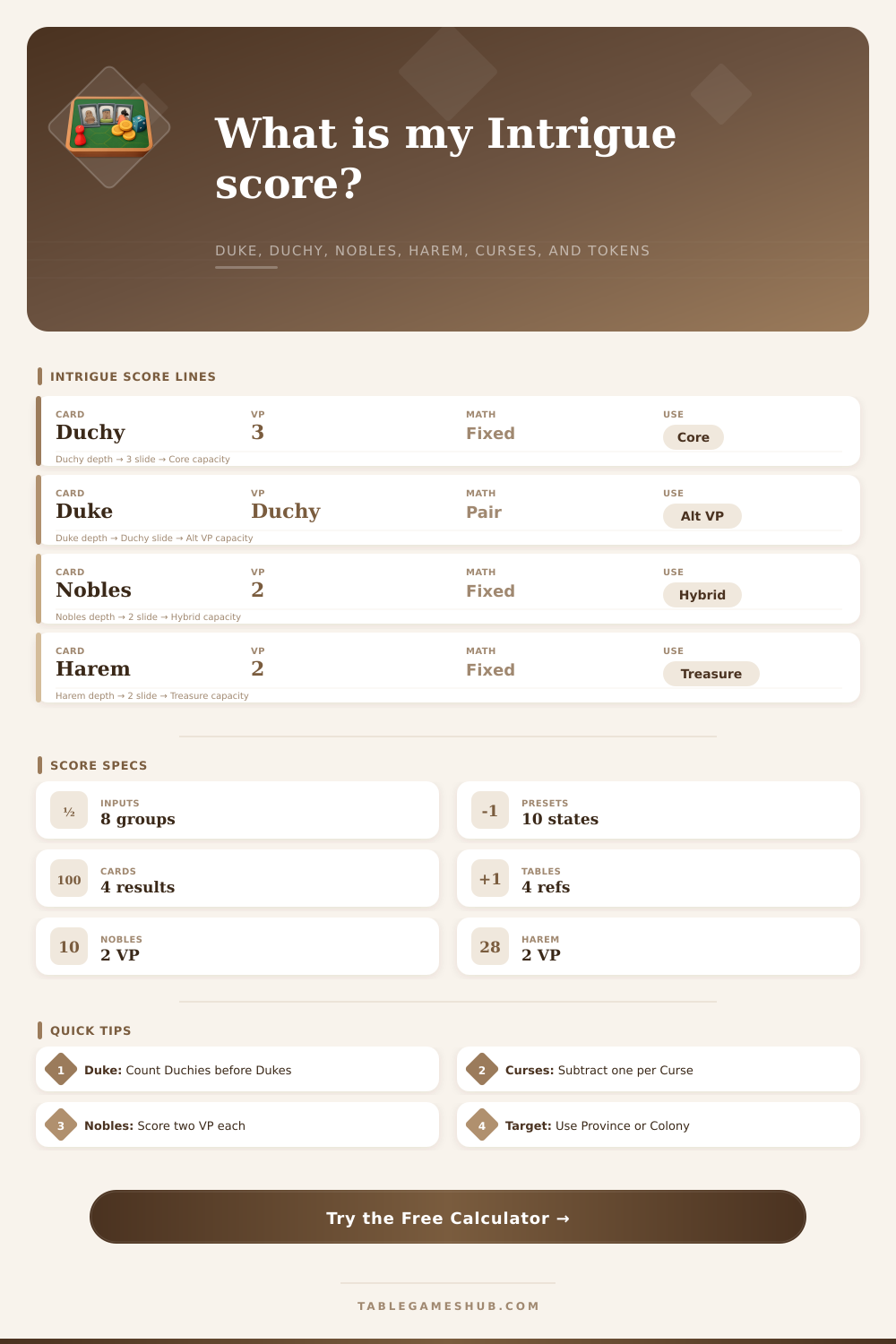
| Duke | Each Duke scores 1 VP per Duchy you own | Count Duchies first, then multiply by Dukes | Turns a Duchy pile into a second score engine. |
| Nobles | 2 VP per copy | Counts as both Action and Victory for ownership | Adds fixed VP while supporting Action payload. |
| Harem | 2 VP per copy | Counts as both Treasure and Victory for ownership | Raises money density without leaving scoring behind. |
| VP tokens | Direct points | Add only tokens actually held at game end | Optional for mixed sets or landmark tables. |
| Target setting | Benchmark | Best use | Score interpretation |
|---|---|---|---|
| Province finish benchmark | 36 VP | Standard four-player Province endings | Six Provinces worth of pressure is the baseline. |
| Strong Province finish | 42 VP | High scoring Province games with Duchies | Checks whether Duke or hybrids beat a big green stack. |
| Colony finish benchmark | 60 VP | Tables with Colonies and higher ceilings | Province totals can look low beside Colony points. |
| Landmark or token finish | 45 VP | Empires-style points mixed into Intrigue kingdoms | Manual tokens can become the decisive swing. |
| Two-player compressed target | 30 VP | Two-player split piles and tighter Duchy races | Useful when the Province pile is smaller. |
| Score shape | Main signal | Payload cue | Audit note |
|---|---|---|---|
| Duke Duchy deck | Duke block beats plain Province count | Action share can be moderate | Each extra Duchy also adds 3 fixed VP. |
| Nobles engine | Hybrid VP plus many Action cards | High Action payload share | Nobles can be counted in Action payload. |
| Harem money deck | Treasure density with fixed VP | Lower Action payload can still score well | Harem is not an Action payload card. |
| Curse recovery | Penalty row drags total down | Payload may clean up but not score itself | Subtract Curses before comparing targets. |
In Dominion, winning or losing are determined by the scoring phase. You’ve bought cards, shuffled your deck, and you’re down to one last calculation: What’s each card worth? It is not just about basic cards; you might even draw a Duke at the end of the game. That might be more valuable then a Province card.
In the Intrigue expansion, they changes the scoring mechanism from raw addition to a network of interdependencies. It’s not enough to simply collect points; it’s building an engine that generates points depending on which other cards you possess. This makes manual calculations hard (you’ll get them wrong) and unnecessary. It gets trickier because Harems add hidden value and Curses subtracts value.
How the Calculator Helps You Score Points
So you can think about strategy, let’s leave the math to a calculator (above). It will count Colonies, Provinces, Duchies, and Estates for you. It will even handle these complex connections in this expansion.
The relationship between Duchies and Dukes is the most significant part here. A Duke does not have a fixed point value. Their value increase based off how many Duchies you own. Enter four Dukes and five Duchies into the calculator, and it’ll know that every one of those Dukes are worth five points. That means twenty points from dukes only, plus another fifteen from the Duchies. Nine cards net you thirty-five points. Rather then the normal thirty points for a decade of Duchies.
The density of your deck matters. How much VP per card? It lets you know if your deck is bloated or efficient. Some victory cards (Harem and Nobles) are hybrids: They score but also do something else for you. For example, Nobles gives you 2 VP per card but add more actions to your engine. Harems increase the number of treasures in play at the cost of that same VP.
The tool breaks out those cards separately when you log them as input. That way, it lets you know whether you’re winning by using an old-school victory strategy, or because you built a hybrid engine. Sometimes the math will show that purchasing Nobles is more worthwhile than pursuing Provinces even though your deck seems shorter.
Each curse will lower your overall score by 1 point. In a Duke-heavy strategy, curses can slip through your mind easy. The tool helps you be mindful about all the negatives. Three curses will add up and become active deductions that might swing the game if it’s a tight matchup. That penalty is right there in the breakdown and makes the price clear. You know not dealing with Curse attacks should of been a tax on your final score.
There’s also the layer of “what’s my endgame target selection?” What’s that? Well you choose a target such as the standard Province finish or a higher Colony threshold, or maybe even higher if you’re playing with an extra colony. Then you compare what you’ve got now to what a winning position is. Then you compare what you’ve got now to what a winning position is.
You might be deciding midway through the game whether to pick up one more Duchy to get the Duke multiplier effect, or keep room open for a card with points on it directly. The embedded reference tables on the page display those tradeoffs nicely so you can compare various victory combinations against popular standards. It’s not a judgment on how you play; It just shows what kind of deck you built.
A high action payload percentage show you’re building an engine; low action + high victory density means you’re building a score-and-cash strategy. Both are legit strategies. The tool removes the guesswork regarding how many points the Duke was worth and replaces it with the question, “Why did I have all those cards?
Mastering Intrigue isn’t about memorizing rules; it’s about understanding the leverage each card provides. There’s only learning leverage; what does this card do for me? How much does it count when I gain it? What card is used as a lever, and which is the one lifted by the lever? Which cards are both levers and weights?
And once you know those relations, how they work together, then points stop feeling like something to add up, and instead become something to diagnose. Your final deck tells the story of your turns, and the calculator checks that story is true, to the very last point.