Wingspan Oceania Calculator
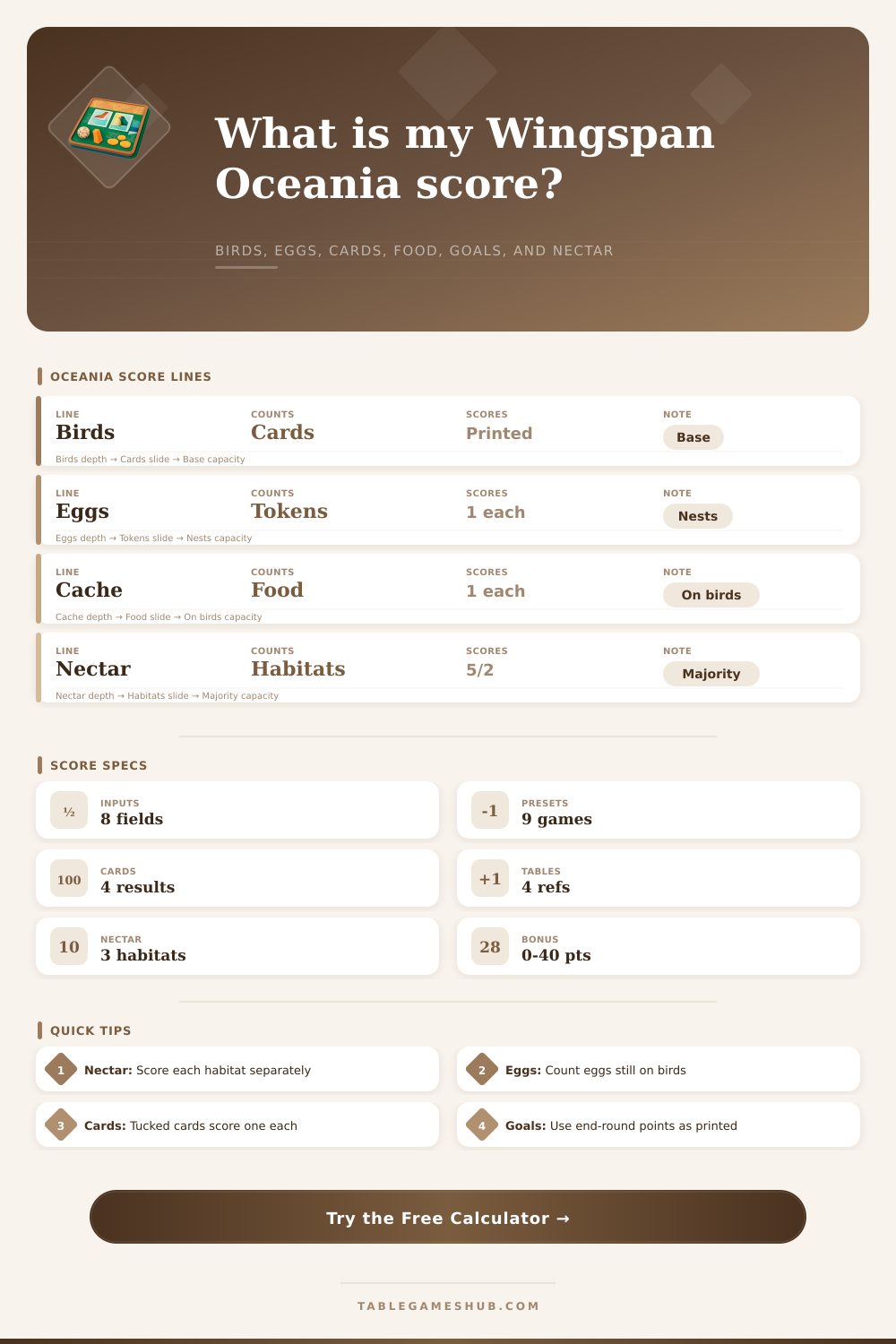
Total the Oceania endgame sheet with bird cards, bonus cards, end-round goals, eggs, cached food, tucked cards, spent nectar by habitat, and nectar majority bonuses.
| Score line | What to count | Point value | Calculator field |
|---|---|---|---|
| Bird cards | Printed points on played birds | Printed value | Printed bird card points |
| Bonus cards | Each completed bonus card | Card condition total | Bonus card points scored |
| End-round goals | Four round-goal awards | Goal board total | End-round goal points |
| Eggs | Egg tokens remaining on birds | 1 point each | Eggs remaining on birds |
| Token or card | Where it sits | Score rule | Common audit cue |
|---|---|---|---|
| Cached food | Food tokens on bird cards | 1 point each | Do not count food still in supply. |
| Tucked cards | Cards tucked under birds | 1 point each | Stacked tucks score individually. |
| Eggs | Eggs on nests | 1 point each | Discarded eggs do not remain. |
| Nectar spent | Habitat nectar slots | 5 or 2 majority points | Score forest, grassland, wetland separately. |
| Setting | First-place estimate | Second-place estimate | Best use |
|---|---|---|---|
| Automatic estimate | 5+ spent nectar | 1-4 spent nectar | Fast score-sheet draft when opponent totals are nearby. |
| Dominant board | Any spent nectar | None | You clearly led every habitat where you spent nectar. |
| Contested table | 6+ spent nectar | 3-5 spent nectar | Multiple players fought for the same habitat tracks. |
| Behind in nectar | None | 5+ spent nectar | You trailed most habitats but still may have second. |
| Score shape | Typical signal | Strong line | Watch item |
|---|---|---|---|
| Bird-heavy board | Bird points lead the sheet | 50+ printed bird points | Check low egg total is intentional. |
| Egg engine | Grassland actions paid off | 25+ eggs | Confirm nest limits were observed. |
| Tuck engine | Wetland card flow scored | 20+ tucked cards | Separate tucked cards from hand cards. |
| Nectar plan | Oceania majority swing | 10+ nectar bonus points | Compare habitat totals before final score. |
In the final few minutes of any game of Wingsspan, it’s time for point-counting. Your turn was your last. You’ve played your last card. And now comes the dreaded task of counting everything while everyone watches.
In Wingspan, with its many various points types and all of that goodness in the Oceania expansion, it’s simple to miss something when you’re tallying them up in the heat of the moment. You need to count not only the points on bird cards but also each egg, each tucked card, and those pesky little nectar majority bonuses that swing a close game. The flashy cards on the board, especially the high value birds, get most of the attention. But it’s those little ones that people don’t notice as quicklyly that can provide margin of victory.
Why You Should Use a Wingspan Scoring Calculator
Each egg on one of your nests are worth a point. Lose three and four of them while trying to calculate how many bird you have, and you just handed the game to someone who kept their eyes on detail. Plug all your numbers into the calculator above, and let it do the math for you. Don’t risk a math mistake when your brain is exhausted from ten rounds of strategic planning.
In Oceania, however, the nectar scoring system add a ton of complexity. Nectar isn’t like normal points; it has three habitats: wetlands, grasslands and forests. You need to keep track of separate spent tokens across these three different habitats. This matters because most of the bonuses is given by habitat, not globally. So even though you may be winning big in the forest, you could be losing the grasslands entirely. And many players makes the mistake of adding up all their nectar together and thinking they’ll recieve some sort of bulk bonus. That’s where leads become losses.
It’s right there on the page, in reference table. You can see that each of the habitats count as its own competition for those two or five point awards. And then there are the tucked cards. They’re easy to forget about, and I don’t even think it occurs to a lot of people when building their deck, but these little slips of paper stashed beneath your birds aren’t main cards, so they lacks the obvious printouts of points from the other side. They’re each worth a point. Add ‘em all up and those points add up quickly if you’ve built a tuck-based strategy. Don’t ignore them. That’s the efficiency of your engine, and you need to be sure you count every tucked card before finalizing your total.
The other variation is in bonus cards and end-round goals. These can add more twists and turns to a game that quickly becomes confusing when calculating math. Bonus cards usually have conditional scores… Like needing to hit a specific combination of numbers or a certain score, otherwise they is worth nothing at all. So yes, sometimes you’ll get zero even though you’re only off by one point. The end-round goals rotate each time you play, so past experience isn’t necessarily applicable. You need to go line-by-line and input that number exactly as shown on the board, otherwise it won’t work. That’s the tedious part but it has to be done for accurate results.
A specialized calculator has another advantage: it’s forced me to parse out my score by category. How many goal points? How many nectar points? How many token points? And how many bird points? When I break my score down this way, I know exactly which categories earned me points, whether a huge bird board won me the game or some sneaky combination of tucks and eggs pulled it out for me. Knowing what helped you earn that score in one game let you know what to adjust for next time.
In the end though, it’s never just about who wins. Scoring is about confirming that what you did was right. You honored the complexities of the system you spent three hours building by taking the time to count all those eggs and make sure you got every nectar bonus. The scores fall into place and you see exactly where your reserve stacks up to the rest of the table.
You should of used a calculator earlier.