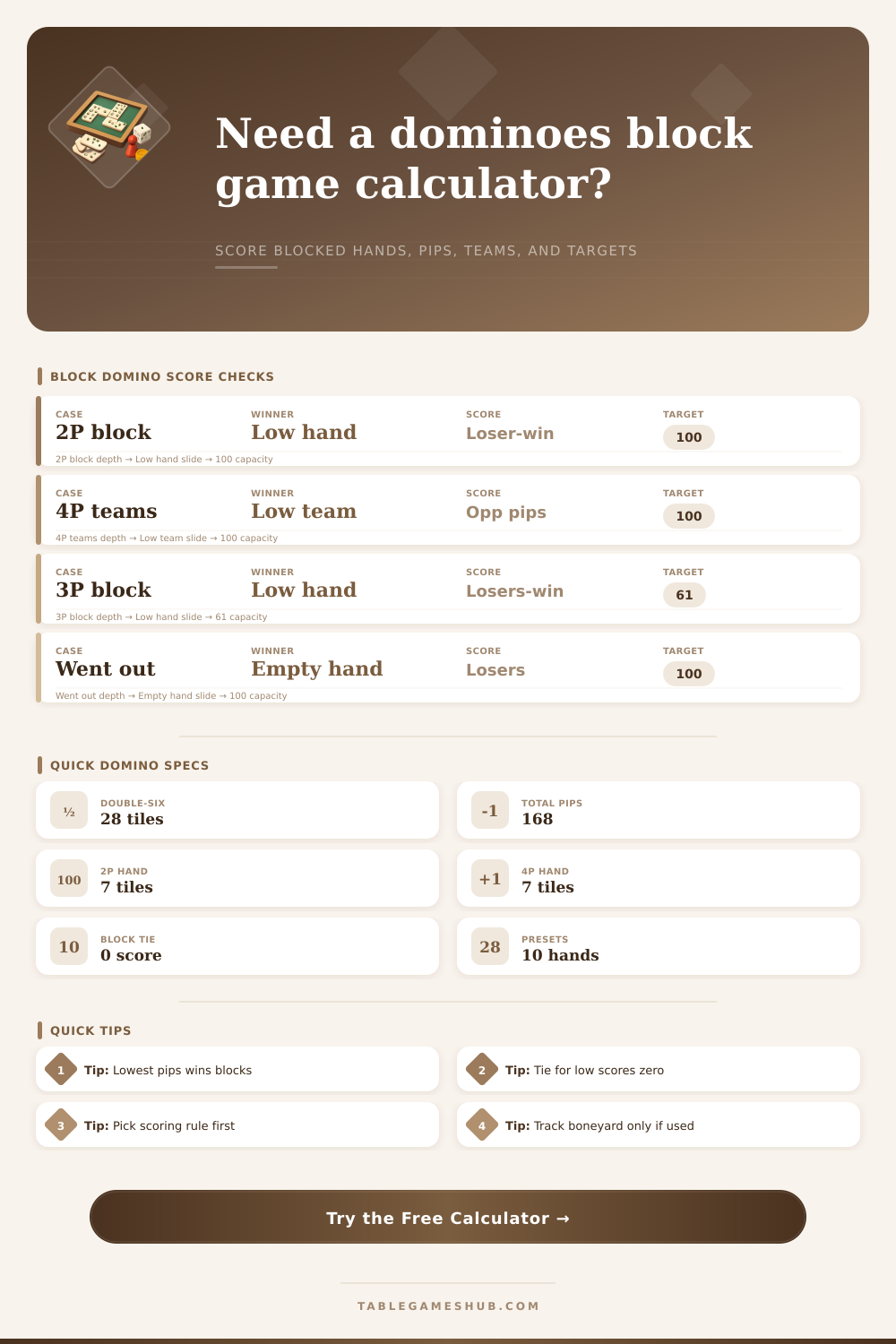
Dominoes Block Game Calculator
Score block domino rounds by hand pips, winner type, team format, rounding rule, current match score, and common double-six through double-fifteen set sizes.
PRBlock Domino Presets
Use a preset to load a complete scoring situation, then adjust hand pips, scoring rule, target, or team format.
INRound Inputs
HPHand Pips and Scores
FCFormula Cards
(n + 1)(n + 2) / 2Counts every unordered domino from blank through the selected highest double.
n(n + 1)(n + 2) / 2Checks whether remaining hand and boneyard pips are plausible for the chosen set.
loser pips - winner pipsCommon block scoring credits the lightest hand after subtracting that winner hand.
target - new scoreShows whether the round reaches the match target and estimates hands remaining.
DGDomino Component Specs
RTReference Tables
| Set Type | Highest Double | Tile Count | Total Pips |
|---|---|---|---|
| Double-six | 6-6 | 28 | 168 |
| Double-nine | 9-9 | 55 | 495 |
| Double-twelve | 12-12 | 91 | 1092 |
| Double-fifteen | 15-15 | 136 | 2040 |
| Format | Typical Draw | Blocked Winner | Common Target |
|---|---|---|---|
| 2 solo players | 7 each | Lowest player pip total | 100 |
| 3 solo players | 5 to 7 each | Lowest player pip total | 61 |
| 4 solo players | 5 to 7 each | Lowest player pip total | 61 |
| 4 with partners | 7 each | Lowest team pip total | 100 |
| Scoring Rule | Went Out | Blocked Hand | Best Use |
|---|---|---|---|
| Losers pips only | All other hands | Losing hands only | Simple home scoring |
| Losers minus winner | All other hands | Losers minus low hand | Classic block scoring |
| Opponents only | Opponent team hands | Losing team hands | Partnership matches |
| All unplayed plus boneyard | Hands plus stock | Hands plus stock minus winner | Draw-style variants |
| Situation | Winner Check | Score Check | Calculator Note |
|---|---|---|---|
| Player empties hand | Selected winner | Other hand pips | Winner pips are normally zero. |
| Blocked solo hand | Lowest player pips | Losers less winner | Tie for low returns zero. |
| Blocked team hand | Lowest team pips | Opponent or losing team pips | A+C are paired against B+D. |
| Rounded house score | Same winner | Nearest, up, or down to 5 | Use only if your table scores that way. |
TPCalculation Tips
Blocked hands: Enter the actual pip totals remaining in each hand before applying the rule. The lightest hand wins only if there is no tie for low.
House rules: Pick the scoring rule before comparing scores. Partnership, boneyard, and nearest-five tables can produce different totals from the same hand.
It’s the end-game: The debate typically erupts after the last tile has been played. “I have fewer pips left!” one player screams, while the opposing players at the table insist the numbers simply don’t match. That’s when a dominoes block game calculator goes from nice-to-have to must-have because it becomes the unbiased judge that will prevent friends from getting into an argument over bad math.
Dominoes isn’t rocket science (you don’t have to be a mathematician), but when all those tiles stop tumbling and it’s time to count, you want clear answers. Use the tool above to do all the work for you. Just input your pip totals, and you can concentrate on human dynamics instead of the digits.
How a Dominoes Calculator Helps You Win
Half the challenge of figuring out how block dominoes realy work is getting that. In a draw variant, you keep pulling from a boneyard until you can’t make a move. In block, you stop once nobody can go and that puts a whole different spin on things, since what’s left in your hands is so important. It doesn’t matter if you’ve been at it for five hours or not; if you have tons of doubles and he has mostly singles, sorry, you’re done for.
The calculator takes all that into consideration, allowing you to enter exactly how many pips remain in each player’s hand. Then it factors in the scoring rule your crew uses (which can be crazy varied based on who taught you or where you come from).
The biggest source of confusion is likely a blocked round and determining who won. Some groups base it purely on total number of pips for the loser(s). Others take the low number of the winner and subtract the high number of the loser(s), which creates a different point spread altogether. Depending on which rule you use, a round could go from a minor victory to a crushing loss. With this calculator, you can switch back and forth between both rules so all parties agree on the result before dealing the next hand. You will no longer argue over whether a tie means no points are earned, or if the boneyard should be included in the final score.
There’s an additional level of complexity for those who play teams against other teams, something that’s never part of the equation for solo players. Rather than simply worrying over your own hand, you must also take into account the overall pip count between both player on your team and the other pair. Suddenly, the strategy becomes one of cooperative load balancing instead of “how do I make it to the end myself?” Now a player can be carrying a heavier tile because they’re saving their partner from being stuck with even more pips. While you could try to track all this in your head as well as keep an eye on the board, the tool makes the logistics of “who owes who” much simpler by totaling up the scores across everyone hands.
Beyond this, the domino set itself determines how quickly and how wildly the game plays out. Most commonly used is a standard double-six set of twenty-eight tiles totaling 168 pips. That’s a speedy, snug game; it’s ideal for a fast round around the family or coffee shop. But serious competitors often use larger sets: double nine or even double twelve. These larger sets introduce more variability and longer games because there are simply more combinations to work through. The calculator fits those bigger sets, changing the number of tiles to be expected and their associated piptotal to match. It keeps the same scoring system working no matter if you’re at home on your kitchen table with a small set or in a tournament room with something much bigger.
There’s also another variable in terms of strategy: your target score. Is it sixty-one points? Or a hundred? Is it sixty-one? Is it a hundred? If it’s low, then each round is more important. Each time you retain some pips, it matters more. It also matters how aggressively you race ahead at the start to keep your own pips down. If it’s high, then you can afford to take a little more risk and still recover from having a bad hand at the start. With this tool, you can specify what those targets are and see how far away you are from reaching them in real time. It will even tell you roughly how long until you’re done based on the average length of hands. This is useful when you need to squeeze in a game between appointments or dinner.
Rounding: You might also discuss house rules about rounding. Some people like to round up their scores to the next 5 to get the game moving faster and have cleaner numbers. Other people like to go with the exact number because they are more precise. This is really a personal preference but just be sure you all agree on one way or another and then follow through when things get hot so no one gets confused. That’s why having this calculator is helpful. It shows that final score reflects whatever house rule your group has come up with, which gives everyone a point of reference to trust and takes away any emotion involved with rounding off scores.
At its core though, dominos is a game of probability and pattern recognition. You have an idea of where most of the pieces might be blocked. So do you go on the offensive or defensive? And then there’s understanding the value behind those choices so that the game can actualy be fun and fair for everyone involved. That’s what the calculator does. It makes it easier for you to make those plans. You will spend less time trying to figure out who owes whom mathematically and more time making your next move. Ultimately, winning isn’t even about hitting the goal score as much as getting through the game without anyone leaving mad.