Bridge Hand Probability Calculator
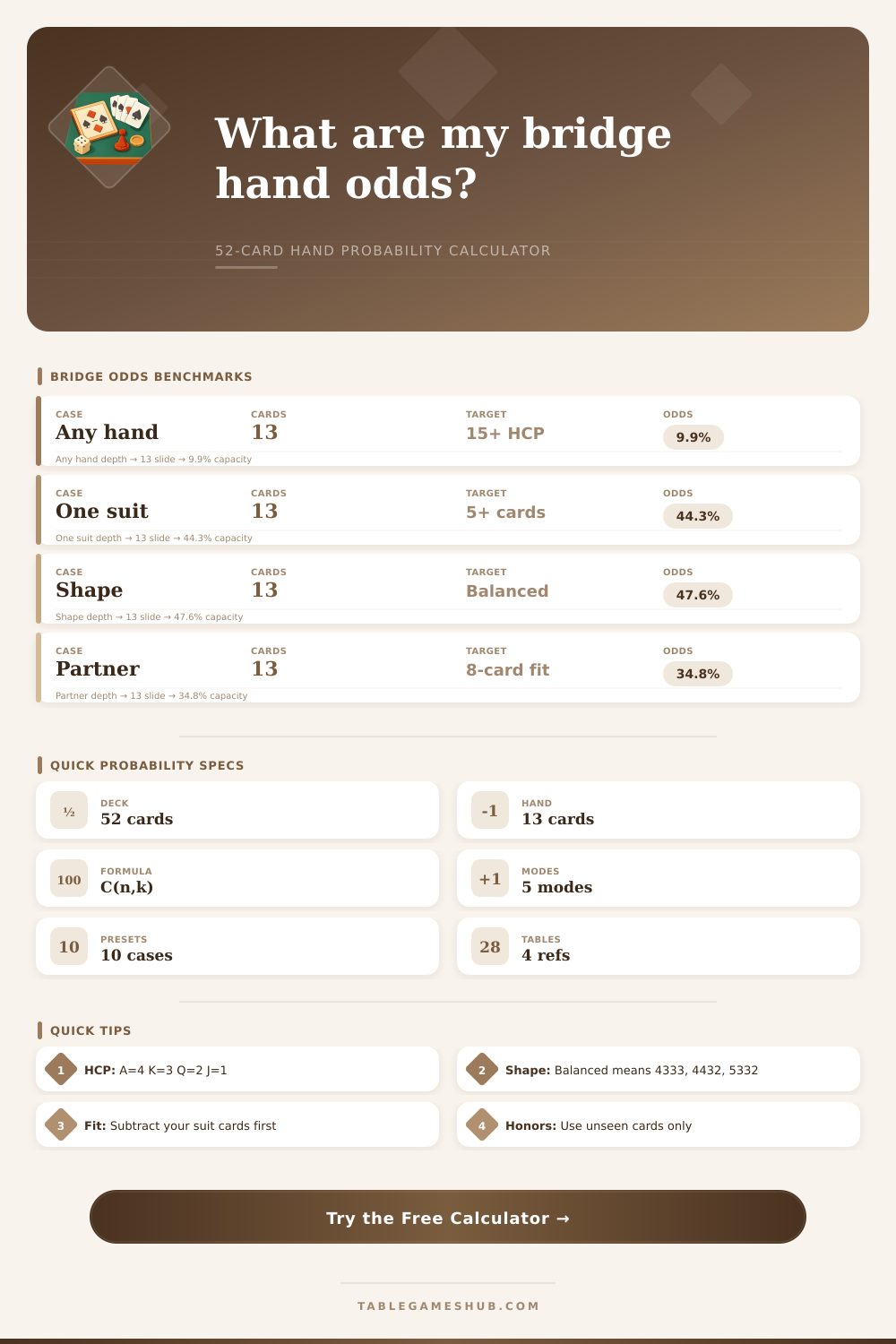
Calculate 52-card bridge odds for 13-card hands, HCP ranges, suit length, balanced shapes, partnership fits, and missing honors.
| Bridge range | HCP band | Approx chance | Common use |
|---|---|---|---|
| Weak hand | 0-5 HCP | 10.2% | Low-card partscore hands |
| Average hand | 9-11 HCP | 27.2% | Invitation context |
| Opening values | 12-14 HCP | 20.6% | Minimum opener range |
| Strong no-trump points | 15-17 HCP | 10.1% | Often paired with balanced shape |
| Very strong | 18+ HCP | 4.0% | Game-force style strength |
| Scenario | Deck model | Target | Probability note |
|---|---|---|---|
| One named suit | 13 successes in 52 | 5+ cards | Hypergeometric hand count |
| One named suit | 13 successes in 52 | 6+ cards | Long-suit opening checks |
| Partner after 5-card suit | 8 remaining in 39 | 3+ partner cards | 8-card fit chance |
| Partner after 6-card suit | 7 remaining in 39 | 3+ partner cards | 9-card fit chance |
| Shape family | Distribution | Included here | Why it matters |
|---|---|---|---|
| Flat balanced | 4-3-3-3 | Yes | No singleton or doubleton |
| Classic balanced | 4-4-3-2 | Yes | Most common balanced type |
| Semi-balanced | 5-3-3-2 | Yes | Often included in no-trump shape |
| Unbalanced | 6-card suit or shortness | Optional | Excluded by balanced preset |
| Honor question | Unseen cards | Sample hand | Calculator setup |
|---|---|---|---|
| One defender has an ace | 26 | 13 | Missing honors 1, exactly 1 |
| One defender has A or K | 26 | 13 | Missing honors 2, at least 1 |
| One defender has both A and K | 26 | 13 | Missing honors 2, exactly 2 |
| One defender has two of AKQ | 26 | 13 | Missing honors 3, at least 2 |
Bridge is a game that is played with incomplete informations. Because bridge is played with incomplete information, bridge is a game of percentage and probabilities. With the thirteen cards that you are dealt in bridge, you has a portion of the deck.
You must determine how the remaining of the deck (the thirty-nine remaining card) are distributed to the other three players. For instance, if you have five of the thirteen spades in your hand, eight of the thirteen spades is remaining in the other thirty-nine cards that the other three players hold. You must calculate how these eight remaining spades are distributed among your partner and your opponents.
How Probability Helps You Play Bridge
The assumption of how cards is distributed in bridge isnt always true of the game; you must use probabilities to determine how the remaining cards may be distributed in the opponents’ and partner’s hands. High Card Points is used to determine the strength of a bridge hand. However, High Card Points are not the only measurement of the strength of a bridge hand.
While a player may have twelve High Card Points, which is often a standard opening bid, the distribution of those High Card Points matters. For instance, a four-four-three-two distribution of suits are considered to be a balanced bridge hand. A balanced bridge hand is often used in No Trump openings.
It is a mistake to value a bridge hand solely on the High Card Points it contain, as the distribution of those High Card Points may significant reduce the overall value and power that those High Card Points can contribute to winning tricks. The length of a suit that a player holds is indicative of the power of a players bridge hand. For instance, a six-card suit is a powerful bridge hand.
However, a six card suit only become powerful if the player’s partner contains cards in that same suit. By counting the number of cards a player has in each suit, a player can determine how many card are missing from that players hand. By calculating the probability that the partner of the player has a specific number of cards in that suit, the player can transform their guess about their partner’s bridge hand into calculated risks.
Probability can also be used in determining the best play for a players hand when playing for missing honors, such as an Ace or the King of a specific suit. If a player is missing the Ace and the King of a specific suit, the player must decide whether to play for a finesse or to play for drop. Both of these plays can be evaluated based off the mathematical probability of the location of those missing honor.
Many players may feel that they can rely on luck when searching for their missing honors. However, mathematical probabilities can determine the likelihood of the opponents holding specific honors. With these probabilities as the player’s guide, the player can determine the best line of play for their bridge hands.
It is critical to understand the difference between the odds of being dealt a specific bridge hand and the odds of any specific card being located in a specific location within that bridge hand. The deal first makes the odds of being dealt a specific bridge hand occur to the players. However, the players evaluate the odds of a specific card being in a specific location over the course of the bridge game.
For instance, the reference table for the frequency of different bands of High Card Points can help to determine how likely it is for any player to be dealt a hand with such High Card Points. Because the odds of being dealt such a strong bridge hand are rare, most bridge hand will fall somewhere in the middle of the High Card Point bands. Therefore, most bridge hands will be average bridge hands.
Because most bridge hands are average bridge hands, the bridge game is usually won or lost through marginal bid and invitations. While probabilities are used to provide baseline measurements and calculations for the bridge game, the probabilities does not account for the human elements of bridge. For instance, a calculator will never be able to determine if a partner holds High Card Points but is cautious about bidding for those tricks, or if an opponent display a sign while the deal is occurring that indicates the opponent holds a specific bridge card.
Thus, while probabilities can account for the general structure and limitations of bridge, players must use their bidding and their play to determine when to deviate from those probabilities. For these reasons, if players dont have an understanding of the probabilities of bridge in their favor, they will feel that they are merely guessing during the bridge game and relying upon luck. However, by understanding these probabilities, the game of bridge can be transformed from one of luck to a game that players can manage to achieve their desired outcomes.