Sevens Dice Calculator
Calculate total-seven odds, dice-pool pair risk, multi-roll streak chances, expected seven hits, and a clean dice tray setup for tabletop sevens games.
🎲Preset Sevens Scenarios
Pick a realistic table situation, then adjust the dice count, rolls, target, tray size, and buffer.
⚙Calculator Inputs
▣Dice Component Spec Grid
📊Reference Tables
| Two-dice total | Combinations | Probability | Sevens note |
|---|---|---|---|
| 2 or 12 | 1 each | 2.78% each | Rarest totals |
| 3 or 11 | 2 each | 5.56% each | Edge totals |
| 4 or 10 | 3 each | 8.33% each | Low-middle totals |
| 5 or 9 | 4 each | 11.11% each | Near-center totals |
| 6 or 8 | 5 each | 13.89% each | Next to seven |
| 7 | 6 | 16.67% | Most common total |
| Dice in pool | Pair checks | At least one 7 pair | Use case |
|---|---|---|---|
| 2 dice | 1 | 16.67% | Classic seven check |
| 3 dice | 3 | 44.44% | Small party roll |
| 4 dice | 6 | 61.11% | Fast teaching tray |
| 5 dice | 10 | 76.85% | Group score sheet |
| 6 dice | 15 | 86.27% | Drop-style pool |
| 8 dice | 28 | 96.32% | Large dice bucket |
| Rolls with two dice | No seven | At least one seven | Expected sevens |
|---|---|---|---|
| 1 roll | 83.33% | 16.67% | 0.17 |
| 3 rolls | 57.87% | 42.13% | 0.50 |
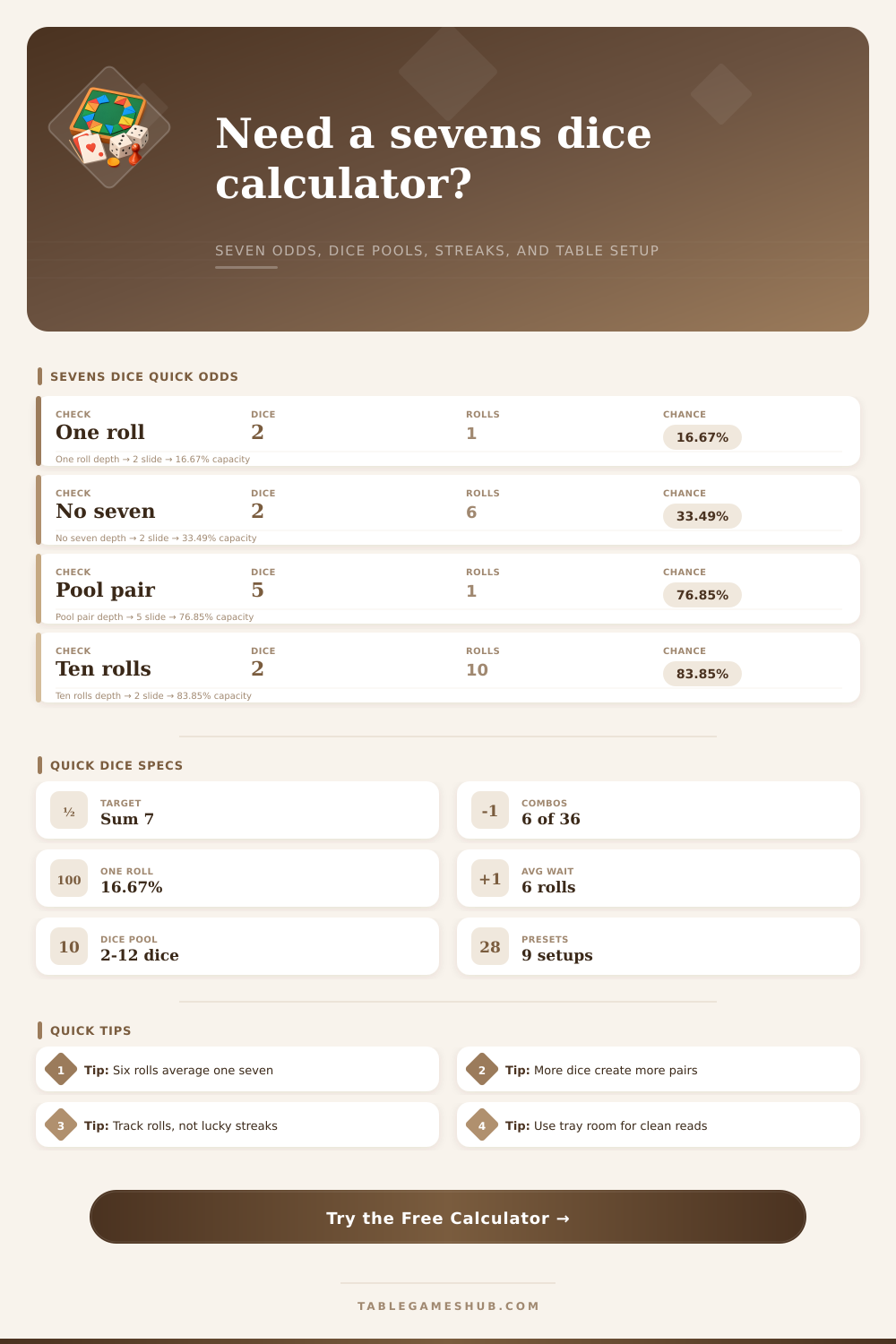
| 6 rolls | 33.49% | 66.51% | 1.00 |
| 10 rolls | 16.15% | 83.85% | 1.67 |
| 18 rolls | 3.76% | 96.24% | 3.00 |
| 24 rolls | 1.26% | 98.74% | 4.00 |
| Setup | Dice | Players | Tray guidance |
|---|---|---|---|
| Solo practice | 2 | 1 | 8 x 6 in tray |
| Teaching round | 4 | 2-4 | 10 x 8 in tray |
| Family table | 6 | 3-6 | 12 x 8 in tray |
| Large rotation | 8 | 6-10 | 14 x 10 in tray |
| Classroom station | 10 | 8-12 | 16 x 12 in tray |
| Travel mini set | 6 | 2-4 | 6 x 4 in tray |
ℹTable Sevens Tips
Keep the math unit clear: a two-dice seven is one event per roll, while a dice pool checks every possible pair inside the same throw.
Give dice room to settle: a tray that is at least ten die-widths across makes seven pairs easier to read without bumping previous results.
Plastic cubes drop into a tray, scattering against each other before settling somewhere unknown. For players, that’s the moment when things get crazy, but if you pay close attention, there’s nothing random happening here; it’s probability in action.
In all kinds of table top gaming, seven occupies a special position: it’s the statistical center of gravity when two six sided dice is rolled together. It shows up more frequent than any other possible result, making it the center of tabletop gaming across every spectrum from the simplest classroom activity to sophisticated gambling simulations.
Why Seven Happens Most Often
To see how this works with seven, you have to step back from the apparent randomness of any particular throw and look at the combination of possibilities. You know what they say; give someone enough rope and they’ll hang themselves. I suppose that applies to dice pools too, even if it’s an incredibly crude metaphor.
To be clear: The calculator up top do the math for you. But understanding what those inputs represent alters your gameplay. Choosing a mode of dice pooling doesn’t simply involve dumping more dice into the pot. It’s more than just adding more dice to the pile. Instead of a pair of dice having one chance-per-roll to total seven, you’re selecting an option that massively multiplies number of ways that seven can occur.
One pair of dice represent one chance on each roll. Two additional dice make three different pairs active during any given moment. And that is where people misunderstands. They think that having more dice means linearly higher odds. But that is not how math work. Each new die introduces new relationships with all the others inside the tray. The number of potential pair expands exponentially. It becomes impossible to keep pace with the scope of possibilities. Rolling two dice doesn’t guarantee a seven. But rolling five or six? Seven is practically guaranteed.
It is not due to luck, but rather due to the fact that the number of possibilities grew beyond what our intuition can easy handle. This also applies to physical set up. If your dice tray is too small, then it creates physical constraints as well: dice bouncing into one another and ending up in a heap that’s hard to untangle or read. This is where fit check comes into play. It not only takes into account the number of dice, but also how much space they take up compared to size of the dice tray. That way you can ensure there’s enough space to roll cleanly without fear of the dice blocking each others’ views.
For instance, normal sized dice from gaming are typically about 1/2 inches across. If you’re using smaller (mini) dice then you may be able to fit six in a small travel dice tray. But if you’re trying to throw in a bit of buffer space for moving them around, then you might of struggling once you try to add some standard sized dice. That’s all part of the space math and is just as frustrating when you can’t get a good look at what happened. So, while you might have great chances on paper, if you can’t tell what happened then the game simply stops.
Things get more complicated when we consider multi-roll situations. For example, what’s the chance of rolling a seven if I use two dice? About sixteen percent. That adds up pretty fast. Independent probabilities add up faster than most people realize. This applies here. In fact, it’s not in your favor after only six tries if you’re looking to not roll a seven for an entire turn.
The page contains a reference table which make this obvious. How does the chance of remaining dry decrease as the number of times you try increases? It decreases quite rapidly. This is good if you want to design a round of the game to be balanced or set reasonable expectations for practicing. You may believe there’s a 50-50 chance of not rolling a seven multiple times during a turn. Math say differently.
They remove the magic from randomness. In games involving dice, we focus on the outcomes of each roll; these are naturaly unknowable. But if we step back and consider expected values, streaks, and pools, then patterns become visible: patterns that are certain and consistent. By using the calculator, you can see them in advance.
If you’re running a competitive league or setting up a teaching tray for children, you no longer have to be frustrated by not knowing what to expect. You stop fighting against the mathematics and begin working with it. Sure, the plastic cubes still tumble randomly, but now you know exactly what to expect once they come to rest.