Dice 421 Calculator
Rank any three-dice 421 roll, estimate the chance of hitting a chosen target after keeping dice, compare table benchmarks, and size the play setup for the session.
◆421 Preset Scenarios
Pick a realistic table state, then adjust the dice, reroll plan, scoring profile, or play area.
◆Rules, Target, and Table Inputs
◆Current Dice and Play Area
◆Selected Component Specs
◆421 Probability and Setup References
| Roll family | Ordered outcomes | One-roll chance | Calculator treatment |
|---|---|---|---|
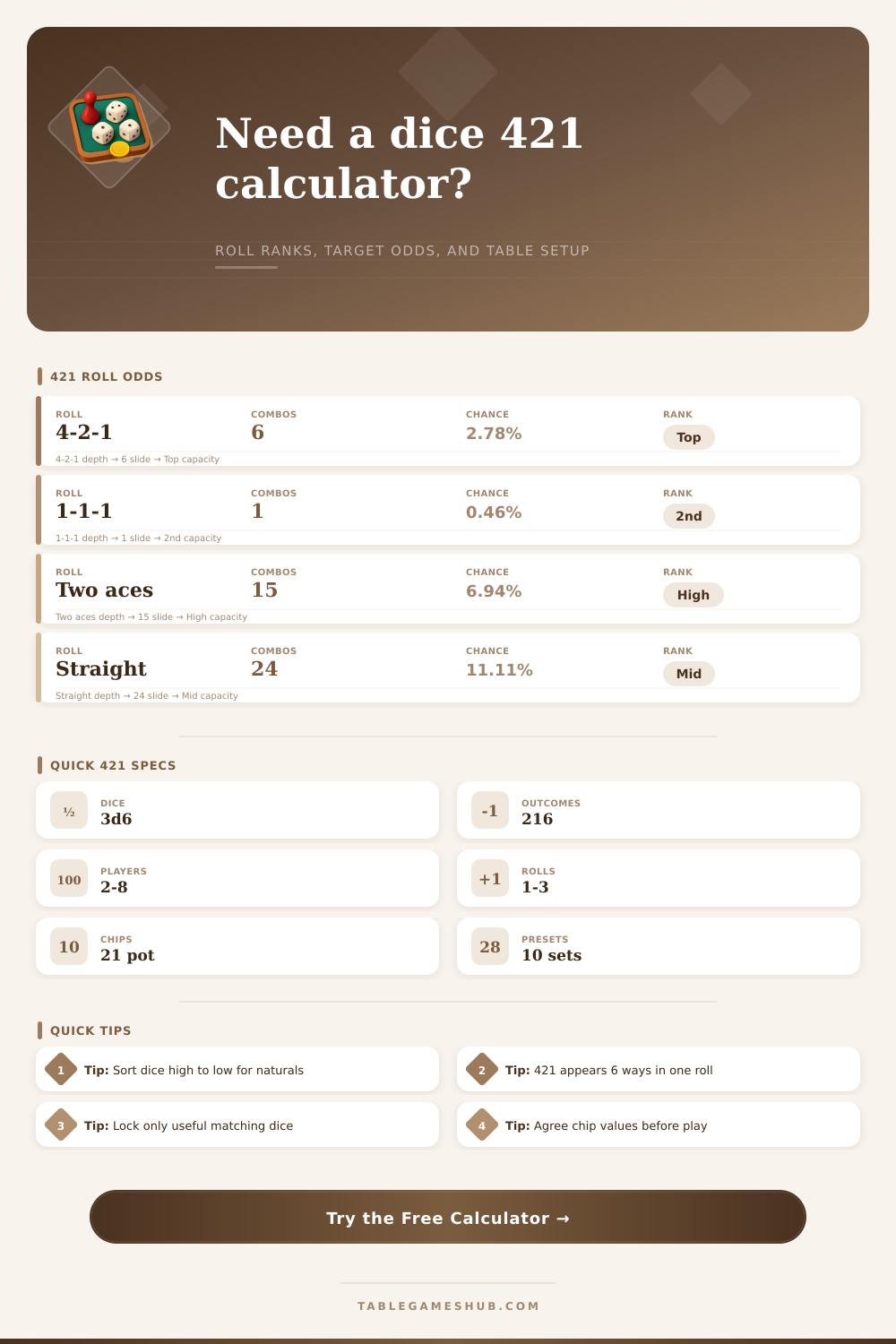
| 4-2-1 | 6 of 216 | 2.78% | Highest named roll in the classic profile. |
| Triple aces 1-1-1 | 1 of 216 | 0.46% | Second named roll, below only 4-2-1. |
| Two aces, x-1-1 | 15 of 216 | 6.94% | Ranks by the third die from 2 through 6. |
| Triples 2-2-2 to 6-6-6 | 5 of 216 | 2.31% | Ranks below two aces and above straights. |
| Straights 1-2-3 to 4-5-6 | 24 of 216 | 11.11% | Ranks by the highest die in the run. |
| Natural sorted rolls | 165 of 216 | 76.39% | All other rolls compare high die, then middle, then low. |
| Scoring profile | 421 value | Triple ace value | Best use |
|---|---|---|---|
| Classic cafe | 10 chips | 7 chips | Traditional chip-pool sessions. |
| Light pot | 8 chips | 7 chips | Shorter rounds with smaller chip movement. |
| Long pot | 11 chips | 7 chips | Longer pot games where 421 should swing hard. |
| Practice ladder | Rank only | Rank only | Teaching roll order without chip penalties. |
| Keep pattern | Dice rerolled | Outcome space | When it helps |
|---|---|---|---|
| Keep none | 3 dice | 216 outcomes | Weak natural rolls or full reset attempts. |
| Keep one die | 2 dice | 36 outcomes | Holding a 1, 2, or 4 toward 421. |
| Keep two dice | 1 die | 6 outcomes | Holding 4-2, 4-1, pair aces, or a pair. |
| Keep all | 0 dice | 1 outcome | Locking a made roll for comparison. |
| Table setup | Suggested surface | Tray or dice area | Player fit |
|---|---|---|---|
| Travel two-player | 18 x 12 in | 6 in tray | Compact scorepad plus chips. |
| Cafe four-player | 30 x 24 in | 9-10 in tray | Comfortable shared center roll. |
| Teaching six-player | 42 x 30 in | 10-12 in tray | Room for rank card and chip pool. |
| Tournament eight-player | 60 x 36 in | 12 in tray | Use a double dice set to keep pace. |
◆421 Calculation Tips
Reroll planning: A one-die chase after holding 4-2 is a 1 in 6 shot for 421; a full reroll is 6 in 216, so the keep pattern matters more than the raw target name.
Table agreement: Confirm whether your group uses 8, 10, or 11 chips for 421 before recording a pot swing; rankings stay the same, but chip movement changes.
In casual boardgaming, rolling dice is a familiar sound. But arguments break out once they hit tray: “He has to count those as pairs,” someone says. “I see a straight.” Suddenly the game becomes an argument. This disconnect between feel of a good roll and the mathematics of a good score are at the heart of 421 games.
It’s no secret that having a four, two, and one is special. That pattern mimics the Yahtzee scoring hierarchy. But that gut feeling doesn’t apply when you’re holding partial dice. You have to decide whether to go for those rarer triple combination or stick with something safer.
How to Play Dice Games Better
Once you know what dice you has on hand, plug them into the calculator above and let it do the heavy lifting for you, eliminating guesswork in the middle of your turn. It doesn’t just tell you whether or not you should of hit that number, it tells you how the hit or miss relate to other rolls and your table’s scoring parameters. Why? Because it’s great to get a big number, but if you can’t protect it or compare it properly it means nothing.
It often feels odd to decide whether you should hold one die versus rolling all three over. Sure, having a pair of a four and two may seem safe. But now your possible results has been cut down to only thirty-six possibilities, which drastically alters the probabilities different than resetting your dice.
Think about how you set up the space. Fewer people thinks about this than they should. Using a tight table results in dice getting knocked off the table (pain point) and slowing down gameplay (pain point). By factoring in tray diameter as well as number of players, the tool can help determine size of the playing surface such that there’s ample buffer space for comfortabley dice rolls.
This may not seem like a big deal but the pacing of the game depends heavily on spatial comfort. Players is able to move around freely and get their turn over with greater speed while keeping energy level up. On the other hand, having a messy table mean dice must be rolled hesitantly and often interrupted when one gets thrown out of reach; which will kill your momentum.
How people interact is shaped by your chosen scoring profile. If your group likes to play like it’s the old days… 421 = ten chips; that means big swings in wealth. Or maybe you go for lighter stakes, rank only, no pressure on new players. Whatever you choose, the calculator will adjust your estimates to match.
You’ll be able to estimate how frequently to expect a few key numbers in any given number of rounds. That’s helpful if you’re balancing player attention span against round count. For example, if you’re managing an eight-player tournament with a limited amount of time, you might want to know roughly how often those high-value rolls occurs. This helps you decide whether to stick with fewer hands or stretch out the round counts.
You can avoid common missteps by not forgetting the line between strategic probability and raw luck. People get frustrated with not getting the score they want so then they keep rolling for something better, which rarely happens. 421 require knowing when it’s time to accept your “good” die and move on or gamble for a “great” die.
Tables inside the tool break down the compared strength of various roll families stacked against each other, clearly defining which one is best from straights all the way up through natural sorted rolls. No more arguing, you know exactly what you’re playing by mathematicaly and not someone’s interpretation at their house.
But now there’s access to some dice games. They just require that you pay attention to what makes them tick. If you set up your physical space to align realisticly with the odds, it turns the whole thing from a wild party of random chance to a game of skill where you no longer bicker about past results, but instead strategize the next move. The dice still clatter around in the box exactly as before, yet somehow, all is better, fairer, smoother, more fun for all involved.