The Voyages of Marco Polo Calculator
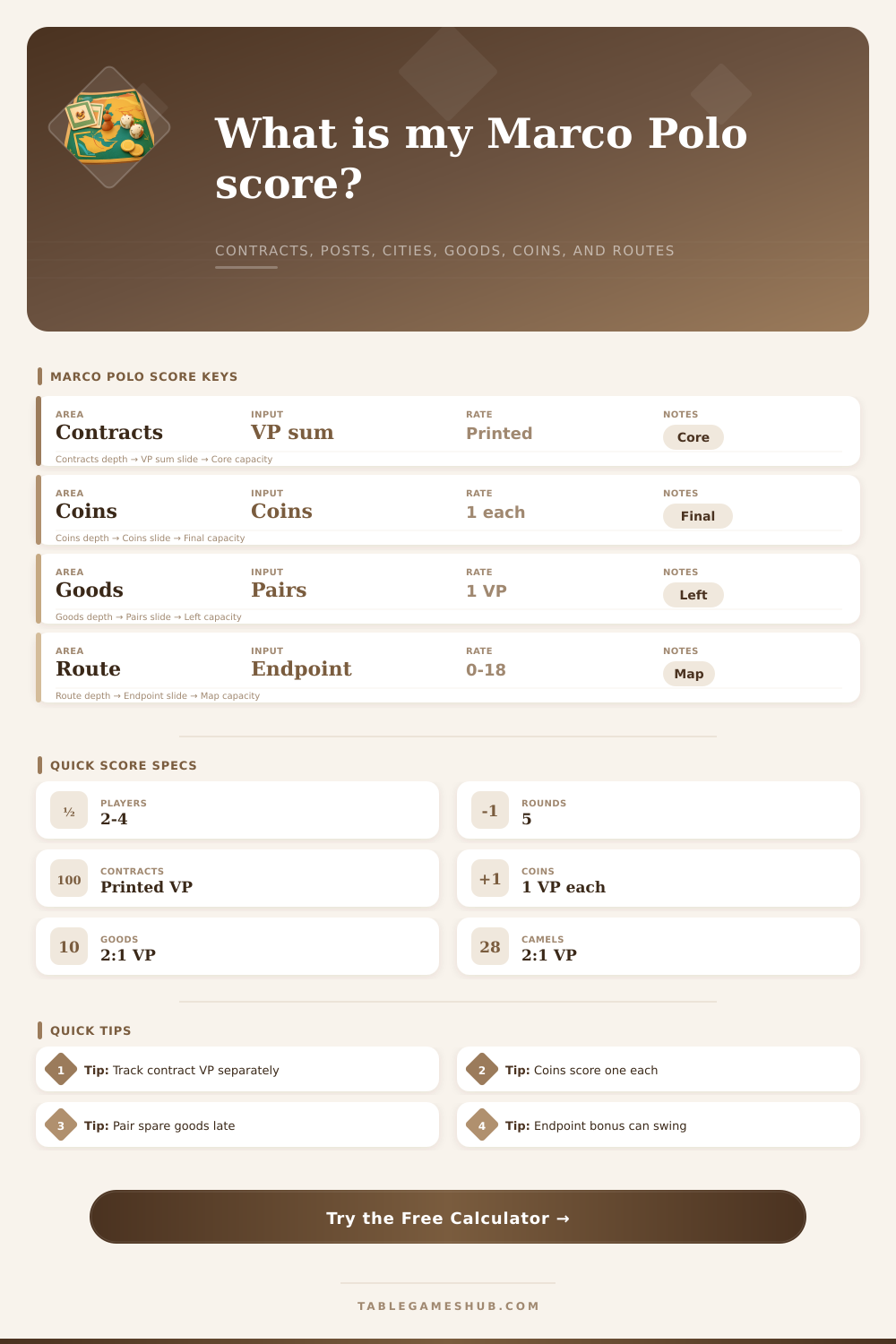
Score contracts, map progress, trading posts, city cards, coins as game points, camels, spare goods, and character bonuses in one endgame ledger.
| Scoring Area | What to Count | Calculator Field | Why It Matters |
|---|---|---|---|
| Fulfilled contracts | Printed VP plus any added contract package | Completed Contracts, Printed Contract VP Total | Contract tiles are the cleanest direct scoring source. |
| Map endpoints | Best far-city or Beijing-style destination bonus | Best Route Endpoint Reached | Long routes can outweigh one extra small contract. |
| Trading posts | Posts placed and the selected post rate | Trading Posts Built, Trading Post Value | Posts reflect access to board actions and city scoring. |
| Remaining economy | Coins, goods, camels, and final conversion | Coins Remaining, Goods Remaining, Camels Remaining | Endgame leftovers matter once contract needs are covered. |
| Route Profile | Typical Posts | Endpoint Range | Best Use |
|---|---|---|---|
| Local contract loop | 2 to 4 posts | 0 to 4 points | Strong when contracts already show high printed VP. |
| Mixed route build | 4 to 6 posts | 7 to 10 points | Good default for balanced city and contract pressure. |
| Beijing pressure | 5 to 8 posts | 14 to 18 points | Best when travel actions arrive early enough. |
| Wide city-card map | 7 to 9 posts | 10 to 18 points | Pairs with city VP and character scoring packages. |
| Resource Type | Primary Use | Endgame Handling | Calculator Treatment |
|---|---|---|---|
| Coins | Travel payments and market flexibility | Score one point each | Added directly to resource score. |
| Camels | Travel, contracts, and action flexibility | Often paired with goods | Converted with selected leftover rate. |
| Pepper, silk, gold | Contract fulfillment | Leftovers convert after scoring plans | Combined as total goods remaining. |
| City card effects | Recurring value or endgame awards | Enter their scored VP | Added as a separate card score line. |
| Character Package | Estimated Range | When to Use | Scoring Note |
|---|---|---|---|
| Extra-post traveler | 6 points | Use when extra posts or movement shape the final map. | Best with post value set to standard or high. |
| Contract specialist | 8 points | Use when bonus income mostly creates fulfilled contracts. | Pairs with the strong contract bonus selector. |
| Market engine | 10 points | Use for steady goods, camel, and coin conversion power. | Check leftover conversion before final action choice. |
| Route master | 12 to 15 points | Use for board states where travel was the main engine. | Endpoint and route steps should both be high. |
The game of The Voyages of Marco Polo require that players find a balance between a variety of goals that the game presents to the players. The game provide players with rewards for finding this balance between the various goals. For instance, players can focus on fulfilling contracts, building trading posts, and traveling to various distant cities within the game; each of these focus areas can impact the final score that each player recieve for that game.
Thus, while the calculator included with the game can assist with determining a player’s score, the player must ensure that they understands each of the variables that impact that potential score. Contracts provides players with points for each contract that is fulfilled; each contract tile has a value printed on it. Additionally, many contracts provides bonus points for fulfilling specific sets of contracts and fulfilling specific character requirements.
How to Calculate Your Final Score
The calculator must enter these bonus points into a separate field provided for contracts. Finally, players must account for the fact that if a player do not fulfill all of their contracted items, the player can lose points; in some cases, the player may lose twice as many points of the value of the contract tile. Players earn additional points through the map by using a variety of different metric to calculate the score that they will receive based off their completed map.
For instance, one metric that may be used is the distance of the player’s route, the number of points that are earned for traveling to either a nearby city or a distant city like Beijing, the number of trading posts that is built, the value of the city cards that the player has collected, and the value of each trading post (which may differ for large cities as opposed to small cities within the game). Additionally, the route distance that is calculated may help determine how many trading posts the player have established. The value of the leftover economy is another factor in calculating a final score.
For instance, each coin that a player has will be worth one point, each good or camel will be worth two points (which the calculator will account for automatic), but the player must make a decision as to whether to use those goods or camels to fulfill a contract or to save them for the end of the game to earn these points. Because each good or camel is not worth many point itself, players should attempt to group their goods and camels together when possible. Finally, another way to earn points is through the player’s characters; many character provide a bonus for fulfilling specific strategies.
Each of these strategies may earn the player extra points, but each character is different than the others. Thus, the player must manually account for the points earned through the player’s character within the score calculator. These reference tables exist to help players understand the relationship between each of the game elements and how they may impact the final score.
For instance, if a player focuses on fulfilling local contracts, they may earn more fewer trading posts but earn more points with their contracts. In contrast, if a player decides to focus on pushing their route towards Beijing, they will need more trading posts and travel step along their route. However, these tables are not the rules of the game that must be followed.
Many players often make mistake when calculating their scores. For instance, many players may count all of the coin that they earned during their game, but the coins that the player has in their hand should be counted. Additionally, many players may not account for the points that can be lost from fulfilling contracts that are not completed with the player’s goods and camels.
Finally, players may think that the route efficiency of their movement does not matter, but it does impact their score relative to the other players. The game is rewarding for those who can understand which scoring engine for the game is the best relative to the others. For instance, if a player’s contract engine is performing particularly well, they may only need one more contract to set their score apart from the other players.
In contrast, if a player’s map engine is performing particularly well, they may need more trading posts or a longer route for the same number of additional points. Thus, before the final turn of the game, each player should of use the calculator to determine which scoring engine will provide the best score for each player, this calculator will help to transform each player’s tiles, cubes, and cards into a single number, which will help them to make a decision regarding their final turn and move within the game.