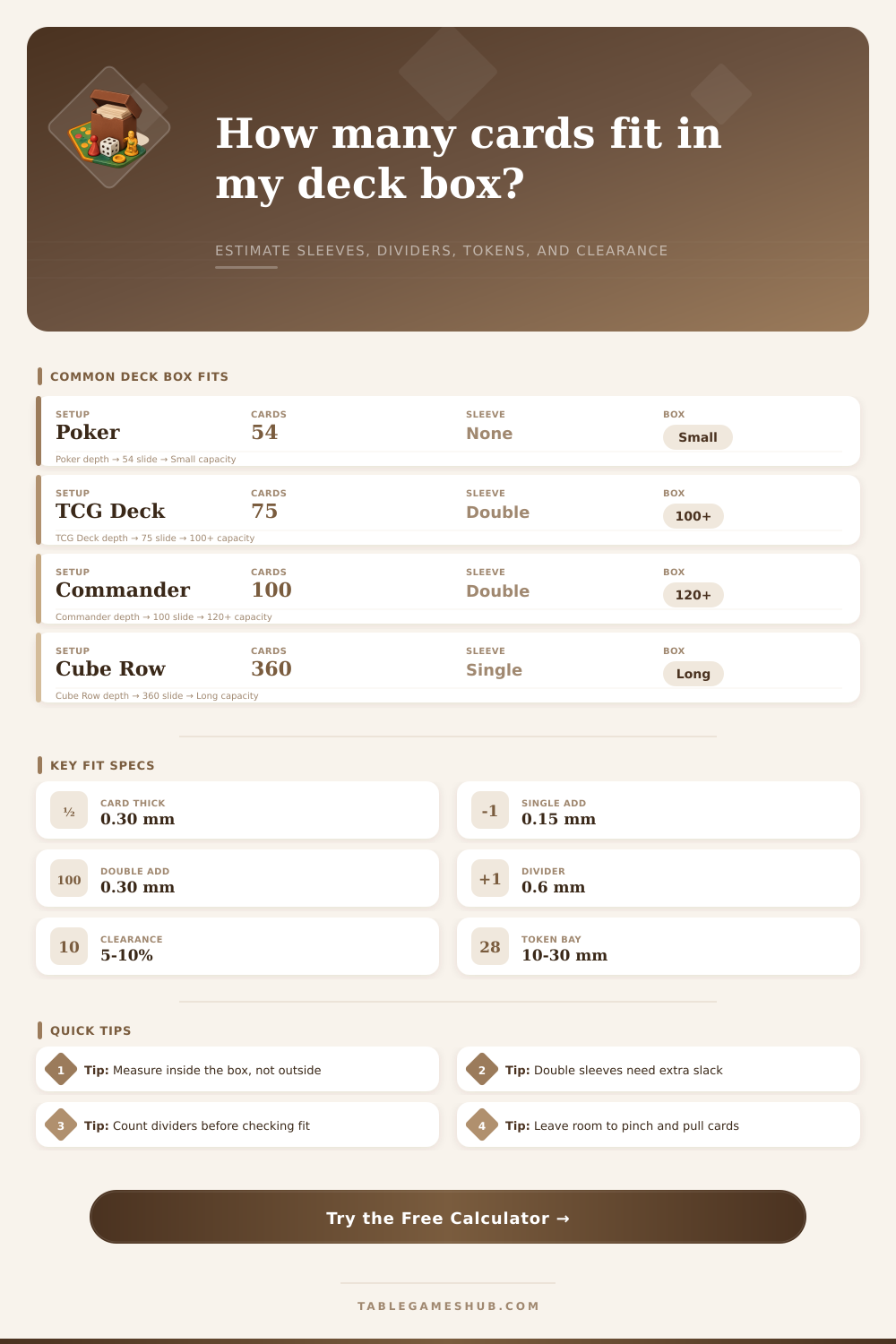
Deck Box Capacity Calculator
Check whether a card stack, sleeves, dividers, tokens, and pull clearance fit inside a real internal deck box space.
| Sleeve setup | Estimated stack thickness per card | Best clearance | Deck box note |
|---|---|---|---|
| Unsleeved paper cards | 0.28-0.33 mm | 3-5% | Low compression risk, but cards slide easily. |
| Thin inner or penny sleeve | 0.38-0.42 mm | 5% | Small box gains disappear quickly above 100 cards. |
| Standard single sleeve | 0.43-0.50 mm | 5-8% | Most board game inserts need divider and token allowance. |
| Double sleeved TCG deck | 0.58-0.68 mm | 8-10% | Fresh sleeves compress less than broken-in sleeves. |
| Storage piece | Typical thickness | When to count it | Capacity effect |
|---|---|---|---|
| Paper index divider | 0.3-0.5 mm | Between factions, colors, or expansions | Minor for small counts, large in cube rows. |
| Plastic tab divider | 0.6-1.2 mm | Deck boxes with labeled sections | Can equal 2-4 sleeved cards per divider. |
| Token packet space | 10-30 mm | Boxes storing tokens beside the deck | Subtracts directly from stack length. |
| Finger pull gap | 5-12 mm | Tall or tight upright boxes | Makes removal easier than a fully packed row. |
| Box style | Internal length | Usual target | Capacity caution |
|---|---|---|---|
| Small poker tuck space | 18-22 mm | 52-56 unsleeved cards | Will not handle most premium sleeves. |
| TCG 80-card deck box | 52-58 mm | 60 sleeved plus sideboard | Double sleeves can be too compressed. |
| TCG 100-card deck box | 72-80 mm | 75 double or 100 single sleeved | Tokens and dividers reduce capacity fast. |
| Long insert row | 250-320 mm | Cube or board game collection | Use dividers and extra pull clearance. |
| Card format | Card size | Sleeved footprint | Box fit check |
|---|---|---|---|
| Poker / TCG | 63 x 88 mm | 66 x 91 mm | Most upright deck boxes use this profile. |
| Bridge | 57 x 89 mm | 60 x 92 mm | Narrow width helps in older card trays. |
| Mini Euro | 44 x 68 mm | 47 x 71 mm | Often shares box space with tokens. |
| Tarot | 70 x 120 mm | 73 x 123 mm | Height clearance matters more than capacity. |
Deck boxes is used to store cards. However, if the deck of cards that is to be stored within the deck box is too large for the size of the deck box, then it can become difficult to use that deck box. A person may find that the deck of cards will not fit into the deck box if the deck of cards are too thick for the size of the deck box.
A person must consider the internal dimension of the deck box because those are the only dimensions of the deck box that can be used to store the cards and any accessory that may be stored within the deck box. One of the factor that can increase the thickness of the deck of cards that is stored within a deck box is the addition of sleeves to the individual cards within that deck. Standard poker cards are approximately three-tenths of a millimeter in thickness; however, if the cards have sleeves, then they will be thicker than a deck without sleeves.
Will My Cards Fit in a Deck Box
Using double sleeves on each of the cards will increase the thickness of each of those cards. As a result, a deck of one hundred double-sleeved cards will take up more space within the deck box than a deck of one hundred cards that are not sleeved. Thus, a deck of one hundred double-sleeved cards may not fit into a deck box that is sized for cards that are not double sleeved.
Another factor that will affect the thickness of the deck of cards is the orientation in which the cards are stored within the deck box. If the cards are to be stored in an upright position within the deck box, then the height of the deck box will be the limiting factor for that deck. However, if the deck is to be stored in a flat position within the deck box, then the depth of the deck box will be the limiting factor for that stored deck.
Finally, if the stored deck is to be stored in a sideways position within the deck box, then both the width and the height of the deck will be the limiting factors for how many card can be stored within that deck box. In addition to the thickness of the cards and their sleeves, the number of dividers and the number of tokens that may be stored within the deck will also impact the number of cards that may be stored within that deck box. Each plastic divider will take up some of the space within the deck box that could be used for the cards.
Thus, each divider within the deck will reduce the number of cards that may be stored within that deck box. The same is true for tokens; any space that is dedicated to the storage of tokens is space that cannot be used for the storage of the deck of cards. Therefore, the space within the deck box that is dedicated to dividers and tokens is space that is fixed and reserve for those items.
The amount of clearance that is provided for the stored deck of cards is another factor that will impact the number of cards that can fit into a deck box. Providing zero percent clearance for the stored deck allows for the cards to be stored as tightly as possible within the box; however, the tight storage may make it difficult for those cards to be removed from the box. If five or eight percent of the internal dimensions of the deck box are to be used for the clearance of the stored cards, then the thickness of the cards will be less than the total amount of the internal dimensions of the deck box.
By allowing five or eight percent of the dimensions of the deck to remain clear of the stored cards, the stored cards will have an even more greater ability to be removed from the box during long-term storage of the deck box. The internal dimensions of the deck box can be measured with a ruler to ensure that the size of the deck is accurate and correct. The size of the space within the box that can be used for the stored cards and accessories is often not reflect in the size of the deck box that is advertised for purchase.
By measuring the internal dimensions of the box, you can determine how many cards will fit in the box by using a provided calculator. The calculator will take into account the thickness of the sleeves, the number of dividers, and the amount of space that may be dedicated to tokens within the deck. This calculator can also be used to determine how many cards will fit in the box with a specific percentage of clearance for those stored cards.
Many people make mistakes when attempting to store their decks into a deck box. For example, they may assume that if the deck box is sized for one hundred cards, it will be able to hold one hundred double-sleeved cards. However, because of the thickness of those sleeves, this assumption is typically incorrect.
Another common mistake is to assume that if the cards are stored in the box in a loose fashion, that the problems associated with such a practice will be solved. However, the sleeves on the cards may settle and compress over time, which will cause the double-sleeved cards to take up more space than if they had be stored in a loose fashion within the box. Therefore, the best way to determine if the deck box that is to be purchased will be able to hold the set of cards that will be stored within it is to test the fit of the deck box with the sleeves that will be utilized for the cards.
These same principles applies to games with different types of cards, such as Mini-Euro cards or cube rows. For instance, the smaller size of the Mini-Euro cards may allow for the decks to be stored in a way that takes up less space within the box. However, the space within the box that is dedicated to the tokens for those games will still be space that is committed to non-card items.
Likewise, if the games that are to be stored within the box have large cube rows, then more space within the box will be taken up by the dividers for those different rows. However, the large cube rows may require more clearance within the box to allow for each row of cards to be pulled from the box in the middle of that row of stored cards. A calculator can be used to make it easier for individuals to determine how many of these items will fit in the box by removing the arithmetic of the process.
By measuring the dimensions of the box and taking into account the thickness of the cards and the number of the dividers and tokens, an individual can make advanced decisions regarding how to store their cards within the box. For instance, they can decide in advance how much of the internal dimensions of the box will be assigned to the cards as opposed to the accessories for those cards. Thus, each of these dimensions can be accounted for in advance, which allows for individuals to make reliable and accuracy decisions with regard to their storage needs.