Daggerheart Encounter Calculator
Estimate encounter pressure from party tier, PC count, adversary mix, action load, terrain demands, and spotlight balance using original planning bands for fantasy table play.
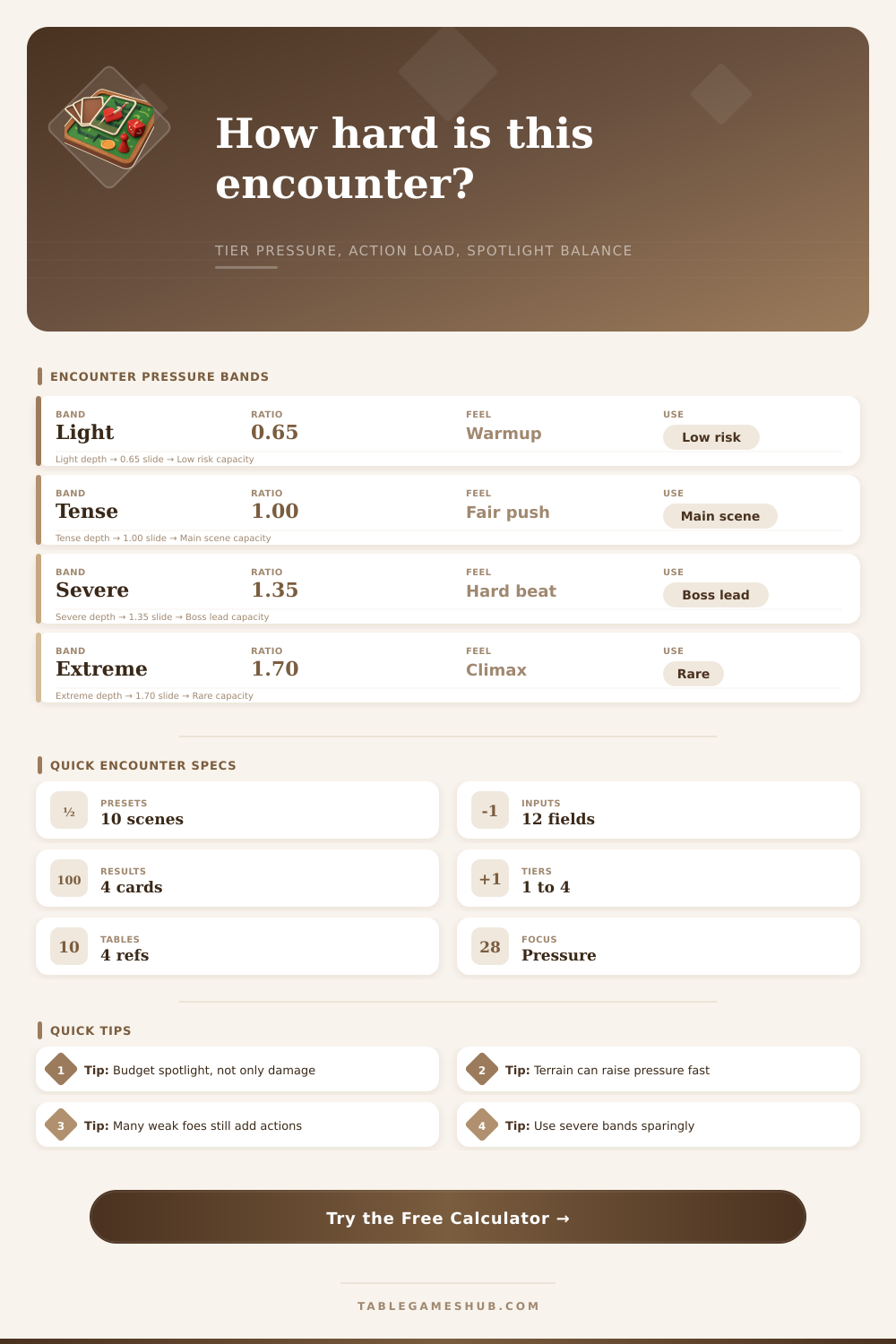
| Band | Pressure Ratio | Table Feel | Best Use | Prep Note |
|---|---|---|---|---|
| Light | Below 0.65 | Quick win or warmup | Travel beats, reveals, momentum | Add a twist if the scene must matter |
| Manageable | 0.65 to 0.89 | Low danger with choices | Routine fights, social risk, scouting | Good when players are low on resources |
| Tense | 0.90 to 1.14 | Fair pressure | Main encounter of a session segment | Most PCs should get a meaningful turn |
| Severe | 1.15 to 1.49 | Demanding and swingy | Boss lead, escape under fire, ritual stop | Use clear stakes and exits |
| Extreme | 1.50 or higher | Climactic pressure | Finale, desperate stand, optional danger | Check that failure still moves play forward |
| Adversary Role | Pressure Points | Action Weight | Spotlight Shape | Use When |
|---|---|---|---|---|
| Minor | 1.5 each | 0.45 each | Wide and noisy | You want motion, cover, or crowding |
| Standard | 3 each | 1.00 each | Even exchanges | You need reliable pressure per PC |
| Elite | 5 each | 1.45 each | Focused threat | You want one strong move to matter |
| Leader | 7 each | 1.70 each | Command center | The scene needs coordination or a face |
| Solo | 10 each | 2.40 each | Boss spotlight | One foe must carry the whole scene |
| Signal | Low | Balanced | High | GM Adjustment |
|---|---|---|---|---|
| Foe actions per PC | Below 0.7 | 0.7 to 1.2 | Above 1.2 | Add delays, objectives, or fewer bodies |
| Minor foe count | 0 to 2 | 3 to 6 | 7 or more | Group actions if the scene drags |
| Solo support | No support | 1 to 3 helpers | 4 or more helpers | Protect PC turns from being buried |
| Narrow spotlight | All roles useful | Two roles pushed | One role targeted | Add alternate angles of contribution |
| Party Tier | Base Budget per PC | Typical Scene Budget | Common Threat Mix | Watch For |
|---|---|---|---|---|
| Tier 1 | 8 points | 24 to 40 points | Minor foes plus standards | Overloading new PCs with actions |
| Tier 2 | 10 points | 30 to 50 points | Standards with one elite | Terrain hazards adding hidden pressure |
| Tier 3 | 12 points | 36 to 60 points | Elite, leader, and support | Focused control effects and narrow goals |
| Tier 4 | 14 points | 42 to 70 points | Solo or leader-heavy set pieces | Boss scenes that ignore some PCs |
Game Masters encounter situation where a combat encounter is either too easy or too dificult for the player. This difficulty with balance in a combat encounter is due to the cinematic nature of the Daggerheart system. While a Game Master may want to create a sense of danger in the encounter, they may also want the players to feels like heroes.
To achieve this, Game Masters must utilize the concept of pressure bands to find the appropriate balance between an encounter that is too boring and one that is too lethally. The key to creating an appropriate balance of difficulty in an encounter is to focus upon the concept of pressure, or the amount of pressure the players will feel during the encounter. The best way to do this is to focus on the ratio of the players to the enemies in the encounter.
How to Balance Combat Encounters
The ratio of players in a Tier 1 party is comparatively low to the resilience of a Tier 4 party. Thus, the higher the tier of the party, the more resilient the player in that party are to the damage that their enemies can deal. Many Game Masters may focus only upon the number of enemy in an encounter when creating it.
However, the type of enemies that the players are to encounter in an encounter have an impact upon the pressure that is created within that encounter. For instance, minions may be numerous in an encounter, but they may not threaten the lives of the player. In contrast, solos and leader may be few in number, but they will soak up the action of the players, and they will command the attention of the players during the encounter.
Therefore, if there are too many high-weight enemy in an encounter relative to the number of the players, then only a few players will feel the pressure of the encounter. For the encounter to feel balanced, every player should feel a sense of role within the encounter and a sense of ability to participate in the resolution of that encounter. In addition to the number and type of enemy that the players threaten, there are also environmental factor that may create pressure upon the players during an encounter.
For example, an encounter in an open field may be different than one in which the players must fight on a crumbling bridge. The terrain of an encounter may introduce additional pressure upon the players. For instance, a scene objective such as protecting an NPC may prevent the players from spending every action in the encounter attacking the enemies in that encounter.
Thus, the budget of action of the players is lowered. These factor may turn a manageable encounter into a severe one for the players. Another factor that Game Masters should consider in the creation of a combat encounter is the action load of that encounter.
Even with a low ratio of pressure in an encounter, if the enemies in that encounter take many action relative to the players, the players will feel as though they are smothered by the enemies during the encounter. The action load of an encounter is best measured by the action weight of each player in the party. If the action load for each player is too high for the enemies in the encounter, that encounter will likely feel like a slog for the players.
The action load can be balanced by either grouping the enemies into single action or making the move of the enemies telegraphed to the players so that they can react. The action load of an encounter should be measured prior to the encounter begins so that the Game Master can avoid having an action load that is too high for the players. Another factor in the success of a combat encounter is the readiness of the players.
The “freshness” of the players can have an impact upon their success during an encounter. A group of players that is fresh and has many resource can take a severe encounter, while a worn-down group of players may find even a light skirmish to be difficult. The readiness of the players is important in that it acknowledges the resource that the players expend during the game session.
For example, if the players have been in the dungeon for three hour, they likely have fewer resources than if they had just begun the session. Game Masters must account for the readiness and resources of the players so as to avoid accidentally killing the players due to ignorance of the resources that they have used. Although these factor are essential in the creation of encounters that are challenging yet not lethal to the players, they are signal only.
The use of dice can introduce an element of chaos into even the most carefully planned encounter. A series of critical success may make even the most severe encounter feel easy for the players, and a series of failures can have the same effect upon a manageable encounter. The goal with these factor is to provide a starting point for Game Masters to adjust the encounters to the players as necessary.
If an encounter is too easy, additional minions can be added to the encounter or a terrain hazard can be introduced. If an encounter is too hard for the players, another encounter can be created in which one of the leaders of the players makes an error in their strategy. In encounter design, it is essential for Game Masters to focus upon the concept of pressure and spotlight.
By focusing upon these two concepts, the encounters will feel more organic to the players. Instead of focusing upon the action of each player, it is more important to focus upon how the encounter feel to the players. Regardless of the type of encounter that is to be created, the goal is for the players to feel as if they barely survive the encounter.