Century Spice Road Calculator
Measure cube value, conversion momentum, merchant card tempo, point-card readiness, coin bonuses, hand efficiency, and turn timing.
Enter your current spice bowl, engine shape, and target point card. The calculator compares cube tier value, missing requirements, action tempo, and bonus coins for a clean table-state read.
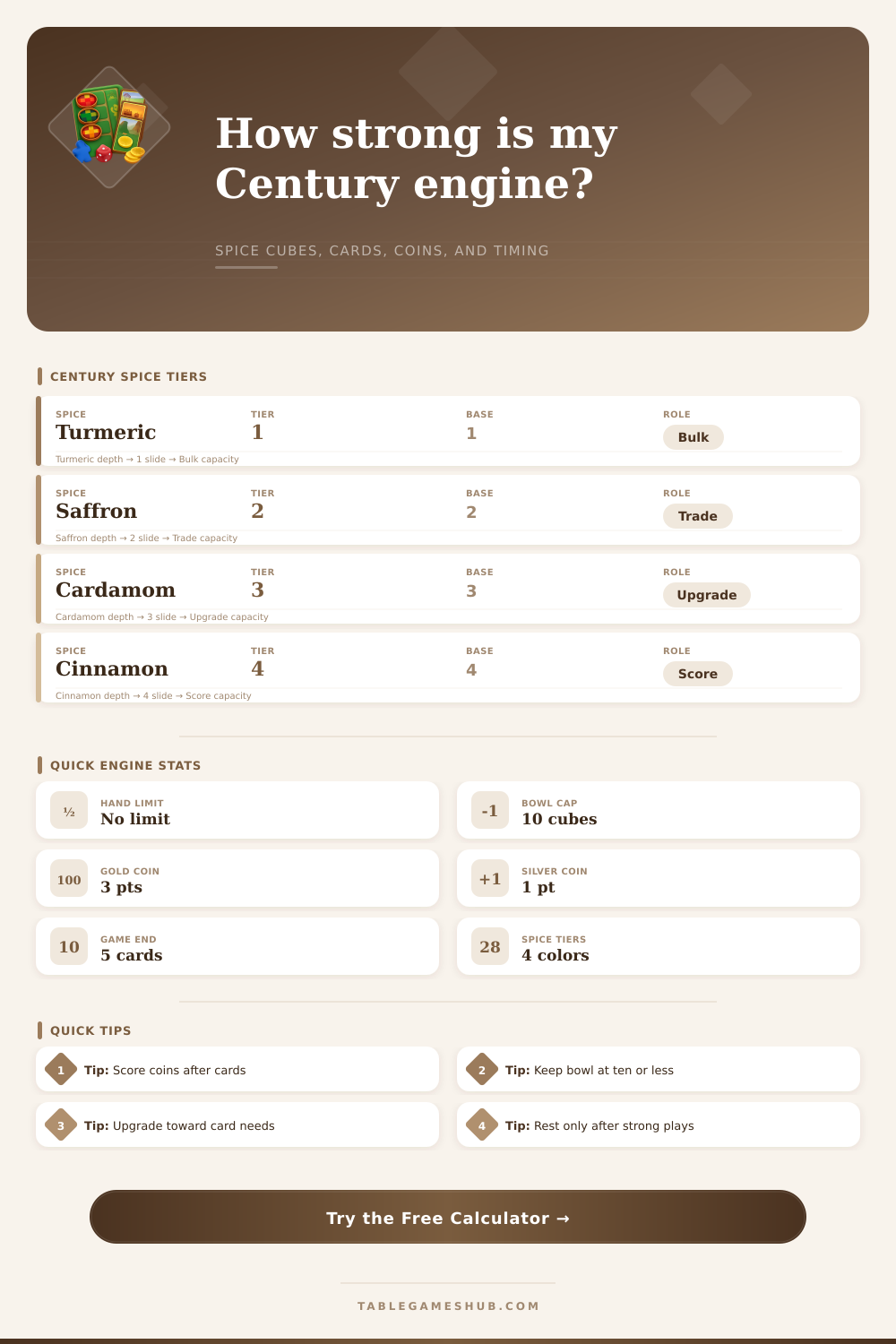
| Spice Cube | Tier Value | Typical Engine Use | Claim Meaning |
|---|---|---|---|
| Turmeric | 1 | Production base and card payments | Low requirement filler |
| Saffron | 2 | First real conversion target | Medium card foundation |
| Cardamom | 3 | Upgrade payoff and trade bridge | High card gate |
| Cinnamon | 4 | Top-tier score cube | Premium card gate |
| Merchant Card Pattern | Action Value | Best Use | Tempo Note |
|---|---|---|---|
| Produce 2 Turmeric | +2 tier value | Early cube supply | Reliable but slow |
| Produce 3 Turmeric | +3 tier value | Feeding trade cards | Strong with converters |
| Upgrade 2 Steps | +2 tier value | Exact color shaping | Low waste |
| Upgrade 3 Steps | +3 tier value | Fast high-tier push | Excellent near claim |
| Trade Ratios | +1 to +3 value | Bulk conversion | Depends on inputs |
| Mixed Combo | +4 value | Late engine swing | Often rest-worthy |
| Point Card State | Printed Score | Cube Difficulty | Priority Read |
|---|---|---|---|
| Small filler card | 6 to 8 | 5 to 7 tier value | Claim for pace |
| Medium efficient card | 9 to 12 | 8 to 11 tier value | Best midgame target |
| Premium card | 13 to 16 | 12 to 16 tier value | Worth setup turns |
| Coin slot card | Any score | Exact availability | Bonus can break ties |
| Engine Tempo | Gain Per Action | Rest Pressure | Practical Read |
|---|---|---|---|
| Starter pace | 1 to 2 | Low | Build before racing |
| Stable pace | 2.5 to 3.5 | Medium | Can chase medium cards |
| Combo pace | 4 to 5 | Medium high | Plan rest after burst |
| Finish pace | 5+ | High | Claim before table shifts |
| Component | Standard Count | Calculator Role | Useful Benchmark |
|---|---|---|---|
| Spice bowls | 4 colors | Cube tier math | Ten cube bowl cap |
| Merchant cards | Deck based | Action value estimate | Rest recovers played cards |
| Point cards | Visible row | Requirement match | Fifth claim triggers end |
| Gold coins | Slot bonus | Adds 3 points | Highest claim bonus |
| Silver coins | Slot bonus | Adds 1 point | Useful tie margin |
Century Spice Road reward players who think in layers, and Century Spice Road rewards players who understand how the early game can affect the later game. The game begins with a bowl of colored cube, but the colored cubes that are chosen in the early game can affect the value of the colored cubes that are selected in the later game of Century Spice Road. A cube that appears to be relatively inexpensive and valuable in the early game can become a necessary cube for claiming a point card in the later and more competitive stage of the game.
Thus, players must understand the value of each of the cubes in the future, while also avoiding making overcommissions of either there hand or there space in the bowl. Players use the calculator to perform mathematical calculation after players input the number of each type of cube that they currently have, the requirements of their target point card, and the number of merchant cards that are currently on the table. The calculator display the number of turns that will be required for the player to reach there target card, the number of points that the player will score if they are successful in claiming the point card, and whether or not it is worth the player effort to claim the card via trading for coins.
Plan Ahead with the Century Spice Road Calculator
Each of these values are only useful if the players understand the inputs that is required to calculate such values. For instance, turmeric cubes are used for performing trade in the early stages of the game, but saffron cubes are required for performing conversions. Additionally, cardamom and cinnamon cubes have higher tier weights, and are often required for claiming the strongest point cards.
Thus, the calculator measures the relationship between the current composition of a player’s bowl and the requirement for the point card. Many players struggle with the concept of valuing there hand size and the number of cards that they have played thus far in the game. While a large number of cards in a player’s hand may be considered to be a strong position in the early game, that same size of hand can become a disadvantage for the player if they have already used their best converter for producing there cubes.
After all of a player’s converters have been used up, any action to rest is forced rather than taken as an optional action. A forced rest can lead to a lost turn for that player, which may allow another player to claim the point card of the player’s desire. The calculator helps to account for this scenario.
The calculator can estimate the number of turns that will remain for the player until the rest action is forced, and it can warn the player if they are filling their bowl to close to the ten-cube limit; too full a bowl may result in awkward trade or wasted productions of cubes. Beyond the risk of forced rests and too-full bowls, there is additional aspect of the game that the calculator can account for. For example, each of the point cards contain coins that add to the score of the player that claims the point card.
These values are included in the total score that the calculator calculates. Thus, players can use the calculator to determine whether the coin value for the point card is worth the number of extra turns that the player will need to claim that point card with there produced color. Another aspect of the game that the tables on the page can reference are the values of the actions for each of the merchant cards, and the difficulty of each of the point card tier.
Though these tables can be of great use to players to understand the game, there are a few exceptions to the information provided on the reference tables. For instance, many players may believe that the mixed-combo merchant card is stronger than the numbers suggest. Additionally, the simple produce merchant card may lead to a stall in the game if too many low-tier cubes are contained within a player’s bowl.
These reference tables provide names for these situations, but do not account for the outcome of the actions described within. In addition to these tables, players may believe that each of the point cards are of equal value. However, the calculator determines the number of claims that each player will have remaining in the game, but it does not take into account the position of each of the player’s opponent.
Thus, if there are only a few remaining point cards that may be claimed by opponents, the pressure for that player to take those point cards is increased. A player must read the reference tables to understand the values of each of the remaining point cards, but the calculator can help players to focus on there engine’s ability to claim those point cards before their opponents do the same. The same principle can be applied to the strategy of the game for choosing conversion routes.
For instance, a player may believe that converting all of there cubes to cinnamon is the best route, or they may feel that producing turmeric and only trading according to need is the best strategy for that round. The calculator can help players to determine which of these routes will result in the best outcome for there player, given their current bowl and the point card that they desire to claim. The calculator can reveal the problem with each of these strategies, such as how one strategy may result in too many low-tier cubes (which may result in forced rests), while another may result in a need to trade awkwardly for high-tier cubes.
The differences between these two strategies are only one or two action, which is again one or two actions necessary to create a difference in which player may claim the point card. The game ends when a player takes there fifth point card. The calculator can provide a snapshot of the strength of a player’s engine, but it cannot provide a recommendation for whether they should take a turn to rest, to perform another conversion, or to claim a point card of there choosing.
Thus, the calculator is most helpful when combined with the player’s observation of the state of the game tables. Overall, then, a player that understands and utilizes the calculator and the reference tables will begin to feel more confident in there understanding of the game. While the player will still have to make a decision of what the number mean in the context of there current game, they will no longer have to remember the number of turns for each of the colors, or how many rest they might need to take in the future.
Thus, the player will be able to consider there next few move in the game two turns ahead.