D10 Probability Calculator
Calculate d10 target odds, exact totals, dice-pool successes, keep-highest sums, reroll effects, and opposed checks for tabletop sessions and design notes.
◎Preset D10 Scenarios
Load a common d10 roll, then adjust dice, target, reroll, modifier, and opposed-roll settings.
⚙Roll Inputs
▣D10 Component Grid
☰Reference Tables
| Single d10 goal | Successful faces | Chance | Common use |
|---|---|---|---|
| Need 2+ | 2 through 10 | 90% | Very easy target check |
| Need 5+ | 5 through 10 | 60% | Moderate face threshold |
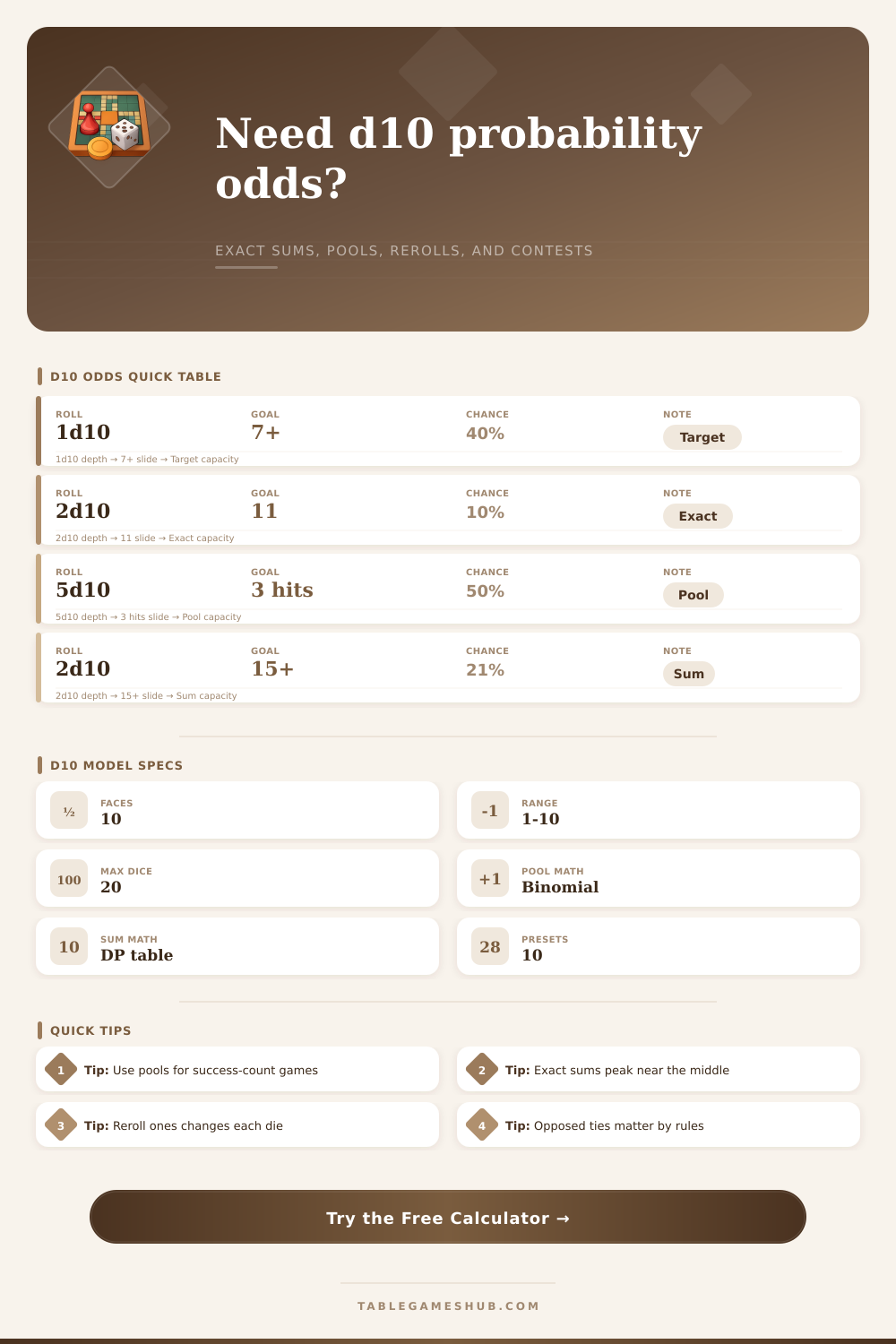
| Need 7+ | 7 through 10 | 40% | Hard single-die task |
| Need 10 | 10 only | 10% | Critical face or rare event |
| Sum model | Minimum | Maximum | Center point |
|---|---|---|---|
| 1d10 | 1 | 10 | 5.5 average |
| 2d10 | 2 | 20 | 11 most central |
| 3d10 | 3 | 30 | 16 or 17 near peak |
| 4d10 | 4 | 40 | 22 average |
| Dice pool setup | Per-die success | Math model | Best input |
|---|---|---|---|
| Threshold 6+ | 50% | Binomial successes | Moderate pools |
| Threshold 7+ | 40% | Binomial successes | Harder pools |
| Threshold 8+ | 30% | Binomial successes | Story-style hits |
| Threshold 10 | 10% | Rare-face successes | Exploding or critical checks |
| Advanced roll | Calculator field | What changes | Read result as |
|---|---|---|---|
| Reroll ones | Reroll below 2 | Low misses get one more try | Adjusted pool chance |
| Keep best dice | Keep highest dice | Low dice are dropped | Top-dice sum chance |
| Opposed check | Opponent dice and mod | Compares two distributions | Win, tie, and loss |
| Exact total | Exact total to match | Counts only one sum value | Exact-result probability |
ℹProbability Tips
Match the model to the rule. Use exact sum only when the game asks for one total; use pool mode when each die can independently become a hit.
Check the tie rule in contests. Opposed d10 systems often treat ties differently, so the calculator keeps tie chance separate from win chance.
For example, tabletop players frequent end up frustrated after rolling dice to find out their chances of success were low, only to discover midway through the game that they weren’t good. Maybe the number was high so you thought you rolled well. But then again maybe not. Because what happens is that your gut doesn’t work when faced with complicated systems or house rules.
The d10 is a strange beast in this regard. Its ten flat surfaces make it seem straightforward. Yet its use as a single digit, half of a percentage, or one element of a pool can change how it act. And this makes all the difference when you have to decide fast during play.
How Dice Pools Change Your Chances
One die? That’s just simple odds; most gamers has a grasp on that. What if two or more are stacked together? That’s when it gets dicey quickly. A pair of d10s (for example) don’t distribute their results equally. In fact, they bunch toward the average, resulting in common bell-curve pattern, with outliers far less likely then numbers near the middle. For instance, it becomes harder to aim for “exact” numbers instead of just hitting a certain range. For example, rolling one die is easy, but needing both dice to equal exactly 18 requires a different way of thinking.
Once you enter the dice count and goal value into calculator above, it spits out the percentage for you so you don’t have to guess how many ways there are to roll 11 versus 19. Sure, you can eyeball that edges will be thin while the middle gets crowded. However, sometimes knowing exactly what that percentage is helps you build a challenge that feels daunting but not too hard.
The beauty of dice pools lies in their ability to flip focus from sum to count. Now instead of thinking about a number on a continuum, each die is a separate trial with its own chance of producing a result. Your odds of getting a successful result increase in set steps. This scales at a steady rate, up to a point where the gains start to slow down. That’s pure binomial math, meaning more dice gives you a steady increase in your odds. Why? Because it replicates consistent performance over time.
Need three out of five dice to get what you want? The tool calculates the different combinations of successes and failures. It does this until it finds a result that matches your criteria. Partial success is meaningful; failure doesn’t mean you’re totally screwed, so this model are popular in narrative games.
Adding to the confusion are reroll mechanics which change the effective probability of each individual die before you even look at pool as a whole. For example, rerolling ones increases the chances that if your roll fails then you’ll get another shot… Which changes the probability in your favor just a little bit. That may not seem like much but then again some character abilities does allow rerolling. And although you may be tempted to dismiss one more try as meaningless, remember… When added up over the course of an entire campaign all these small improvements can become huge benefits.
The page includes a reference table (shown below) that shows the relative chance of success for each die based off different thresholds. This helps you understand what’s going on and why a difficulty level 8 seems so much easier than a difficulty level six, purely from a probability standpoint.
Incorporating opposed rolls adds a social element to the math; it makes it so two distributions are pitted against one another. The likelihood of a tie becomes less clear at a glance to people who is new, especially when each side has multiple dice. The choice between re-rolls and ties can change whether you use more dice or higher modifiers depending on rule set. Rules that favor the defender on ties also changes this strategy. Resource management throughout encounters and character building depends on knowing if you’re working to best your opponent, or merely keep pace with them.
And finally, it’s less about making predictions than knowing the territory. The die has just enough outcomes to feel random, but stays structured enough to study and calculate. This puts the d10 in a sweet spot where we get the best of both worlds. We need to look at more than just the individual number on a die. We must also consider how dice combine when contesting each other and rerolling in a pool. This gives us a better sense of which rolls will feel inevitable and which will feel like heroics. We move from seeking good fortune to building it into our results.
It’s largely a matter of recognizing what you’re measuring; is it one particular face value or some sort of total of many little pushes? After recognizing the form within the chaos, every roll has more coherent narrative to tell.