Chicken Foot Dominoes Score Calculator
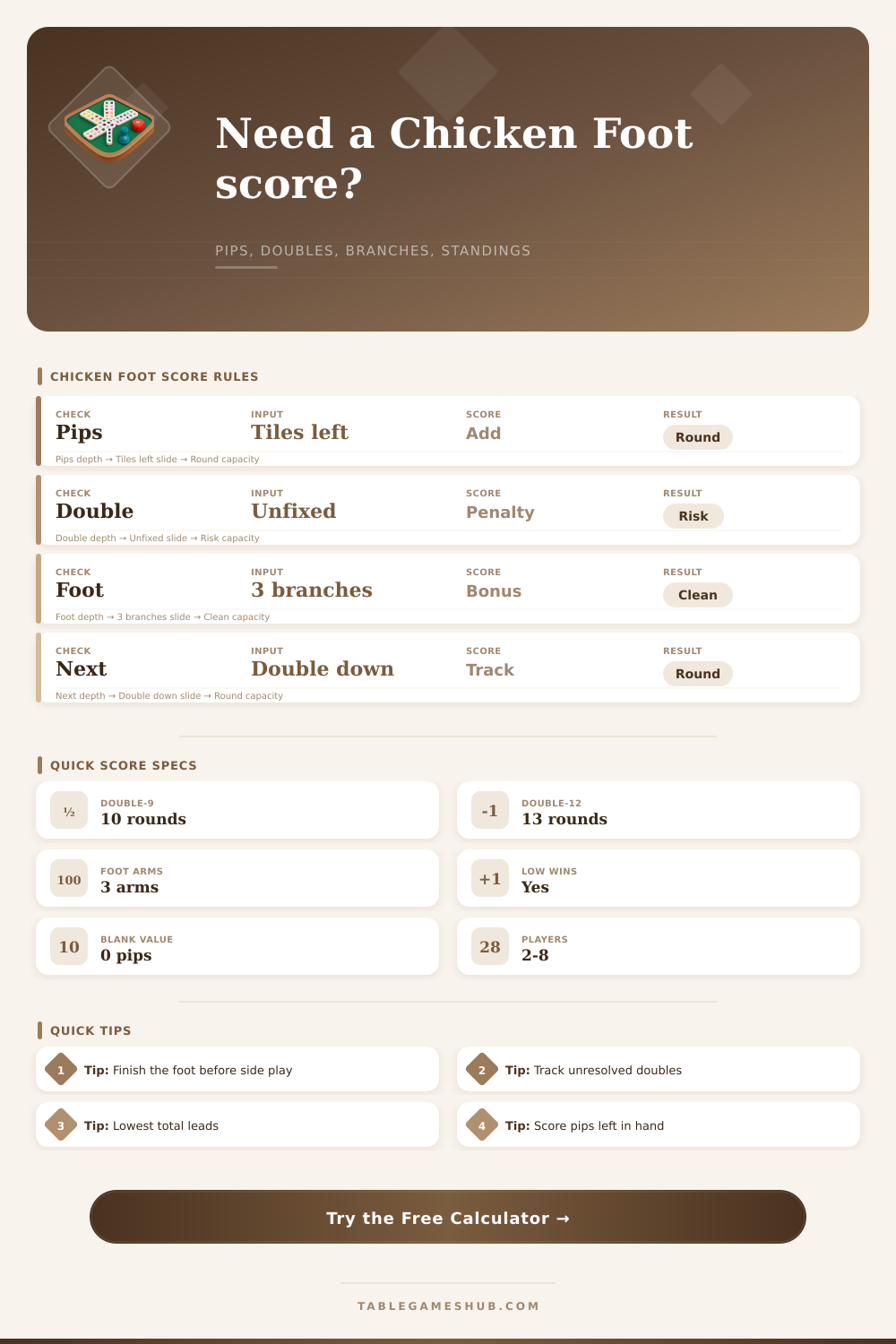
Total pips left in hand, unresolved doubles, chicken foot branches, round double sequence, and low-score standings from one scorekeeper panel.
| Domino set | Opening double | Round count | Typical sequence |
|---|---|---|---|
| Double-9 | Double 9 | 10 rounds | 9, 8, 7, 6, 5, 4, 3, 2, 1, blank |
| Double-12 | Double 12 | 13 rounds | 12 down through blank |
| Double-15 | Double 15 | 16 rounds | 15 down through blank |
| Short table variant | Chosen high double | House choice | Count down one double each round |
| Score item | How calculator uses it | Typical value | Effect on standings |
|---|---|---|---|
| Tiles in hand | Add total pips remaining | 0 to 300+ | Higher score hurts because low total leads |
| Unresolved double | Add selected double penalty | 0 to 6 doubles | Marks unfinished forced play |
| Missing foot branch | Add selected missing-branch penalty | 0 to 5 branches | Separates clean finish from blocked foot |
| Completed foot branch | Optional reduction per completed branch | 0 to 5 branches | Rewards a clean starting foot |
| Table state | Branch math | Score risk | Calculator status |
|---|---|---|---|
| Foot complete | Completed branches equal required branches | No missing-foot penalty | Normal branch play ready |
| Foot short by one | One branch still missing | Small house-rule penalty possible | Finish foot before side ends |
| Multiple doubles open | Unresolved doubles above one | Penalty grows quickly | Forced-double pressure |
| No open branches | Open playable branches equal zero | Blocked table ending likely | Round may end with hands scored |
| Set | Tiles | Max pip tile | Best player range |
|---|---|---|---|
| Double-6 | 28 tiles | 12 pips | 2 to 4, very short Chicken Foot variants |
| Double-9 | 55 tiles | 18 pips | 2 to 5, quicker full sequence |
| Double-12 | 91 tiles | 24 pips | 3 to 8, common family table |
| Double-15 | 136 tiles | 30 pips | 5 to 8, longer high-pip rounds |
| Preset | Round double | Main calculation | Why it is useful |
|---|---|---|---|
| Double-9 Opener | 9 | Full foot complete, normal pips scored | Checks basic Chicken Foot scorekeeping |
| Foot Still Open | 11 | Missing branches add pressure | Shows branch completion math |
| Two Doubles Unfixed | 8 | Double penalty added twice | Tests forced-double house rules |
| Final Double-0 Round | 0 | Blank round sequence closes the match | Confirms next-round message |
Score the player's pips left first, then add any house penalty for missing chicken foot branches or unresolved doubles.
Use the current round double to keep the score sheet moving downward; after double blank, the full set sequence is complete.
Chicken Foot is a game in which each player intend to maintain the lowest possible cumulative scores. The number of pips that each player’s hand contain is to be added to a cumulative total that determines the winner of the game. Such a total can be managed with the aid of a calculator, which can also track the various rules that can modify the player’s score.
The first of the rules that can modify a player’s score is the rule related to the formation of a “chicken foot.” A “chicken foot” is formed when three branches are formed off of an opening double. The chicken foot must be completed before play can continue after the opening double. Some groups of players awards a penalty to those who have not completed their chicken foot at the end of the round.
How to Keep Score in Chicken Foot
Other groups of players provide a credit to those who have completed their chicken foot in that round. The calculator allow for players to set the rule for the chicken foot, ensuring that the score is modified appropriately according to the rules that a given group of players utilizes. The importance of this rule is that a ten point swing in either direction can alter the standings in the game.
The second rule is the rule regarding unresolved doubles. An unresolved double is formed when a double is established on the table but no player play tiles to match that double. Some groups of players award extra points for each unresolved double.
Other groups of players double the penalty for each unresolved double. Other groups of players award fifty points for each unresolved double. As with the rule related to chicken feet, the calculator allows for players to test each of these options for their group of players.
The third part of the game is related to the cumulative score for each player. The total score for each player are used to determine the winner of the game. The total score also displays the number of points that each player leads the game by in comparison to each of the other players.
This information can help each player to make strategy decisions as to whether they should take risks or avoid risk in their current round. The sequence in which the rounds are played can inform the players of the value of the different tiles within their hand. Most groups of players begin with the highest valued double within a set of doubles and count down to the blank.
Sets that contain doubles ranging from a double-9 contains ten rounds while sets that contain doubles ranging from double-12 contain thirteen rounds. Rounds that contain the high valued doubles often have larger player hands than later rounds. This is due to the decreased likelihood that players will be able to play their tiles in such rounds.
A calculator can display which double the current player is to play next. Players can often make mistake in the game if they dont consider the number of tiles that each opponent holds. For example, players who have many opponents who hold high valued tiles will soon end their round.
Players who have opponents who hold few tiles will have long rounds. Players who do not consider this aspect of the game may end up with many unresolved double during the game. Furthermore, each player should remember the rule related to the chicken foot.
This rule can be easily forgotten during the course of the round, especially by the opponents of the current player. The other rule that each player should be aware of is the specific penalty for an unresolved double. Some tables awards extra points for each unresolved double.
Other tables require the next player to the player whose double was unresolved to play a double of the same number of pips as the unresolved double. The strategy for the game may involve players who utilize the stricter rule for unresolved doubles to intentionally leave a double unresolved themselves to prevent another opponent from winning that round. Small decisions can have an impact on the outcome of the game.
For example, if a player completes their chicken foot while others leave their doubles unresolved, the player will have a lead in the game. However, if a player should of been awarded a bad hand during the round that contains the blank (the double of the highest number of pips), that player can fall behind those who was leading the game. A player should enter the number of pips that each player has into the calculator after each round but prior to the drawing of the next double.
This will ensure that the calculator display the correct and accurate standings of each player. Furthermore, the calculator will follow the same mathematical formula as the players. Thus, the player with the lowest total score will win the game of Chicken Foot.