🎲 D&D Death Save Probability Calculator
Calculate your exact survival odds when making D&D 5e death saving throws
| Roll (d20) | Outcome | Effect | Cumulative (Fresh) |
|---|---|---|---|
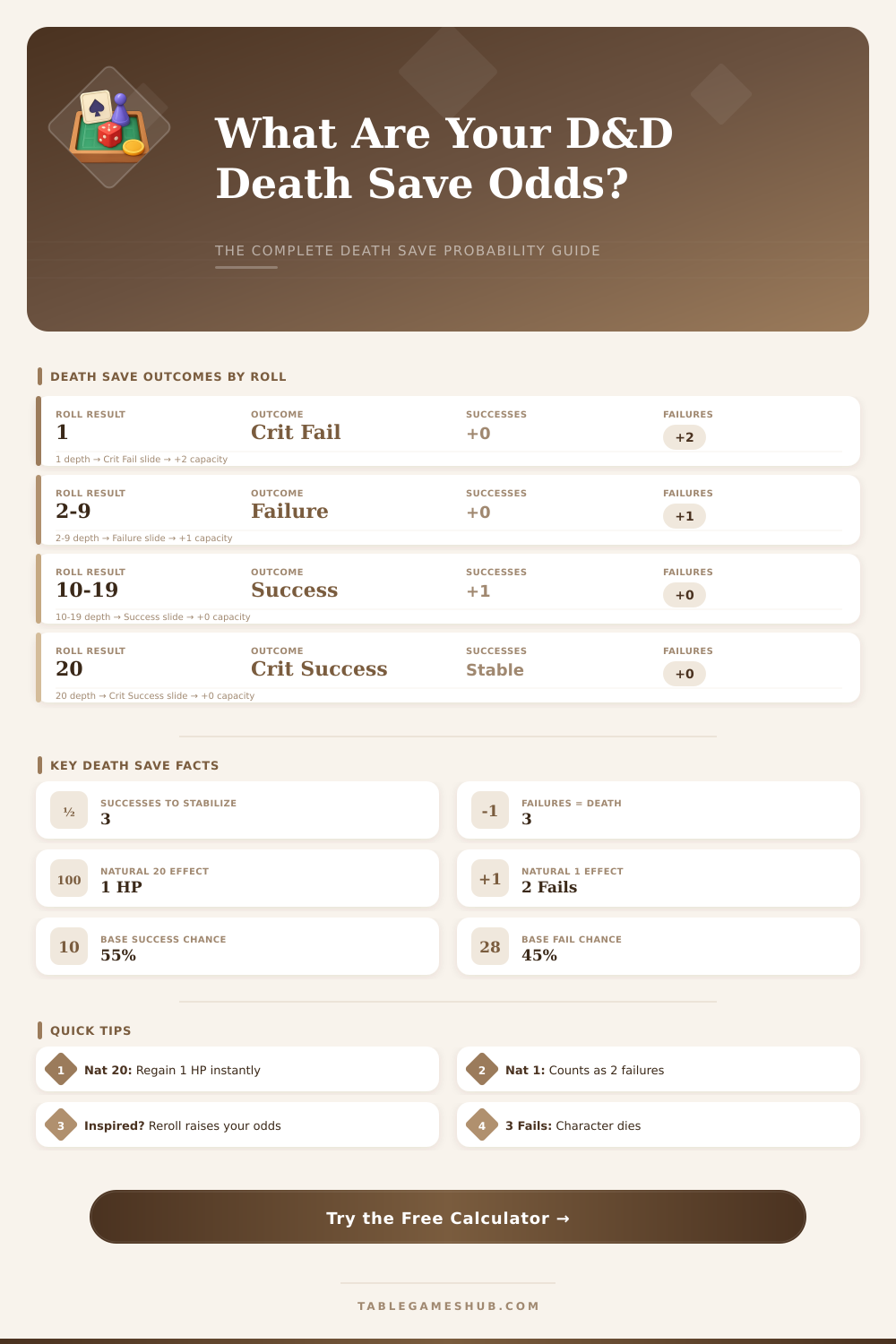
| 1 (Natural 1) | Critical Failure | +2 Failures | 5% chance |
| 2–9 | Failure | +1 Failure | 40% chance |
| 10–19 | Success | +1 Success | 50% chance |
| 20 (Natural 20) | Critical Success | Regain 1 HP | 5% chance |
| Successes / Failures | Survive % (No Bonus) | Survive % (+2 Bonus) | Survive % (Advantage) |
|---|---|---|---|
| 0 Succ / 0 Fail (Fresh) | ~65.0% | ~74.8% | ~79.7% |
| 1 Succ / 0 Fail | ~74.8% | ~83.3% | ~88.2% |
| 2 Succ / 0 Fail | ~86.5% | ~92.0% | ~95.0% |
| 0 Succ / 1 Fail | ~50.6% | ~62.3% | ~67.4% |
| 1 Succ / 1 Fail | ~62.1% | ~73.5% | ~80.0% |
| 2 Succ / 1 Fail | ~77.5% | ~86.0% | ~90.2% |
| 0 Succ / 2 Fail | ~29.8% | ~42.0% | ~47.2% |
| 1 Succ / 2 Fail | ~43.0% | ~55.0% | ~61.2% |
| 2 Succ / 2 Fail | ~60.5% | ~71.5% | ~77.0% |
| Condition / Bonus | Mechanic | DC 10 Success Rate | Net Survival Boost |
|---|---|---|---|
| No bonus (baseline) | 1d20 vs DC 10 | 55% | — |
| +2 Bonus (Bless) | 1d20+2 vs DC 10 | 65% | +10% per roll |
| +5 Bonus (Bless + Prof) | 1d20+5 vs DC 10 | 80% | +25% per roll |
| Advantage | 2d20kh1 vs DC 10 | ~69.75% | +14.75% per roll |
| Disadvantage | 2d20kl1 vs DC 10 | ~30.25% | –24.75% per roll |
| Halfling Lucky | Reroll nat 1s | ~57.25% | +2.25% per roll |
| Portent Die (15) | Replace roll with 15 | 100% | Guaranteed success |
| Reliable Talent | Min roll = 10 | 100% | Guaranteed success |
| Scenario | Min Throws | Max Throws | Expected Throws |
|---|---|---|---|
| 3 successes before 3 failures | 3 | 5 | ~4.1 |
| Stabilize with Nat 20 | 1 | 1 | 1 (5% chance each throw) |
| Die by Nat 1 only | 2 | 2 | ~2 (2.25% each sequence) |
| Die on first throw | 1 | 1 | 0.25% (two nat 1s in 1 roll impossible; 45% fail first) |
When a character reaches 0 hit points, the character must use death saving throws to determine if the character will survive or die. Death saving throws are use to determine the fate of a character that reaches 0 hit points. A person succeed on a death saving throw if they roll a ten or higher on a 20-sided die.
A person rolls a failure on a death saving throw if they roll between a 2 and 9 on a 20-sided die. A natural twenty on a death saving throw immediately stabilize the character at 1 hit point. A natural one on a death saving throw add two failures to the character’s failures.
How Death Saving Throws Work
A natural one is more dangerous then a failed death saving throw because it adds two failures rather than one. A character survive death saving throws if they reach three successes on death saving throws before they reach three failures. The probability of surviving death saving throws can change depending on the character’s successes and failures on death saving throws.
A character with high successes and low failures has a more higher chance of surviving than a character with high failures and low successes. Using a probability calculator will help a person to understand the probability of surviving death saving throws for a character with different amount of successes and failures. The probability calculator will perform the math for a person to determine the probability of surviving death saving throws.
Some modifiers or special abilities increases the probability of success for a character on death saving throws. A character that casts the bless spell, for example, will have a higher probability of success on there death saving throws because the spell provide a bonus to their rolls on death saving throws. Using advantage will increase the probability of success on a death saving throw because a character will roll two 20-sided die and keep the higher score.
Using the halfling lucky trait is helpful on death saving throws because a halfling can reroll a natural one on death saving throws. A natural one on death saving throws add two failures to a character’s failures. Bardic Inspiration provide a character with a second roll on a death saving throw, which is helpful if a character is close to three failures in a row.
A probability calculator allow a person to see how all of these modifiers and abilities will affect the survival chance of a character during combat. One of the most common mistake that people make is to treat each death saving throw as if it is an independent event from the others. However, these are not independent events from one another because each die roll will change the state of the character for the next round of death saving throws.
The probability of surviving combat is not the same as the chance of success on a single death saving throw roll. The survival chance is the chance that a character will reach three successes before they reach three failure on death saving throws. The chance of success on a single roll is, as the name suggests, only the chance that a character will roll a success on one roll of the die.
A probability calculator account for the survival chance because it calculate the likelihood of every possible sequence of rolls that a character can make during combat. A person can use a probability calculator to help decide when to use limited resource during combat. For example, if a character is at 0 hit points, a character might use a spell slot to gain a death saving throw bonus.
The probability calculator can provide information on the survival chance of a character with and without using these resources. However, no calculator can make a decision for a person. A person must use this information to make an informed decision on whether or not to spend their resources.
Understanding how death saving throws work will help a person prepare for combat. A person who understand how all of the modifiers and special abilities will affect death saving throws can make better decision in combat. The probability calculator make this information immediately available to a player without having to perform the calculations in one’s head.
A person who understands the math behind death saving throws can prepare to make the most best possible decisions in combat.