Cribbage Nobs Calculator
Score the one-point hand jack, the starter-jack heels award, crib context, and the final hand subtotal without mixing the two jack rules.
Nobs
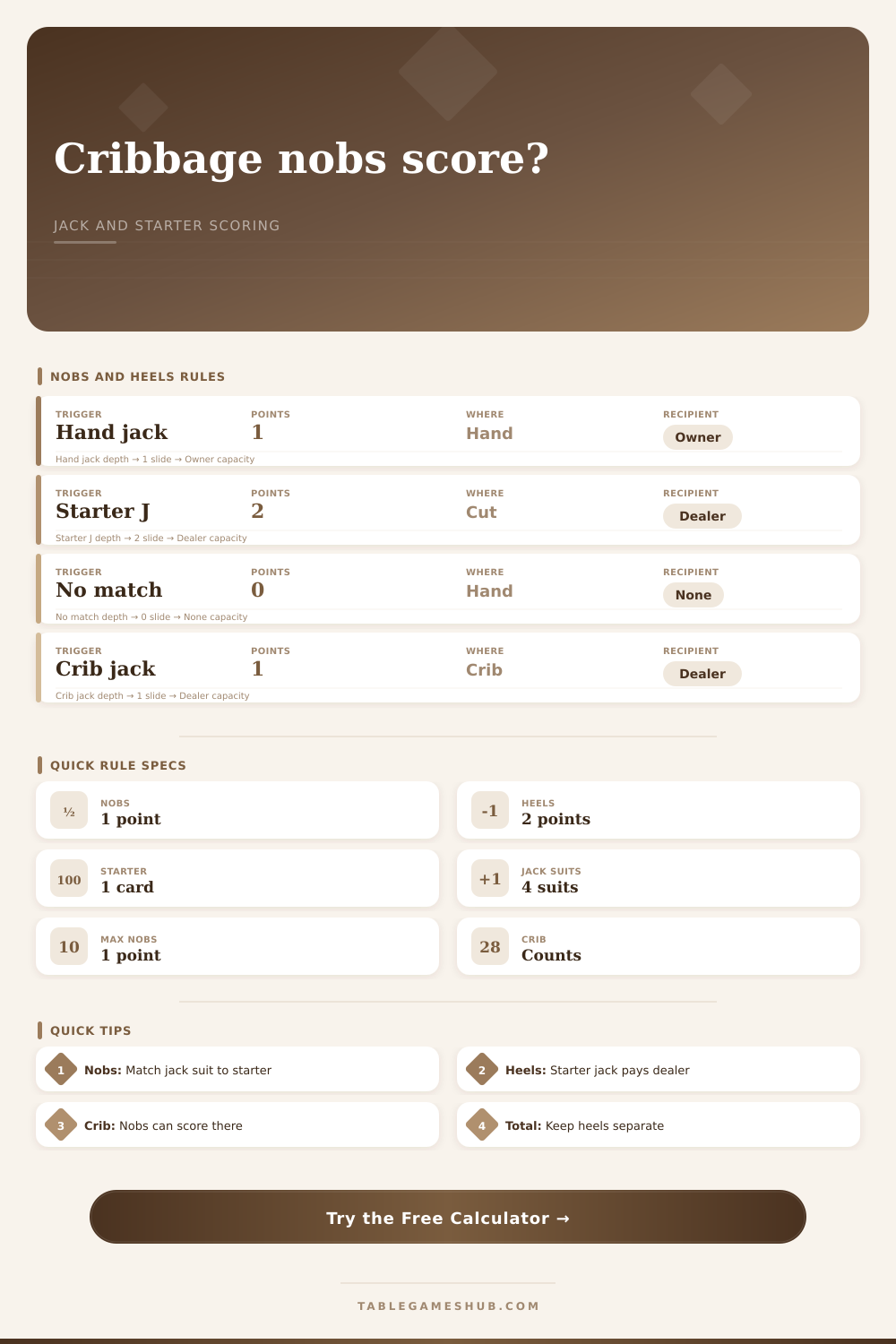
Checks the jacks in the scored hand or crib against the starter suit and adds one point to that hand.
Heels / Nibs
Checks whether the starter card itself is a jack and awards two immediate points to the dealer.
Hand Total
Adds the entered subtotal and the nobs point. It keeps starter-jack heels outside the hand score.
Crib Context
Treats the crib as the dealer's scored hand, so crib nobs belongs to the dealer's crib score.
| Rule Event | Calculator Check | Points | Added To |
|---|---|---|---|
| Nobs, also called his nob | Hand contains jack matching starter suit | 1 | Scored hand or crib total |
| Heels, also called his nibs | Starter card is any jack | 2 | Dealer's running score |
| Different-suit hand jack | Hand jack suit differs from starter suit | 0 | No jack-point addition |
| No jack in hand or crib | All hand jack fields are set to no | 0 | Subtotal remains unchanged |
| Starter Suit | Matching Hand Jack | Nobs Result | Example Output |
|---|---|---|---|
| Clubs | Jack of clubs | +1 | Subtotal 8 becomes 9 |
| Diamonds | Jack of diamonds | +1 | Subtotal 10 becomes 11 |
| Hearts | Jack of hearts | +1 | Subtotal 12 becomes 13 |
| Spades | Jack of spades | +1 | Subtotal 14 becomes 15 |
| Scoring Context | Nobs Eligible? | Heels Recipient | Calculator Treatment |
|---|---|---|---|
| Non-dealer hand | Yes | Dealer | Hand total excludes heels |
| Dealer hand | Yes | Dealer | Hand total and heels shown separately |
| Dealer crib | Yes | Dealer | Crib nobs adds to crib total |
| Single-deck audit | Yes | Dealer if starter jack | Warns on duplicate starter jack suit |
| Scenario | Starter Card | Hand Jack | Points Added |
|---|---|---|---|
| Jack of hearts in hand | 7 of hearts | Jack of hearts | +1 nobs |
| Jack of spades in hand | 7 of clubs | Jack of spades | +0 nobs |
| Starter is jack | Jack of diamonds | No matching hand jack | +2 heels to dealer |
| Crib has matching jack | 9 of clubs | Jack of clubs | +1 crib nobs |
There’s something about the click of a wooden peg finding its home in a hole that satisfies you. There’s also something about the click that derails most casual cribbage games into an argument. Oh, you thought you had thirteen? No, says your opponent. It was twelve.
The argument never seems to be about runs and pairs (those should of being obvious). Instead, it’s nearly always about that damn jack. That’s right, it’s about matching the starter card and who gets to call the point.
How to Score Nobs and Heels Correctly
Knowing how to tally up the nobs and heels is important. It take the uncertainty out of what is possibly the most argued part of scoring. Once you have your starters and suits matched up, let the calculator do all the heavy lifting (see top of page). No more mental gymnastics about whether the starter was a jack or if you held king’s servants in your hand.
To understand the difference between heels and nobs, consider this: they’re not the same thing. While both include jacks and tend to throw new player for a loop, there is a diffrentence. With nobs, you get a point for having the jack in your hand that matches the suit of the starter card. With heels, also known as his nibs, the dealer receives two points for simply starting with a jack.
This is where folks screw the pooch. They attempt to combine them both into the same hand total. That only puffs out the number and make it inaccurate.
Keep in mind, though, what your hand is scored against. For instance, you might be dealing and have the jack of hearts, while the starter has the seven of hearts. In this case, you’d score one point for nobs. But say the starter was instead holding the jack of diamonds… Since they don’t share any matching suit, you wouldn’t earn any nobs at all. On the other hand (pun intended), you still score two points for heels as the dealer.
The dealer scores their hand different than their own crib. While a player only earns their points from their hand, the dealer earns theirs from the crib. Their crib is all theirs. The dealer says that if the crib includes a jack that matches the suit of the starter card, that’s worth one point. Whether the player added these cards to the crib or not, they are still part of the crib and now belong to the dealer.
Crib: Most players wait too long to realize you get nobs from the crib. They are so focused on the run and fifteen in their own five-card hand that they don’t remember there is four other cards stashed in the center of the table. This is a tactical mistake. As with runs and fifteens, a good crib should be designed to score nobs. Because you control what gets put into the crib, if you pay attention, as the dealer you will often ensures at least one point goes in the crib.
The tables on the page explain how all the scenarios play out. This makes it clear that mismatched suits earn no points, which stops people from trying to take partial credit for a close call. It is a binary rule. Suits matched, or they’re not. No half-points for near misses.
But then there’s the psychology of cribbage, which is something easily overlooked, yet always present. You know the board is pressing on you to add when you’re not sure. Every point becomes monumental as the score gets close. And in those moments clarity is worth more than its weight in gold.
Showing how the heels award, the nobs addition, and the subtotal breakdown work will keep you objective. It will force you to think about the parts instead of the stress of the whole. Enter your pre-calculated hand score, choose your suits and let the math take over. It won’t be big but it’ll matter.
Keeping accuracy in check preserves friendships at the card table. These are some hard rules to learn but what they do is take a jumbled game and streamline it. It keeps you from arguing about jack suits and helps make for a more strategic game.
This isn’t really about the calculator. That’s just the safety net in case there’s ever any doubt. It’s about learning the logic so well that you don’t even have to look it up anymore. You will know exactly how many you’ve got when you go to peg them all in. Knowing you can check your score at the end will help you stay on track until then.
When that peg finally slides home, it had better feel like sweet victory, not the lead-in to an argument.