Chicago Dice Game Calculator
Estimate Chicago target odds, expected score, comeback probability, table pace, and component needs for the classic 2 through 12 dice game and common reroll variants.
1Preset Chicago Setups
Load a real table state, then adjust the target range, variant, score gap, and table setup.
2Game Inputs
Calculation Breakdown
3Component and Spec Grid
4Chicago Dice Reference Tables
| Target | 2d6 Ways | One-Roll Odds | Score Value | Expected Points |
|---|---|---|---|---|
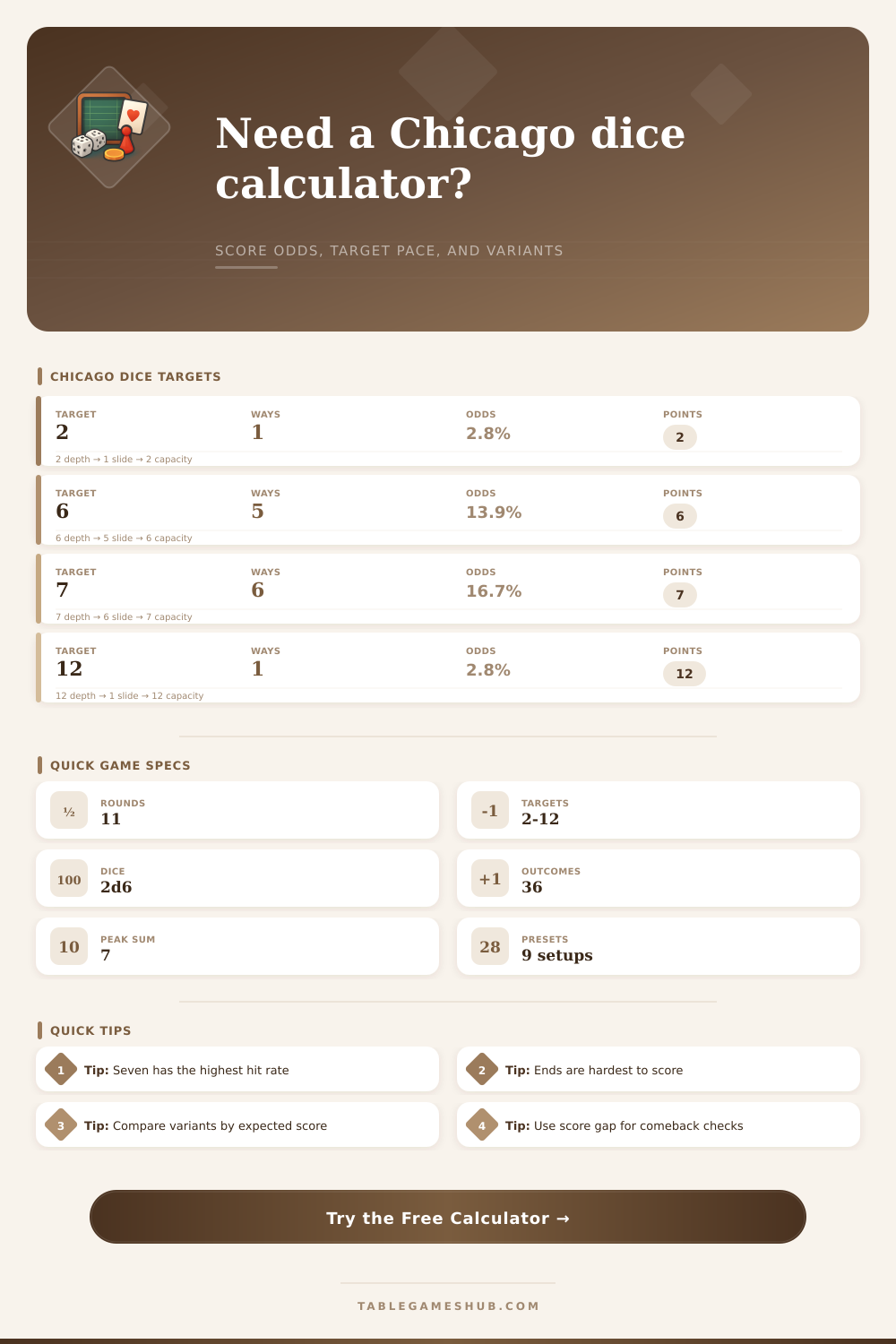
| 2 or 12 | 1 of 36 | 2.8% | 2 or 12 | 0.06 or 0.33 |
| 3 or 11 | 2 of 36 | 5.6% | 3 or 11 | 0.17 or 0.61 |
| 4 or 10 | 3 of 36 | 8.3% | 4 or 10 | 0.33 or 0.83 |
| 5 or 9 | 4 of 36 | 11.1% | 5 or 9 | 0.56 or 1.00 |
| 6 or 8 | 5 of 36 | 13.9% | 6 or 8 | 0.83 or 1.11 |
| 7 | 6 of 36 | 16.7% | 7 | 1.17 |
| Variant | Dice Used | Reroll Rule | Best For | Math Model |
|---|---|---|---|---|
| Standard Chicago | 2 dice | No reroll | Fast score sheets | Target ways / 36 |
| Miss-Only Reroll | 2 dice | Reroll one die after a miss | Friendlier scoring | Initial hit plus salvage faces |
| Three Dice | 3 dice | Keep any scoring pair | Higher hit frequency | Any pair sum across 216 rolls |
| Three Dice Plus Reroll | 3 dice | Reroll one die after no pair hits | Teaching and party tables | Any pair plus salvage faces |
| Players | Full-Game Turns | Score Lines | Typical Time | Table Note |
|---|---|---|---|---|
| 2 players | 22 turns | 2 names | 8-12 min | Duel or teaching setup |
| 4 players | 44 turns | 4 names | 15-22 min | Most common family table |
| 6 players | 66 turns | 6 names | 22-35 min | Use a wide score sheet |
| 8 players | 88 turns | 8 names | 30-45 min | Consider a shared target board |
| Component | Count | Standard Size | Player Range | Use Case |
|---|---|---|---|---|
| Classic dice pair | 2 dice | 16 mm each | 1-8 | Normal Chicago |
| Three-dice set | 3 dice | 16 mm each | 1-8 | Three-dice variant |
| Score sheet | 11 rows | Letter half-sheet | 2-8 | Targets 2 through 12 |
| Dice tray | 1 tray | 8 in square | 2-8 | Contained rolling area |
5Table Tips
Target pacing: Middle targets score more often, but the late high targets carry larger point swings. Use the score-to-beat input when the table reaches 9, 10, 11, or 12.
Setup spacing: Give every player enough edge for a score column and keep the dice tray visible to the next player. A small buffer prevents the target sheet from being covered.
It’s a brutal exercise in managing probabilities, but it feels easy. You’re sitting around the table with some friends rolling two regular six-sided dice onto numbers ranging from two to twelve. Everyone thinks they’re playing a game of pure luck, but it isn’t. The potential results has a bell curve distribution, meaning rolling a 7 is far more likely then a 2 or a 12. Most people instinctive grasp this fact, but very few realize how much those changes will hurt them throughout a complete game.
Once you choose which variant you’d like to play (and how many players) and press the button, the calculator does all the work for you. It keeps track of winner and saves you from memorizing every combination of dice rolls.
How to Play Chicago Dice Better
In Chicago, it’s the endpoints vs the middle rounds that create underlying tension. Because there are more ways to roll a 6, 7, or 8 with two dice, these totals appears more often as targets. In fact, just seven is responsible for nearly seventeen percent of all outcomes. But the ends are also statistical traps. To get a two or a twelve, you need both dice to display the exact same extreme value. That only occurs slightly under three percent of the time. You lose momentum early and late in the round, which means bleeding points.
As you recognize shape of the round, you’ll begin setting reasonable goals for what your overall score might be. You won’t be holding out for a miracle on the last roll. The trick is to pick your variant based off the group of people playing beforehand so you don’t have to do math in your head when the dice hit the table (because variants really shift the math). In Chicago standard, if you miss the target, you get zero points for that round. A lot of people tweak this by making it so that if the initial dice throw doesn’t work out, then you can simply re-roll one die. That simple change greatly raise your hit ratio. It reduces the variation. It’s friendlier to novices. And you can easily turn it on or off in the tool. See at what point you think players should of been given a lifeline and see the difference in points it would yield. It is not just for fun. It is for balance.
There’s another hidden variable that can ruin a lot of evenings of gaming, but nobody notices: table pace. Twenty-five second turns for each player makes it so whole game can be played out in less than half an hour. Add two more players and things gets much longer, everybody’s attention starts to wane. Use the calculator to estimate how long it will take given your typical turn length. That’ll help you determine whether you need to narrow the target range or give yourself more tries in a round.
Maybe you’re trying to teach some kids? Stop at target seven. Hosting a party with eight adult-sized sofa? Probably gonna need a bigger score sheet. You could even use a shared target board to see who’s doing what, this way, there isn’t total chaos. Strangely, a game about little cubes require some serious real estate planning. Each player should have enough writing area at the table’s edge to scribble their scores with clarity. There should be space at the edge to see into the dice tray for the next person. Messiness results in incorrect numbers and finger-pointing over illegible handwriting.
The calculator’s set-up inputs will help you here. Based on your preferred buffer, it’ll suggest how much linear space each participant need. Going for the tight table is exciting yet dangerous. Going roomy protects against errors but may stall the hand-off speed of dice.
In the end, Chicago dice is about dealing with limitations. One roll can’t be changed. However, you can control how long you spend on each turn and how many times you choose to roll. Each result changes depending on how you see that last roll of 12; whether it was math at work or just luck. When you do get that 12, though, rolling those dice again will still be as stomach-turning as ever. You’ll have left nothing to chance. Not before you’ve even rolled a die.