Catan Resource Odds Calculator
Estimate resource production by number token, settlement or city multiplier, current hand, build target, robber downtime, and port conversion pressure.
◎Resource Odds Presets
Load a realistic Catan board state, then adjust tokens, buildings, hand cards, robber pressure, and the build you are chasing.
⚙Target and Table Inputs
📦Current Hand
Enter cards already in hand. The target odds estimate only the missing resources.
🏠Producing Hexes
Add up to six productive hexes touched by your settlements or cities. Leave unused spaces as None.
Hex 1
Hex 2
Hex 3
Hex 4
Hex 5
Hex 6
∑Formula Cards
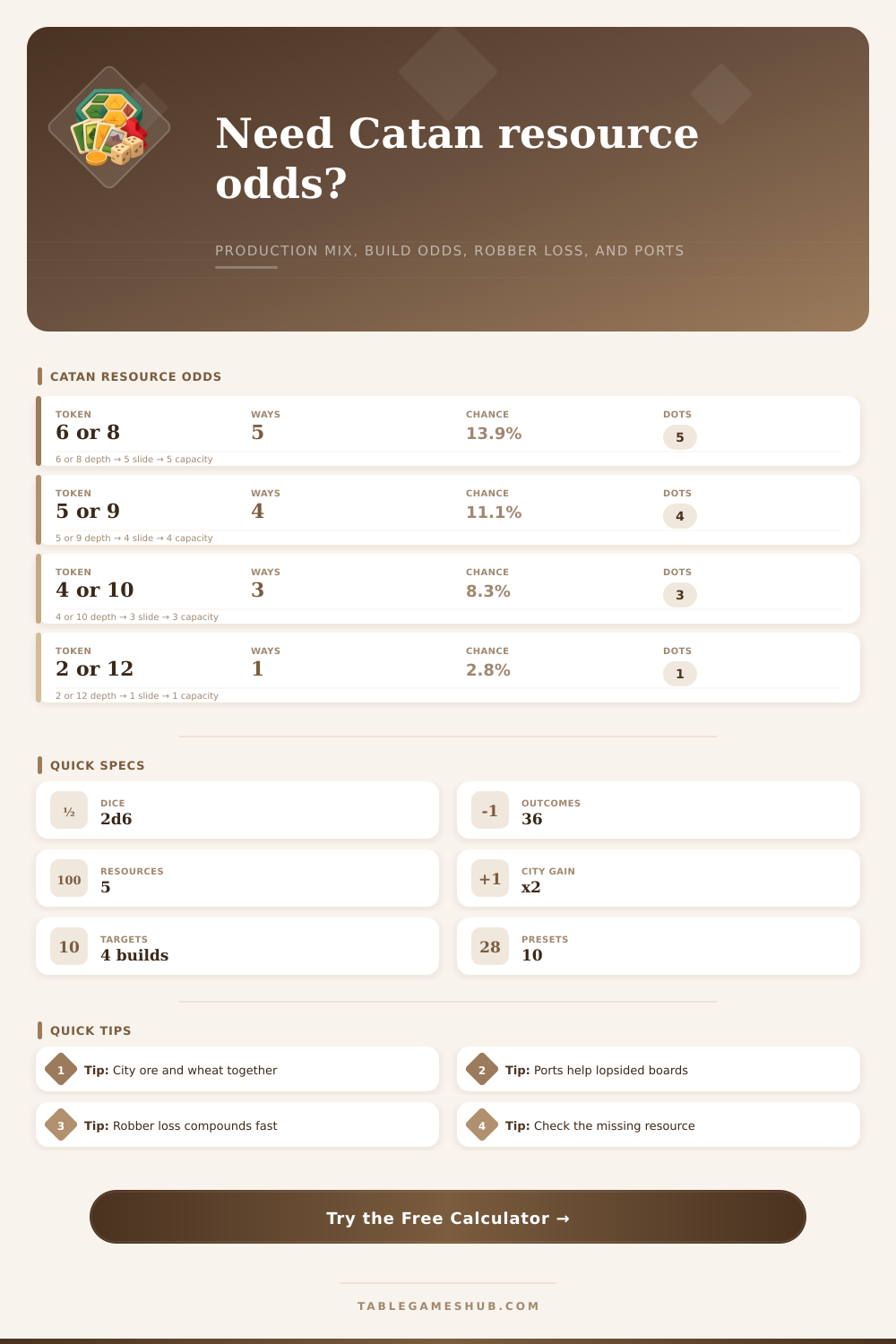
Each Catan production number uses exact two-dice combinations, with 6 and 8 at five ways each.
Settlement multiplier is 1, city multiplier is 2, then robber downtime reduces matching tokens.
Missing resources use a Poisson tail approximation from expected card flow for a readable planning odds estimate.
Resource surplus above target needs can be converted through 3:1 or matching 2:1 port access.
⚒Catan Resource Spec Grid
☰Reference Tables
| Number token | 2d6 ways | Chance per roll | Expected hits in 36 rolls |
|---|---|---|---|
| 6 or 8 | 5 of 36 | 13.89 percent | 5 hits per settlement |
| 5 or 9 | 4 of 36 | 11.11 percent | 4 hits per settlement |
| 4 or 10 | 3 of 36 | 8.33 percent | 3 hits per settlement |
| 3 or 11 | 2 of 36 | 5.56 percent | 2 hits per settlement |
| 2 or 12 | 1 of 36 | 2.78 percent | 1 hit per settlement |
| Build target | Brick | Wood | Sheep | Wheat | Ore |
|---|---|---|---|---|---|
| Road | 1 | 1 | 0 | 0 | 0 |
| Settlement | 1 | 1 | 1 | 1 | 0 |
| City | 0 | 0 | 0 | 2 | 3 |
| Development card | 0 | 0 | 1 | 1 | 1 |
| Resource plan | Needed flow | Healthy sign | Common shortage |
|---|---|---|---|
| Road expansion | Brick and wood | Both produce within 2 to 3 turns | Brick on low numbers |
| Settlement race | Four different resources | No single missing resource below 1 expected card | Wheat or brick |
| City upgrade | Ore and wheat | Ore plus wheat exceeds 6 expected cards | Ore blocked by robber |
| Development cards | Ore, sheep, wheat | Three-resource engine stays balanced | Sheep without wheat |
| Trade access | Conversion rate | Best use | Calculator treatment |
|---|---|---|---|
| No port | 4:1 table trade baseline | Emergency conversion only | Small surplus support |
| 3:1 port | Any 3 same resource | Smoothing lopsided production | Moderate surplus support |
| 2:1 resource port | Two of one resource | Turning a strong resource into missing cards | Best support if surplus matches port |
| Player trade | Negotiated | Filling one shortage quickly | Not counted as guaranteed odds |
ℹResource Odds Tips
Judge the bottleneck. A board with strong total production can still miss a city or settlement if one required resource has weak number coverage.
Use ports as insurance. A 2:1 port is most valuable when the matching resource is your surplus, not when it is also the scarce card.
There you are, next to a clump of sixes and eights. On paper it’s a sweet set-up; the board is clean. You pick up your pen and start scribbling plans for an empire of wheat and ore, while your opponent nurse his cup of joe beside the three and the twelve. It’s the age-old Catan mirage.
Until the dice say otherwise, high probability seems like a certainty. But resource management isn’t about just bridging the difference between what you expect and what you need; it’s bridging the gap between what you expect to get and the variance you actualy see. Sure, you expect to draw five cards when you roll a six, but it only take half a dozen rolls to go dry as a bone. And that’s the point where most strategies fails.
How to Plan Your Game Better
Plug in the state of your board, and the calculator will do the work for you (no more guessing at conversions or coefficients). It’ll translate raw dice probability into a task for your particular turn. Not only does it tell you that a 6 is better than a 4, but it tells you whether you can really afford to hold out for those rolls while upgrading a settlement to a city or finishing off another one.
It considers your current hand size, if your ports are open, and whether the robber has claimed any tiles. This is important because knowing how much you could produce doesn’t help you if you don’t have anywhere to stash those card, or if the robber has blocked your main source of income.
Take the robber mechanic, for example. A penalty? Sure, sorta. But a risk multiplier more so. If the robber lands on a 6, in effect the token become worth half of what it was before. This downtime affects the calculator because it reduces number of hits the blocked tokens are expected to make. Say you have a 6 for ore that you need for city upgrades, and the robber goes there. Your expected income plummets. You may pull off the coin flip and steal someone’s card, but now your production consistency go away.
Often times it is better to plan for worst case scenarios rather then averages. A board with high variance depend on one strong resource that could be blocked. This is usually less safe than having a board with moderate, well-balanced numbers.
Ports shift the equation dramaticly. They are insurance policies. Brick ports mean that if you’re unlucky and end up with more wood (and/or more sheep), you can switch that over to bricks. The calculator uses your surplus flow to make this guess. It’s not a promise that you’ll actually have anything left to trade; but it tells you whether or not the math is in favor of doing so.
Player trading is another thing entirely. That isn’t about probabilities; it’s about leverage and psychology. There’s no way to model that interpersonal negotiation, which is why the tool stick to what the dice and board give you.
The other quiet assassin is hand management. Holding seven cards means one more puts you over the limit. If you have more than that, you must discard a card. That happens fast. If you expect heavy production, things will move fast. You want to invest those resources before they’re gone. Enter the hand safety limit in the calculator. This will tell you if you are running the danger of producing cards faster then you can build, thereby causing you to throw away your hard-earned pile from wasteful discards.
This is why not just how much, but when you build, is also important. Is it better to build now with what you have, or save up for an ideal amount and take twice as long? It’s this understanding of the layers that makes Catan no longer a game of chance but a test of plans.
It’s not about rolling some dice, it’s about running a system of probabilities, constraints, and inputs. To see that, look at the table on the page, the one that tells you how many combinations there are to roll any given number. That’s what the best tokens do less frequently: fail. Stress-test your situation with the tool. Can you hold up against the robber? See if your wheat surplus justifies a port trade. Is your ore production holding up?
It’s not about predicting the future, it’s about preparing for it. When those dice finally go, you would of known exactly what to do with them.