Bohnanza Coin Calculator
Estimate bean-field coin harvests, trade planting impact, third-field value, and round totals with beanometer thresholds.
Bohnanza Coin Result
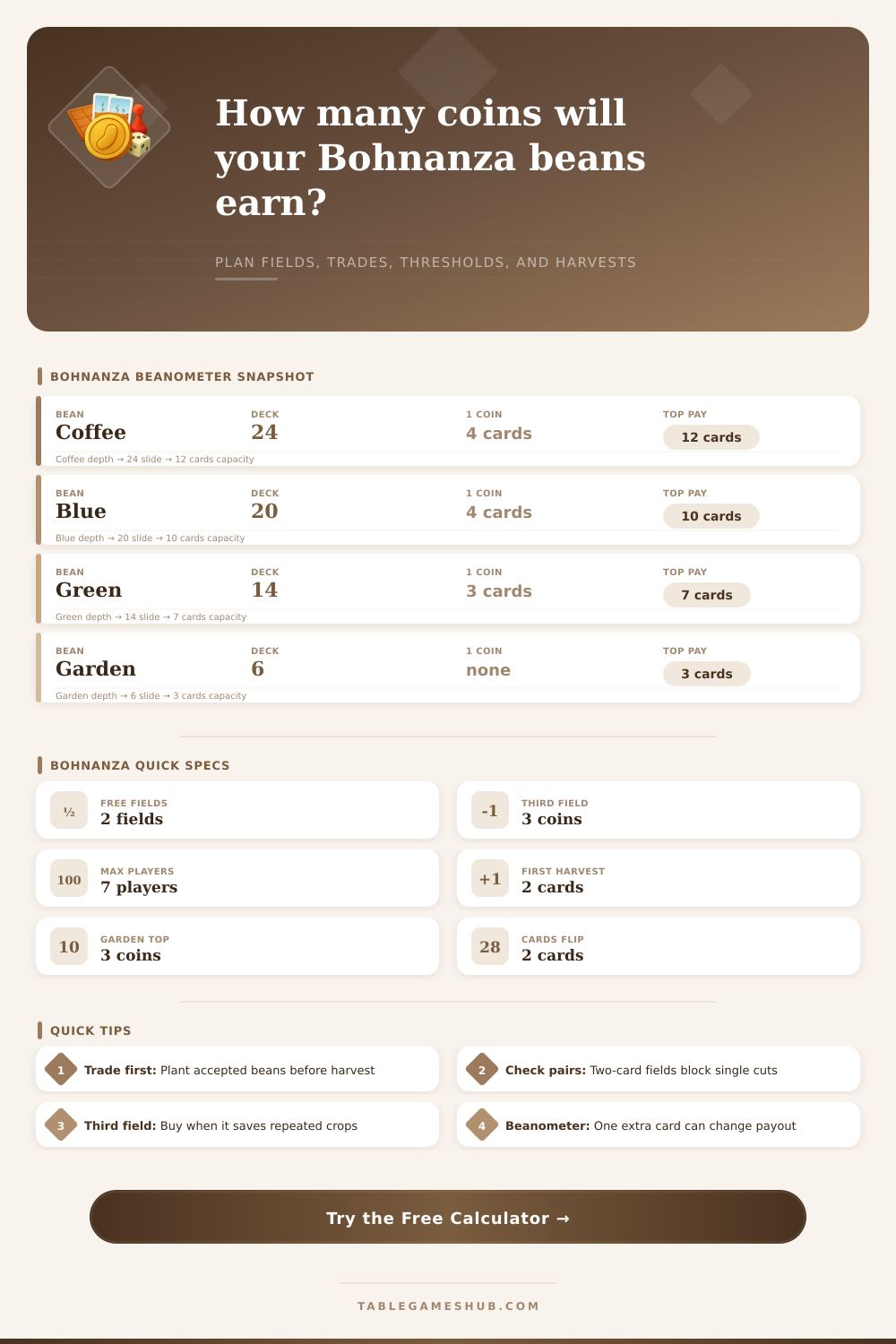
| Bean Type | Deck Count | 1 Coin | 2 Coins | 3 Coins | 4 Coins |
|---|---|---|---|---|---|
| Coffee Bean | 24 cards | 4 | 7 | 10 | 12 |
| Wax Bean | 22 cards | 4 | 7 | 9 | 11 |
| Blue Bean | 20 cards | 4 | 6 | 8 | 10 |
| Chili Bean | 18 cards | 3 | 6 | 8 | 9 |
| Stink Bean | 16 cards | 3 | 5 | 7 | 8 |
| Green Bean | 14 cards | 3 | 5 | 6 | 7 |
| Soy Bean | 12 cards | 2 | 4 | 6 | 7 |
| Black-Eyed Bean | 10 cards | 2 | 4 | 5 | 6 |
| Red Bean | 8 cards | 2 | 3 | 4 | 5 |
| Garden Bean | 6 cards | — | 2 | 3 | — |
| Situation | Field Check | Coin Impact | Planning Signal |
|---|---|---|---|
| Forced plant conflict | No matching open field | Clear a field first | Compare smallest field with best field |
| Trade accepted | Trade bean matches planted type | Adds to same beanometer | Often worth delaying harvest |
| Third field purchase | Three active bean types | Subtracts 3 coins | Useful when it prevents repeated low crops |
| Garden timing | Two or three Garden Beans | High coin density | Harvest before space is lost |
| Large deck bean | Coffee, Wax, or Blue | Needs more cards | Watch one-card gaps to next payout |
| Trade Result | Calculator Treatment | Best Use | Risk Note |
|---|---|---|---|
| Matching field | Add trade cards to existing field | Reach next beanometer line | May still be short by one card |
| Open third field | Start field 3 when available | Preserve two stronger fields | Third field may have net penalty if bought |
| No open field | Mark as pressure cards | Shows forced harvest danger | May require clearing a small field |
| Multiple same beans | Apply all cards to one crop | Improve coin density | Overfilling beyond four coins has no extra payout |
| Players | Opening Fields | Trade Pressure | Harvest Rhythm |
|---|---|---|---|
| 3 players | 2 fields | Lower | Longer personal planning window |
| 4 players | 2 fields | Moderate | Stable trade cycle |
| 5 players | 2 fields | High | Frequent forced planting |
| 6 players | 2 fields | Very high | Shorter turns between harvest checks |
| 7 players | 2 fields | Very high | Field space becomes tight quickly |
Bohnanza is a game of managing space, timing, and coins. While many players feels that Bohnanza is a game about matching cards and clearing fields, most of the decision in Bohnanza occur between the forced planting of crops and harvesting of fields. One extra card could move your field past the payout line, or planting cards at a wrong time can mean that your beans cant be planted anywhere beneficial.
The calculator will calculate for you the math behind your fields and trade cards. It will show you how close each field is to the next coin threshold. It will also show you the difference in harvesting a field now versus later.
How the Calculator Helps You Play Bohnanza
Additionally, it will show you if buying a third field would help your situation or if it is simply going to cost you three coin that you cannot spend. All of the inputs for the calculator are the same as the games decisions, so you can directly use the calculators outputs in the game. The number of players can change the function of the game.
If there are many players in the game, then the trade row will move faster and there will be more forced planting. This means that there will be more value to an open field. If there are fewer players in the game, there will be less pressure on the fields, meaning there is time to protect a field that is one card away from the next payout.
You can select the number of players on the calculator because a field configuration may be beneficial for three players but disadvantageous for seven players in the game. The thresholds for the beanometer change based off the type of bean that is being planted. Coffee and wax beans require larger stacks in order for coffee and wax bean fields to pay well for the player.
Garden beans and red beans pay well with fewer cards in the field. The calculator accounts for these different thresholds by asking for the type of beans that will be planted and how many cards are in each field. The reference chart can change with the addition of just one trade card or the clearing of a field.
Thus, the calculator is beneficial for players in tracking these changes. Buying a third field is a difficult decision for most players. On the one hand, it costs three coins.
On the other, planting a third field may prevent you from having to harvest your beans at low value from your two starting fields. The calculator will allow you to input these variables so that you can see if adding a third field will benefit or cost you more coins during that round. It is a decision that most experienced Bohnanza players have programmed into their intuitions for the game, but some players may approach it as an automatic purchase of a third field.
Because trade cards show up without warning, it is difficult to calculate in advance the effect that they will have on your game. A field that matches the trade card will receive it without resistance, and it is likely that the field will jump the beanometer line to the next threshold. An unmatched trade card will force you to make a decision between clearing a field or planting the third field.
The calculator does not account for trade cards but will offer a true output regarding such a decision. One of the biggest decisions in Bohnanza is the decision of which field to harvest and which field to clear. By harvesting the field with the most coins, you maximize the number of coins that you earn for the round.
Alternatively, clearing the weakest field allows for additional space for strong planted fields. Both options for players in Bohnanza, but it is impossible to say which is the “correct” choice at any given time. The correct choice will depend upon the type of beans that remain in the deck and the number of turns that remains for the round.
A common mistake with Bohnanza is to treat each field as if they is equal in value. One field may contain a two-card garden bean field that is complete with its maximum number of garden bean coins, but another field could contain nine coffee plant cards that are still two coins away from being planted with maximum efficiency. The calculators output will show the value of each field and prevent the error of harvesting a field that is complete with its best planting of beans.
The skill in Bohnanza is the ability to read the game table correctly. Once you understand Bohnanza well and the variables in the game, the calculator will help to reinforce that intuition. The calculators output can provide confirmation of the intuitions that the experienced Bohnanza player has developed in relation to the game, which is crucial in making quick decisions in the game.